
[Paper Review] Engineering Software Systems for Quantum Computing as a Service: A Mapping Study
The paper conducts a systematic mapping study of QCaaS research, identifying modeling notations, patterns, languages, deployment platforms, and emerging trends.
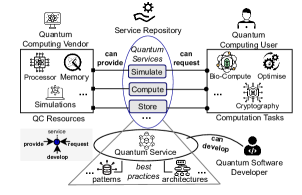
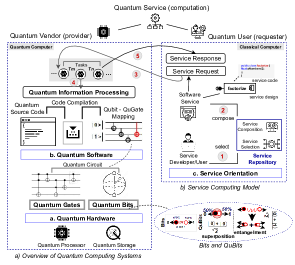
Quantum systems have started to emerge as a disruptive technology and enabling platforms - exploiting the principles of quantum mechanics - to achieve quantum supremacy in computing. Academic research, industrial projects (e.g., Amazon Braket), and consortiums like 'Quantum Flagship' are striving to develop practically capable and commercially viable quantum computing (QC) systems and technologies. Quantum Computing as a Service (QCaaS) is viewed as a solution attuned to the philosophy of service-orientation that can offer QC resources and platforms, as utility computing, to individuals and organisations who do not own quantum computers. To understand the quantum service development life cycle and pinpoint emerging trends, we used evidence-based software engineering approach to conduct a systematic mapping study (SMS) of research that enables or enhances QCaaS. The SMS process retrieved a total of 55 studies, and based on their qualitative assessment we selected 9 of them to investigate (i) the functional aspects, design models, patterns, programming languages, deployment platforms, and (ii) trends of emerging research on QCaaS. The results indicate three modelling notations and a catalogue of five design patterns to architect QCaaS, whereas Python (native code or frameworks) and Amazon Braket are the predominant solutions to implement and deploy QCaaS solutions. From the quantum software engineering (QSE) perspective, this SMS provides empirically grounded findings that could help derive processes, patterns, and reference architectures to engineer software services for QC.
Motivation & Objective
- Investigate existing solutions that enable or enhance Quantum Computing as a Service (QCaaS).
- Characterize functional aspects, design models, patterns, programming languages, deployment platforms, and operationalisation of QCaaS.
- Identify emerging trends and gaps to guide future QCaaS research and practice.
- Provide empirically grounded guidance for engineering software services for QC from a Quantum Software Engineering perspective.
Proposed method
- Performed a systematic mapping study (SMS) using evidence-based software engineering methods.
- Search across major Electronic Data Sources (IEEE Xplore, ACM DL, SpringerLink, ScienceDirect, Wiley Online Library) plus Google Scholar; customized search strings per source.
- Applied forward snowballing from seed studies to expand the candidate set.
- Screened and quality-assessed studies using predefined criteria (S1-S4, Q1-Q5) to select 9 studies for final analysis.
- Structured data extraction aligned with an adapted IBM SOA lifecycle (Conception, Modeling, Assembly, Deployment).
- Reported results in terms of functional aspects, modeling notations, patterns, languages, and deployment platforms.
Experimental results
Research questions
- RQ1RQ1: What solutions are reported in the literature to support the development of quantum computing as a service?
- RQ2RQ2: What are the emerging trends of research on quantum computing as a service?
Key findings
- Three modelling notations are identified for QCaaS (UML, graph-based models, and process models).
- A catalogue of five design patterns for QCaaS is reported (API Gateway, Layered Architecture, Classic-Quantum Split, Service Wrapping, Repository).
- Python (native or via frameworks) and Amazon Braket are the predominant implementation/deployment choices for QCaaS solutions.
- Four application domains are identified for QCaaS: Optimisation, Process Automation, Mathematics, and Quantum Simulation, influencing tool/language choices.
- Three quantum vendors/platforms are highlighted for deployment: Amazon Braket, IBM Quantum, and Rigetti.
- Emerging trends include emphasis on non-functional aspects, model-driven engineering and low-code approaches, quantum domain engineering (QSRs), human roles, and process-centric development of QCaaS.
Better researchstarts right now
From reading papers to final review, dramatically reduce your research time.
No credit card · Free plan available
This review was created by AI and reviewed by human editors.