
[Paper Review] Enhanced Controllability of Diffusion Models via Feature Disentanglement and Realism-Enhanced Sampling Methods
This paper enhances controllability in diffusion models by conditioning on disentangled content and style latent codes, using a generalized composable diffusion framework (GCDM) that allows dependent conditional inputs and timestep-dependent weight scheduling. The method enables fine-grained, realistic image translation with improved disentanglement and smoother interpolations compared to prior approaches.
As Diffusion Models have shown promising performance, a lot of efforts have been made to improve the controllability of Diffusion Models. However, how to train Diffusion Models to have the disentangled latent spaces and how to naturally incorporate the disentangled conditions during the sampling process have been underexplored. In this paper, we present a training framework for feature disentanglement of Diffusion Models (FDiff). We further propose two sampling methods that can boost the realism of our Diffusion Models and also enhance the controllability. Concisely, we train Diffusion Models conditioned on two latent features, a spatial content mask, and a flattened style embedding. We rely on the inductive bias of the denoising process of Diffusion Models to encode pose/layout information in the content feature and semantic/style information in the style feature. Regarding the sampling methods, we first generalize Composable Diffusion Models (GCDM) by breaking the conditional independence assumption to allow for some dependence between conditional inputs, which is shown to be effective in realistic generation in our experiments. Second, we propose timestep-dependent weight scheduling for content and style features to further improve the performance. We also observe better controllability of our proposed methods compared to existing methods in image manipulation and image translation.
Motivation & Objective
- To improve controllability in diffusion models beyond unconditional or single-condition generation.
- To address limitations in existing methods that assume independent conditioning inputs or lack fine-grained control.
- To enable realistic, disentangled image translation by learning separate but composable content and style latent spaces.
- To develop inference-time techniques that allow dynamic control over content, style, and their joint distribution during sampling.
- To leverage the inductive bias of diffusion models by scheduling conditional guidance across timesteps for better feature composition.
Proposed method
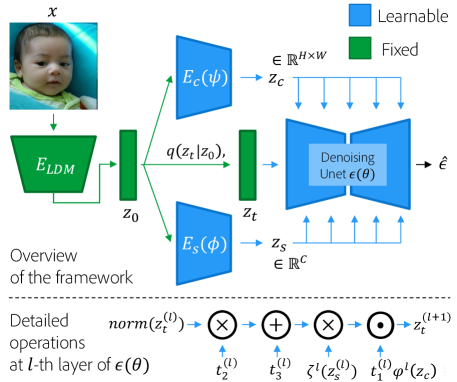
- Train a latent diffusion model conditioned on two separate latent codes: a spatial layout mask (content) and a flattened semantic embedding (style), learned via dedicated encoders.
- Inject content and style codes differently into the UNet architecture to preserve distinct semantic factors—structure vs. appearance.
- Propose Generalized Composable Diffusion Models (GCDM) to handle dependent conditional inputs, enabling joint control over content, style, and their interaction.
- Introduce timestep-dependent weight scheduling that applies style guidance primarily in early denoising steps and content in later steps, mimicking a mixture-of-experts.
- Use a sigmoid-based scheduling function to smoothly transition between content and style guidance, improving generation quality and controllability.
- Apply the framework to both image-to-image translation and text-to-image generation, demonstrating generalization across tasks.
Experimental results
Research questions
- RQ1Can disentangled content and style latents be effectively learned and used to condition diffusion models for improved controllability?
- RQ2How can conditional inputs that are not independent (e.g., face shape and gender) be composed meaningfully during generation?
- RQ3Does timestep-dependent scheduling of conditional guidance improve image quality and disentanglement in diffusion-based image translation?
- RQ4Can GCDM outperform standard composable diffusion models in generating realistic, semantically consistent images?
- RQ5To what extent can the inductive bias of the denoising process be exploited to improve feature composition through scheduling?
Key findings
- The proposed GCDM framework significantly improves image quality and realism compared to standard CDM, especially in cases with dependent conditional inputs.
- Timestep-dependent scheduling with a sigmoid function yields more natural generations than exclusive or linear scheduling strategies.
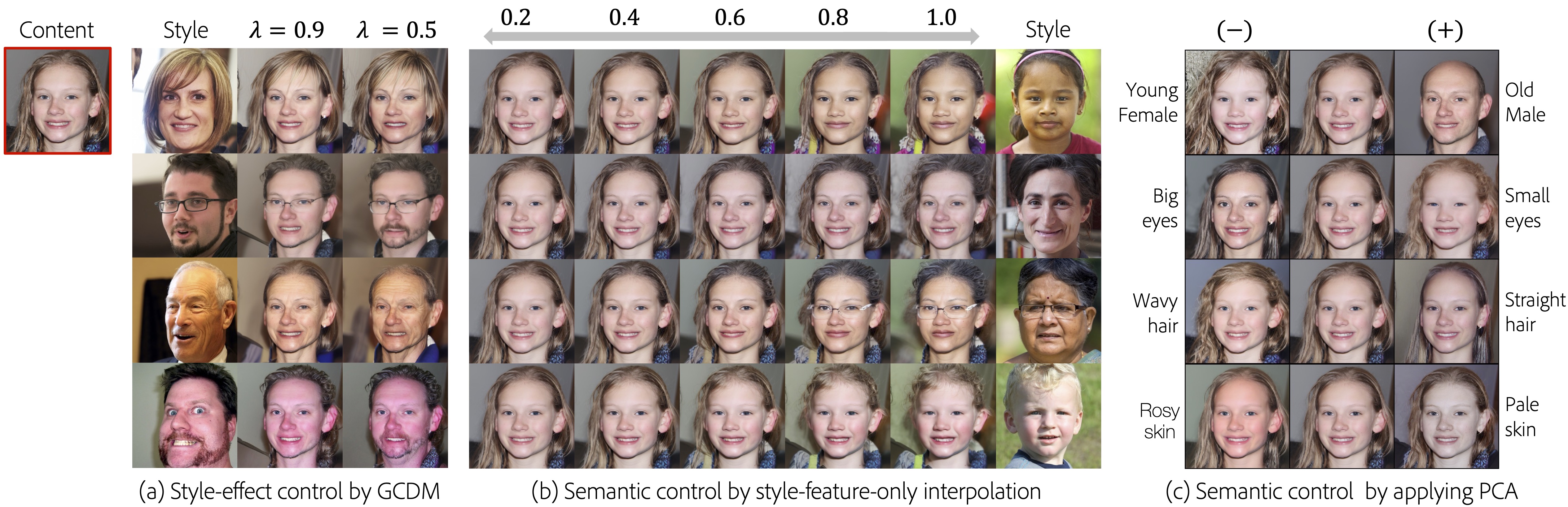
- The model enables smooth, disentangled interpolations between style codes while preserving content structure, as shown via PCA on learned style codes.
- Content and style latents are effectively disentangled, with style codes capturing attributes like eyeglasses and hair color, and content masks preserving layout and pose.
- Applying timestep scheduling during training improves disentanglement and model specialization, suggesting implicit mixture-of-experts behavior.
- The method achieves better control over style translation magnitude via a learnable hyperparameter λ, enabling fine-grained manipulation without retraining.
Read this paper
Open the full text in the Nubint reader and ask about any passage as you read.
Read this paper on NubintThis review was generated by AI from the original paper. Please check the paper before citing it.