
[Paper Review] Enhanced Detection Classification via Clustering SVM for Various Robot Collaboration Task
This paper proposes a k-SVM method that integrates k-means clustering with Support Vector Machines to enhance robot type classification in multi-robot collaboration tasks. By clustering robot feature data before SVM training, the approach reduces support vector count and accelerates recognition, achieving lower classification errors than traditional SVM across diverse robot distributions, especially as dataset size increases.
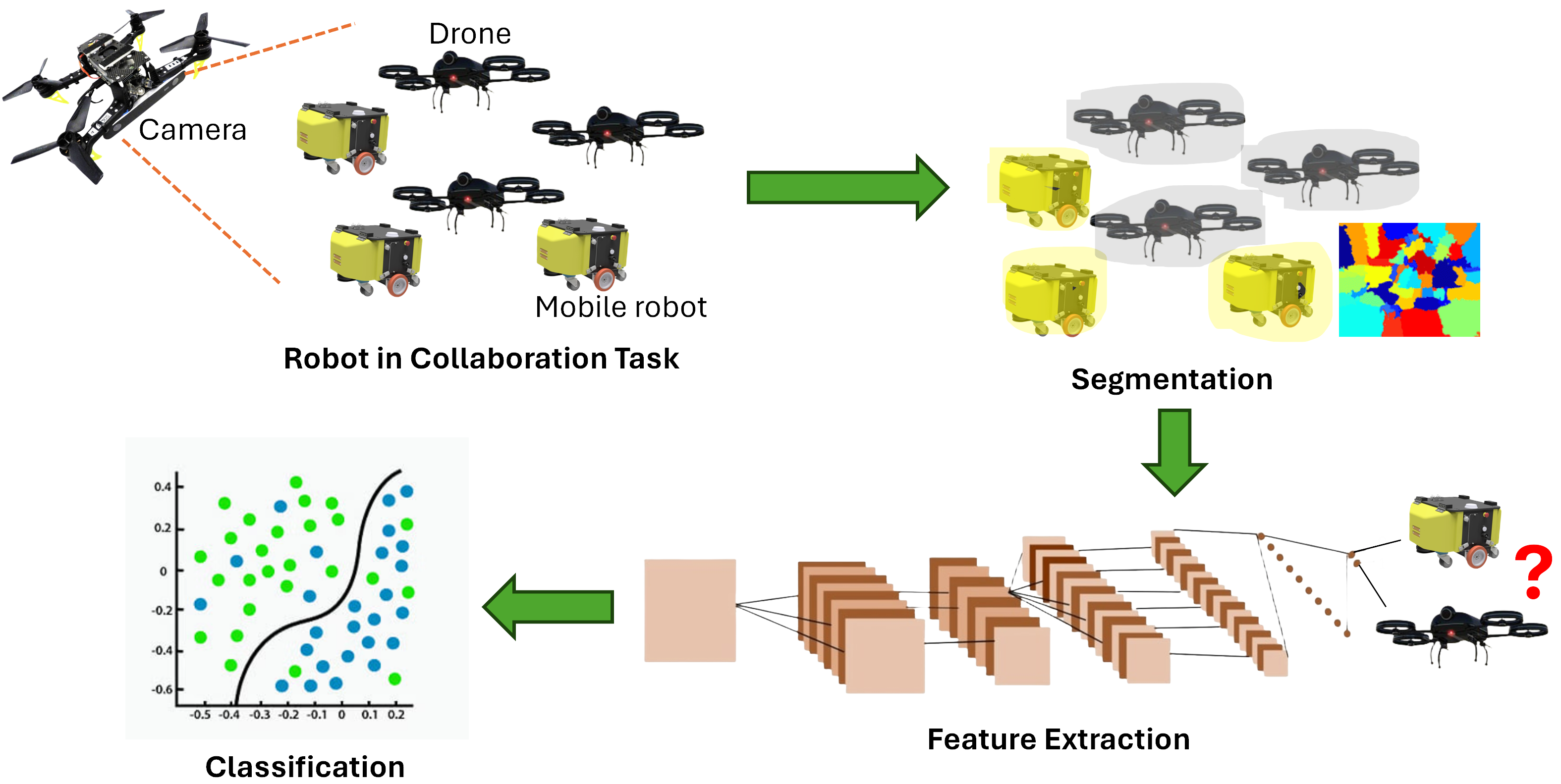
We introduce an advanced, swift pattern recognition strategy for various multiple robotics during curve negotiation. This method, leveraging a sophisticated k-means clustering-enhanced Support Vector Machine algorithm, distinctly categorizes robotics into flying or mobile robots. Initially, the paradigm considers robot locations and features as quintessential parameters indicative of divergent robot patterns. Subsequently, employing the k-means clustering technique facilitates the efficient segregation and consolidation of robotic data, significantly optimizing the support vector delineation process and expediting the recognition phase. Following this preparatory phase, the SVM methodology is adeptly applied to construct a discriminative hyperplane, enabling precise classification and prognostication of the robot category. To substantiate the efficacy and superiority of the k-means framework over traditional SVM approaches, a rigorous cross-validation experiment was orchestrated, evidencing the former's enhanced performance in robot group classification.
Motivation & Objective
- To address the challenge of classifying robot types (flying vs. mobile) during collaborative curve negotiation with high accuracy and speed.
- To overcome the computational inefficiency of traditional SVMs on non-linearly separable datasets common in multi-robot systems.
- To improve classification performance by reducing the number of support vectors through data clustering prior to SVM training.
- To validate the superiority of the k-SVM approach over standard SVM using cross-validation across varying robot population sizes and distribution types.
Proposed method
- The method employs k-means clustering to partition robot feature data into K distinct clusters, reducing data complexity and improving feature discrimination before SVM application.
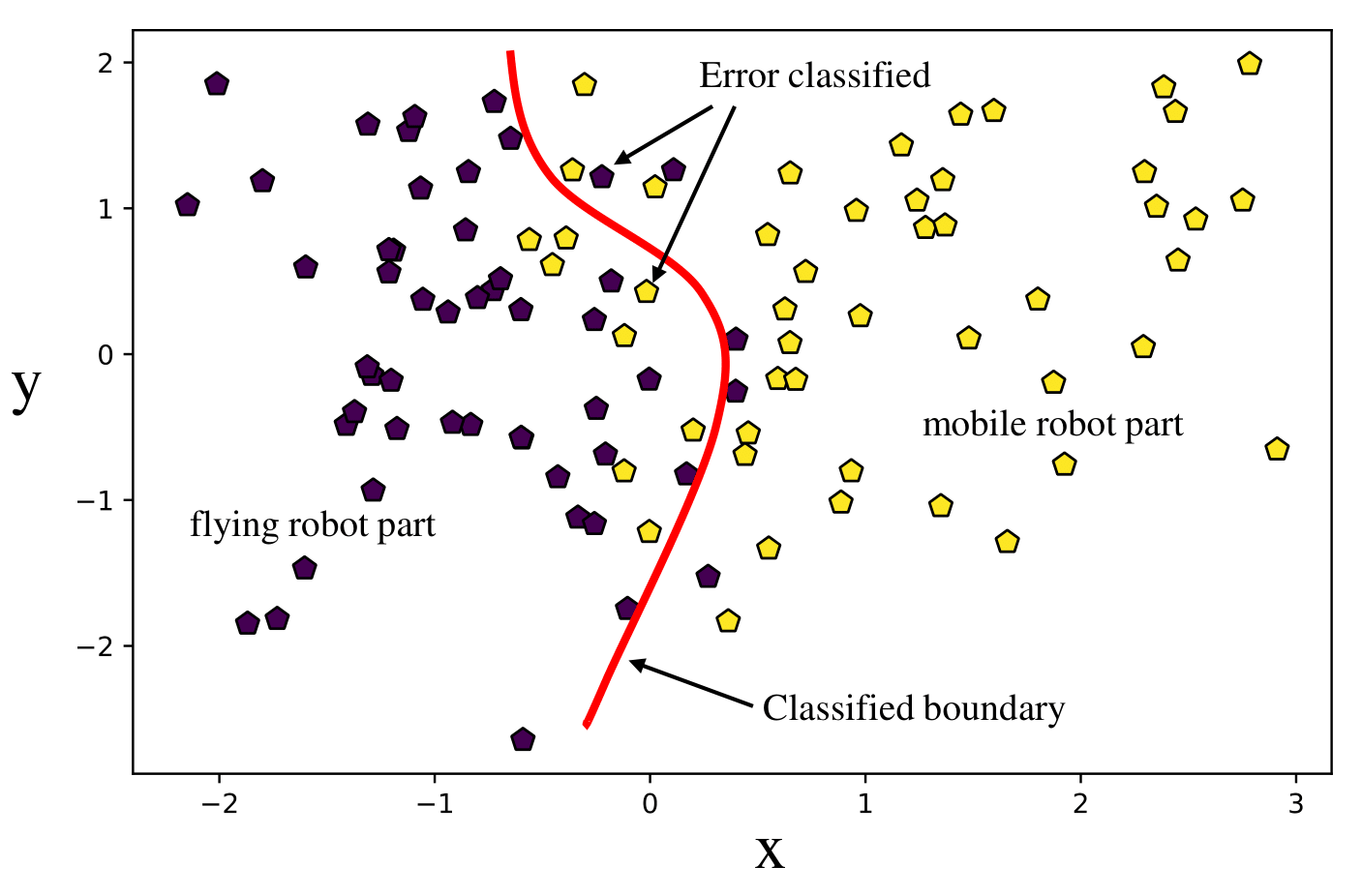
- Support Vector Machines are applied to each cluster to construct a discriminative hyperplane for classifying robot types (flying or mobile) based on their spatial and feature characteristics.
- The objective function minimizes the sum of slack variables and the norm of the weight vector, ensuring a global optimum solution for non-linearly separable data.
- Cross-validation is used to evaluate performance, with the dataset split into η=1 subsets for training and validation, enabling robust model assessment.
- Temporal clustering is applied over a fixed time span δ=0.12, where each centroid represents a clustered robot pattern, enabling dynamic pattern recognition.
- Classification error is quantified using error metrics e_s = ℜ(w_{s−δ,p}, y_{s−δ}), with performance evaluated across normal, uniform, and Poisson-distributed robot populations.
Experimental results
Research questions
- RQ1Can k-means clustering improve the efficiency and accuracy of SVM-based robot type classification in multi-robot collaboration tasks?
- RQ2How does the k-SVM method compare to traditional SVM in terms of classification error across different robot distribution patterns?
- RQ3Does increasing dataset size enhance the performance of k-SVM relative to standard SVM in classifying flying and mobile robots?
- RQ4To what extent does clustering reduce the number of support vectors and accelerate recognition in non-linearly separable robot data?
Key findings
- k-SVM achieves lower classification error than traditional SVM across all tested robot distribution types, particularly excelling with larger datasets.
- For normally distributed robots, k-SVM reduces error from 0.2941 (SVM at N=100) to 0.0996 (k-SVM at N=400), demonstrating improved scalability.
- In uniform distribution scenarios, k-SVM shows consistent improvement, reducing error from 0.2302 (SVM at N=100) to 0.0912 (SVM at N=400), though k-SVM shows higher error at N=300 and N=400, indicating sensitivity to distribution shape.
- For Poisson-distributed robots, k-SVM reduces error from 0.3189 (SVM at N=100) to 0.0851 (k-SVM at N=400), showing strong performance gains with increasing data volume.
- The method significantly shortens training time and improves recognition accuracy by reducing the number of support vectors through effective clustering.
- The cross-validation results confirm that k-SVM outperforms standard SVM in handling complex, non-linearly separable robot pattern distributions, especially under high data volume.
Better researchstarts right now
From reading papers to final review, dramatically reduce your research time.
No credit card · Free plan available
This review was created by AI and reviewed by human editors.