
[Paper Review] Enhanced Load Forecasting with GAT-LSTM: Leveraging Grid and Temporal Features
The paper introduces GAT-LSTM, a hybrid model that fuses Graph Attention Networks with LSTM to capture grid-topology and temporal dynamics, using edge attributes to improve short-term load forecasting. It outperforms several baselines on the Brazilian Electricity System dataset.
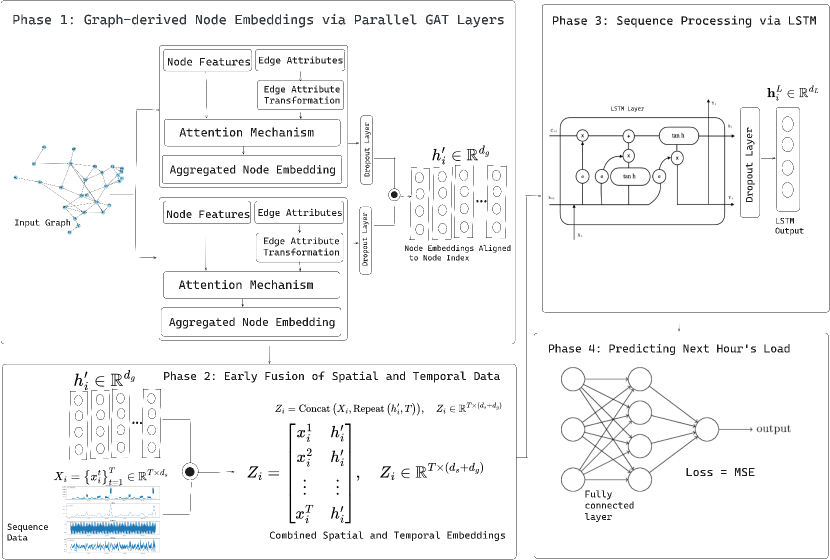
Accurate power load forecasting is essential for the efficient operation and planning of electrical grids, particularly given the increased variability and complexity introduced by renewable energy sources. This paper introduces GAT-LSTM, a hybrid model that combines Graph Attention Networks (GAT) and Long Short-Term Memory (LSTM) networks. A key innovation of the model is the incorporation of edge attributes, such as line capacities and efficiencies, into the attention mechanism, enabling it to dynamically capture spatial relationships grounded in grid-specific physical and operational constraints. Additionally, by employing an early fusion of spatial graph embeddings and temporal sequence features, the model effectively learns and predicts complex interactions between spatial dependencies and temporal patterns, providing a realistic representation of the dynamics of power grids. Experimental evaluations on the Brazilian Electricity System dataset demonstrate that the GAT-LSTM model significantly outperforms state-of-the-art models, achieving reductions of 21. 8% in MAE, 15. 9% in RMSE and 20. 2% in MAPE. These results underscore the robustness and adaptability of the GAT-LSTM model, establishing it as a powerful tool for applications in grid management and energy planning.
Motivation & Objective
- Motivate accurate short-term load forecasting in modern grids with high RES integration.
- Propose a hybrid GAT-LSTM architecture that incorporates grid-specific edge attributes into spatial-temporal modeling.
- Evaluate the model against state-of-the-art baselines on a Brazilian power system dataset.
- Demonstrate improvements in MAE, RMSE, and MAPE compared to baselines.
Proposed method
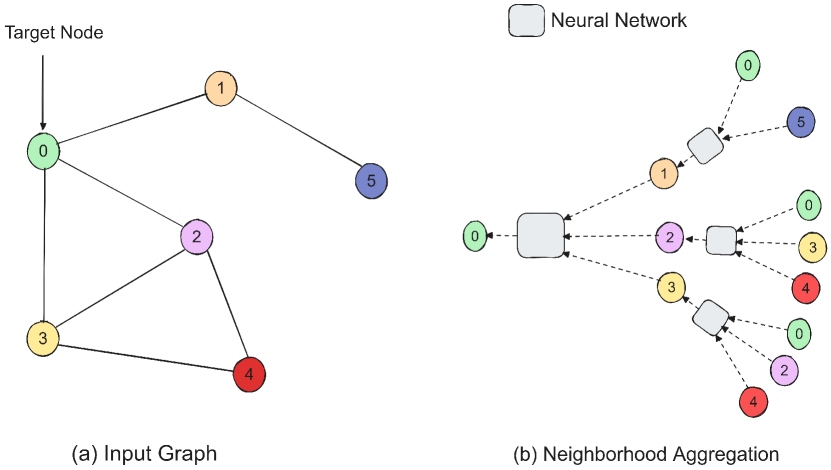
- Develop two parallel GAT layers that incorporate edge attributes into attention coefficients.
- Perform early fusion of spatial graph embeddings with temporal sequence data before feeding into an LSTM.
- Use a multi-head attention mechanism and LeakyReLU activation in the GAT to learn node-edge importance.
- Process data with an LSTM-based sequence model to capture temporal dependencies and generate hourly forecasts.
- Train with MSE loss using Adam optimizer, with learning-rate scheduling and early stopping to ensure generalization.
- Compare against baselines including LSTM, GCN-LSTM, EdgeGCN-LSTM, and XGBoost on 2019–2020 Brazilian data.
Experimental results
Research questions
- RQ1How does GAT-LSTM perform relative to baseline models in short-term hourly load forecasting?
- RQ2What is the impact of incorporating edge attributes into the GAT attention mechanism on forecasting accuracy?
- RQ3Does early fusion of spatial embeddings with temporal data improve predictive performance for hourly load?
- RQ4How does GAT-LSTM handle peak versus off-peak periods in accuracy metrics?
- RQ5What are the comparative gains in MAE, RMSE, and MAPE when using GAT-LSTM on the Brazilian power system dataset?
Key findings
- GAT-LSTM achieves the best overall accuracy among evaluated models across MAE, RMSE, and MAPE.
- The model yields substantial improvements, with a 21.82% MAE reduction versus LSTM and a 23.62% reduction versus EdgeGCN-LSTM.
- On the Brazilian dataset, GAT-LSTM attains MAE 64.64 MW, RMSE 119.06 MW, and MAPE 4.59%.
- Compared to XGBoost, GAT-LSTM significantly outperforms with much lower errors (MAE 64.64 MW vs 297.47 MW, RMSE 119.06 MW vs 517.69 MW, MAPE 4.59% vs 40.50%).
- Early training analysis shows fast convergence and stable validation performance for GAT-LSTM, with higher stability than edge-based GNN variants.
- Peak-hour analysis indicates strong tracking of load trends with minor deviations during rapid ramp-ups, suggesting room for improvement in high-gradient periods.
Read this paper
Open the full text in the Nubint reader and ask about any passage as you read.
Read this paper on NubintThis review was generated by AI from the original paper. Please check the paper before citing it.