
[Paper Review] Enhanced sensitivity via non-Hermitian topology
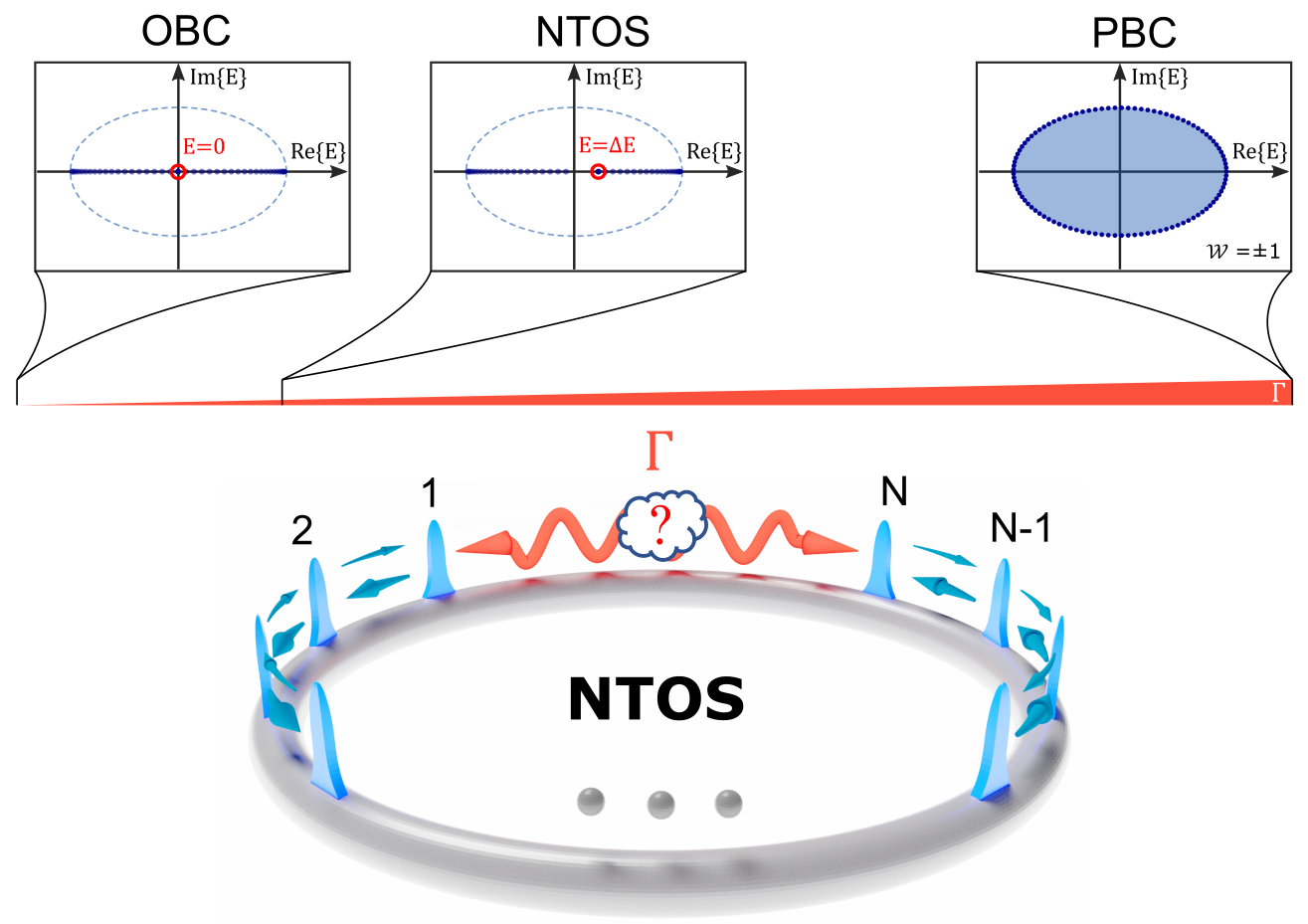
This paper experimentally demonstrates non-Hermitian topological sensors (NTOS) using a photonic time-multiplexed resonator network based on the Hatano-Nelson model. By exploiting the synergy between non-Hermiticity and topology, the system achieves exponentially enhanced sensitivity with increasing lattice size, confirmed experimentally for up to N=23 lattice sites, surpassing conventional sensing limits.
Sensors are indispensable tools of modern life that are ubiquitously used in diverse settings ranging from smartphones and autonomous vehicles to the healthcare industry and space technology. By interfacing multiple sensors that collectively interact with the signal to be measured, one can go beyond the signal-to-noise ratios (SNR) than those attainable by the individual constituting elements. Such distributed sensing techniques have also been implemented in the quantum regime, where a linear increase in the SNR has been achieved via using entangled states. Along similar lines, coupled non- Hermitian systems have provided yet additional degrees of freedom to obtain better sensors via higher-order exceptional points. Quite recently, a new class of non-Hermitian systems, known as non-Hermitian topological sensors (NTOS) has been theoretically proposed. Remarkably, the synergistic interplay between non-Hermiticity and topology is expected to bestow such sensors with an enhanced sensitivity that grows exponentially with the size of the sensor network. Here, we experimentally demonstrate NTOS using a network of photonic time-multiplexed resonators in the synthetic dimension represented by optical pulses. By judiciously programming the delay lines in such a network, we realize the archetypical Hatano-Nelson model for our non-Hermitian topological sensing scheme. Our experimentally measured sensitivities for different lattice sizes confirm the characteristic exponential enhancement of NTOS. We show that this peculiar response arises due to the combined synergy between non-Hermiticity and topology, something that is absent in Hermitian topological lattices. Our demonstration of NTOS paves the way for realizing sensors with unprecedented sensitivities.
Motivation & Objective
- To demonstrate experimentally that non-Hermitian topological sensors (NTOS) can achieve exponentially growing sensitivity with lattice size.
- To validate the theoretical prediction that the sensitivity enhancement in NTOS arises from the cooperative interplay between non-Hermiticity and topology, absent in Hermitian systems.
- To realize and characterize a non-Hermitian topological lattice using a time-multiplexed photonic platform with tunable boundary coupling.
- To compare the sensitivity scaling of NTOS with conventional distributed sensing and Hermitian topological systems, showing superior performance.
- To provide a proof-of-concept for high-sensitivity sensors applicable in quantum sensing, LiDAR, and gravitational wave detection.
Proposed method
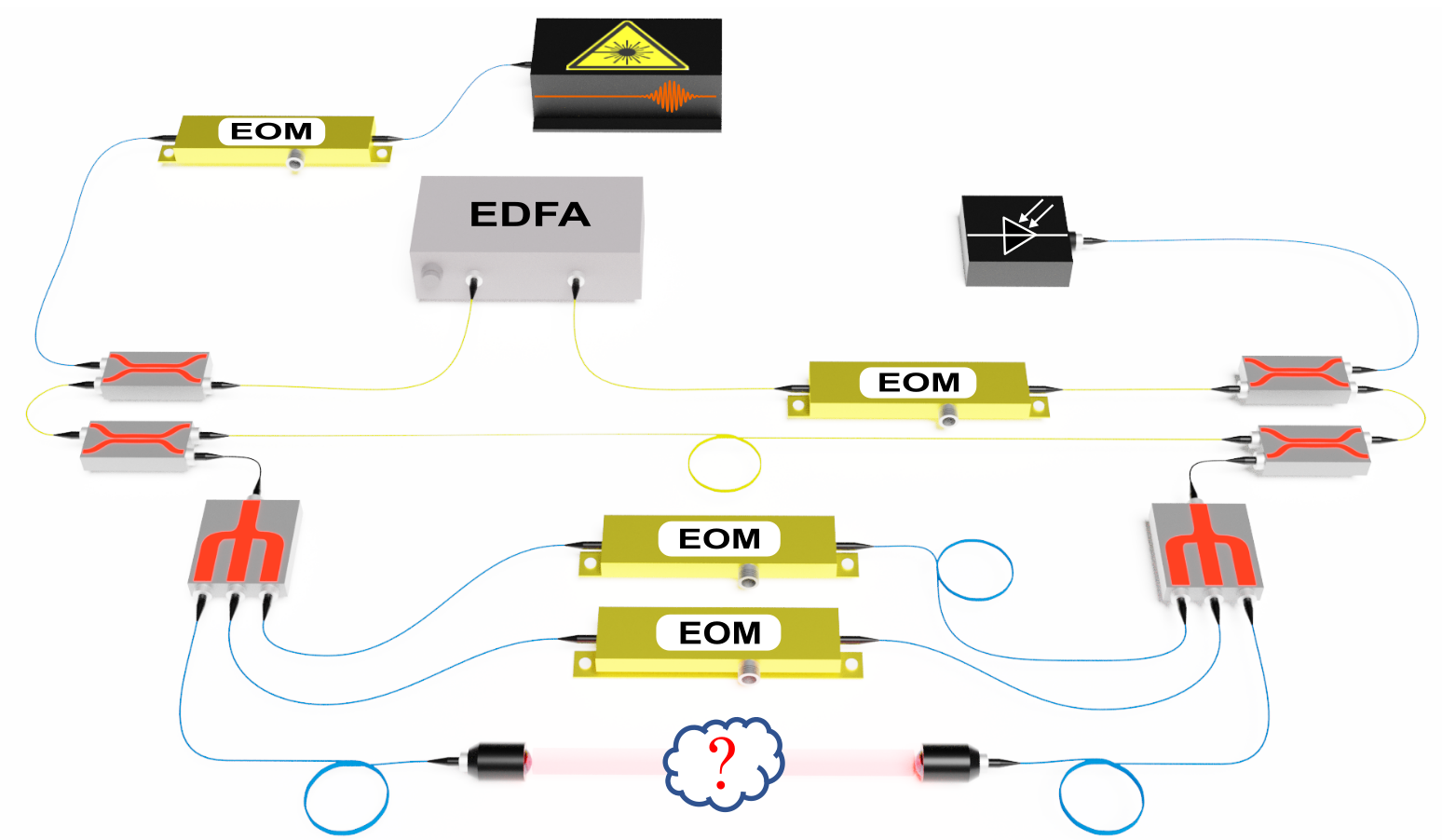
- The experiment uses a fiber-based time-multiplexed resonator network with optical pulses in a synthetic dimension defined by temporal delays.
- The Hatano-Nelson Hamiltonian is implemented using electro-optic modulators to create asymmetric, non-reciprocal couplings between adjacent pulses.
- Boundary coupling between the first and last pulse is controlled via a long delay line with tunable electro-optic modulators to simulate perturbations.
- The zero-mode of the Hatano-Nelson lattice is injected and allowed to build up over 10 roundtrips, followed by activation of nearest-neighbor couplings.
- Cavity ring-down traces are recorded over 50 repetitions to extract decay rate shifts, with a reference pulse used to calibrate intrinsic decay.
- Sensitivity is quantified as the shift in the eigenvalue (decay rate) of the zero-mode due to boundary coupling perturbation, scaled with lattice size.
Experimental results
Research questions
- RQ1Can non-Hermitian topological sensors (NTOS) achieve exponentially increasing sensitivity with lattice size in a real experimental system?
- RQ2Does the sensitivity enhancement in NTOS arise exclusively from the interplay of non-Hermiticity and topology, and not from other mechanisms?
- RQ3How does the sensitivity scaling of NTOS compare to conventional distributed sensing and Hermitian topological systems?
- RQ4Can the theoretical predictions of exponential sensitivity scaling in the Hatano-Nelson model be experimentally verified in a photonic platform?
- RQ5Is the enhanced sensitivity robust and observable without fine-tuning of system parameters?
Key findings
- The experimentally measured sensitivity of the non-Hermitian topological sensor exhibits exponential growth with the number of lattice sites, confirming theoretical predictions.
- For lattice sizes up to N=23, the sensitivity increases by more than two orders of magnitude compared to conventional distributed sensing with √N scaling.
- The sensitivity enhancement is observed without requiring fine-tuning of system parameters, distinguishing NTOS from other non-Hermitian sensing schemes.
- The response is dominated by the interplay of non-Hermiticity and topology, as evidenced by the absence of similar scaling in Hermitian topological systems like the SSH model.
- The eigenvalue shift in the zero-mode due to boundary coupling perturbation scales exponentially with lattice size, with a measured sensitivity enhancement factor consistent with theoretical expectations.
- The reference pulse confirms that the observed decay rate shift is due to the non-Hermitian topological effect and not intrinsic cavity losses.
Better researchstarts right now
From reading papers to final review, dramatically reduce your research time.
No credit card · Free plan available
This review was created by AI and reviewed by human editors.