
[Paper Review] Enhancing Autonomous Vehicle Training with Language Model Integration and Critical Scenario Generation
This paper proposes CRITICAL, a closed-loop framework that enhances autonomous vehicle (AV) training by integrating real-world traffic dynamics, surrogate safety metrics, and Large Language Models (LLMs) to generate critical driving scenarios. By iteratively identifying failure patterns via LLM analysis and refining training scenarios, CRITICAL boosts learning efficiency and safety, achieving a 76.886 average reward and 61 crashes (vs. 89 in baseline) in PPO-based AV training.
This paper introduces CRITICAL, a novel closed-loop framework for autonomous vehicle (AV) training and testing. CRITICAL stands out for its ability to generate diverse scenarios, focusing on critical driving situations that target specific learning and performance gaps identified in the Reinforcement Learning (RL) agent. The framework achieves this by integrating real-world traffic dynamics, driving behavior analysis, surrogate safety measures, and an optional Large Language Model (LLM) component. It is proven that the establishment of a closed feedback loop between the data generation pipeline and the training process can enhance the learning rate during training, elevate overall system performance, and augment safety resilience. Our evaluations, conducted using the Proximal Policy Optimization (PPO) and the HighwayEnv simulation environment, demonstrate noticeable performance improvements with the integration of critical case generation and LLM analysis, indicating CRITICAL's potential to improve the robustness of AV systems and streamline the generation of critical scenarios. This ultimately serves to hasten the development of AV agents, expand the general scope of RL training, and ameliorate validation efforts for AV safety.
Motivation & Objective
- Address the lack of interpretable, diverse, and safety-critical scenario generation in open-source RL-based AV training frameworks.
- Overcome limitations of traditional training that rely on repetitive, non-critical scenarios, which fail to prepare AVs for real-world complexity.
- Improve RL agent robustness and learning efficiency by dynamically generating high-fidelity, critical driving scenarios based on failure analysis.
- Integrate LLMs to interpret training episodes and generate semantically meaningful, diverse, and challenging scenario variations.
- Establish a closed-loop feedback mechanism between scenario generation and RL training to continuously refine agent performance and safety
Proposed method
- Utilize the highD dataset to model real-world traffic dynamics and driving behaviors, enabling high-fidelity simulation environments.
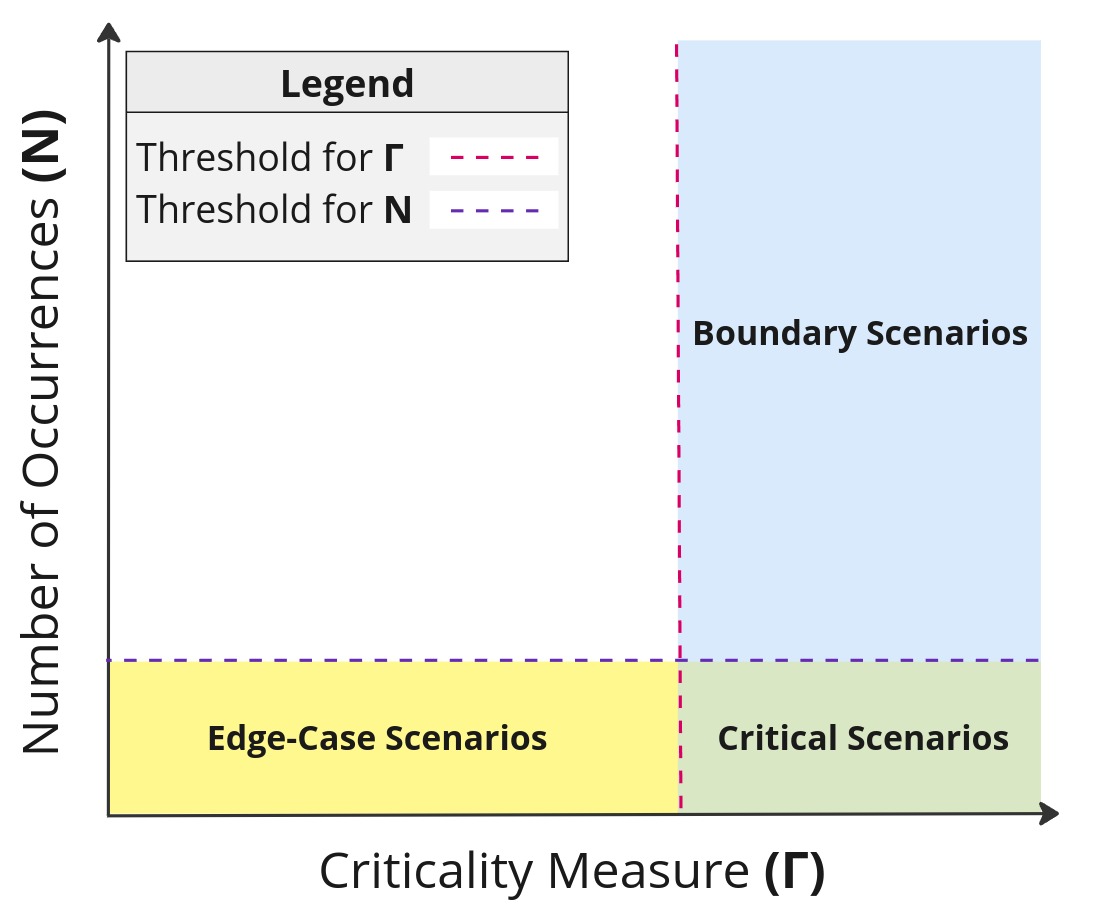
- Apply clustering techniques (e.g., K-Means, HCA) to identify edge-case scenarios from real-world data, focusing on high-risk configurations.
- Introduce two surrogate safety metrics—Time-to-Collision (TTC) and a unified risk index (r)—to quantify scenario criticality and guide scenario selection.
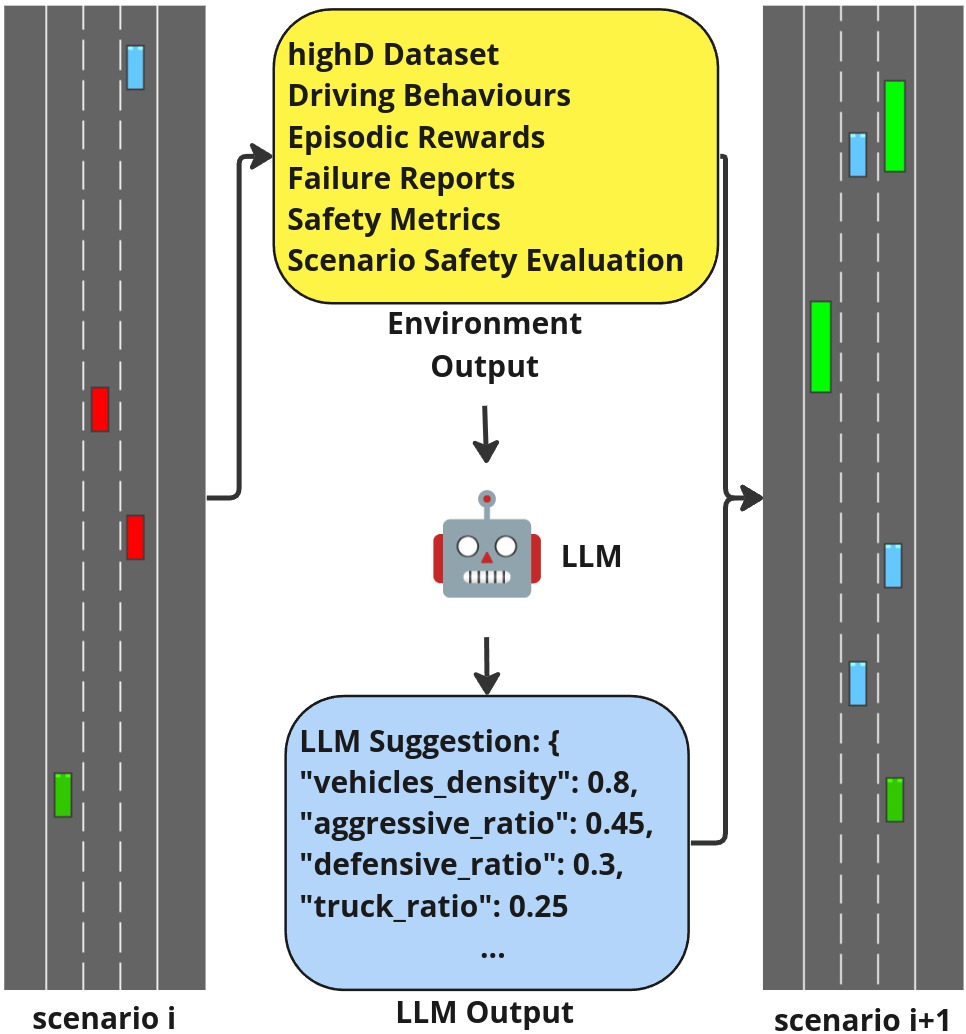
- Feed episode outputs into a Large Language Model (LLM) to parse failure patterns and generate semantically rich, novel scenario configurations.
- Construct a closed-loop framework where LLM-generated scenarios are fed back into the RL training loop, enabling iterative improvement.
- Use Proximal Policy Optimization (PPO) in the HighwayEnv simulation environment to train and evaluate the RL agent under dynamically enriched scenario distributions.
Experimental results
Research questions
- RQ1Can a closed-loop framework that integrates real-world data, safety metrics, and LLMs effectively generate diverse and critical driving scenarios for AV training?
- RQ2How does LLM-enhanced scenario generation improve the learning rate and performance of RL-based AV agents compared to baseline and non-LLM critical scenario generation?
- RQ3To what extent do surrogate safety metrics (TTC and unified risk index) reflect the evolving criticality of scenarios during training and correlate with agent performance?
- RQ4Does the integration of LLMs into the scenario generation pipeline lead to more semantically meaningful and complex scenarios that better reflect real-world driving challenges?
- RQ5Can the framework generalize across different traffic conditions and road layouts, and how does it impact crash frequency and episode length in RL training?
Key findings
- The integration of LLM-enhanced critical scenario generation increased the average episode reward from 50.068 (baseline) to 76.886, indicating substantial performance gains.
- The average episode length rose from 55.760 to 93.019 with LLM-enhanced generation, demonstrating improved navigation stability and longer successful trajectories.
- Crash counts decreased from 89 in the baseline to 61 with LLM-enhanced scenario generation, confirming improved safety resilience.
- The unified risk index (r) and TTC near-miss counts showed a marked reduction in mean criticality scores over time, especially in the LLM-enhanced setup, indicating better handling of high-risk scenarios.
- The closed-loop feedback mechanism significantly accelerated learning and improved agent robustness by continuously exposing the agent to increasingly complex and critical scenarios.
- LLM analysis enabled the discovery and generation of semantically rich, failure-informed scenarios that were not captured by clustering alone, expanding the training distribution beyond data-driven edge cases.
Read this paper
Open the full text in the Nubint reader and ask about any passage as you read.
Read this paper on NubintThis review was generated by AI from the original paper. Please check the paper before citing it.