
[Paper Review] Enhancing Conversational Search: Large Language Model-Aided Informative Query Rewriting
This paper proposes using large language models (LLMs) to generate informative, context-rich query rewrites for conversational search, enhancing retrieval performance beyond human-rewritten queries. By designing instruction-tuned LLMs to produce well-formed rewrites with four key properties—clarity, informativeness, non-redundancy, and semantic fidelity—and employing a 'rewrite-then-edit' workflow with LLM editors, the approach achieves superior results, especially with sparse retrievers, while distillation enables efficient inference.
Query rewriting plays a vital role in enhancing conversational search by transforming context-dependent user queries into standalone forms. Existing approaches primarily leverage human-rewritten queries as labels to train query rewriting models. However, human rewrites may lack sufficient information for optimal retrieval performance. To overcome this limitation, we propose utilizing large language models (LLMs) as query rewriters, enabling the generation of informative query rewrites through well-designed instructions. We define four essential properties for well-formed rewrites and incorporate all of them into the instruction. In addition, we introduce the role of rewrite editors for LLMs when initial query rewrites are available, forming a "rewrite-then-edit" process. Furthermore, we propose distilling the rewriting capabilities of LLMs into smaller models to reduce rewriting latency. Our experimental evaluation on the QReCC dataset demonstrates that informative query rewrites can yield substantially improved retrieval performance compared to human rewrites, especially with sparse retrievers.
Motivation & Objective
- To address the limitation of human-rewritten queries in conversational search, which often lack sufficient context and informativeness for optimal retrieval.
- To explore large language models (LLMs) as a scalable, high-quality alternative to human-rewritten queries for training query rewriting models.
- To define and enforce four essential properties for well-formed query rewrites: clarity, informativeness, non-redundancy, and semantic fidelity.
- To propose a 'rewrite-then-edit' framework where LLMs act as both rewriters and editors to improve rewrite quality.
- To distill LLM-generated rewrites into smaller, efficient models for low-latency inference without sacrificing performance.
Proposed method
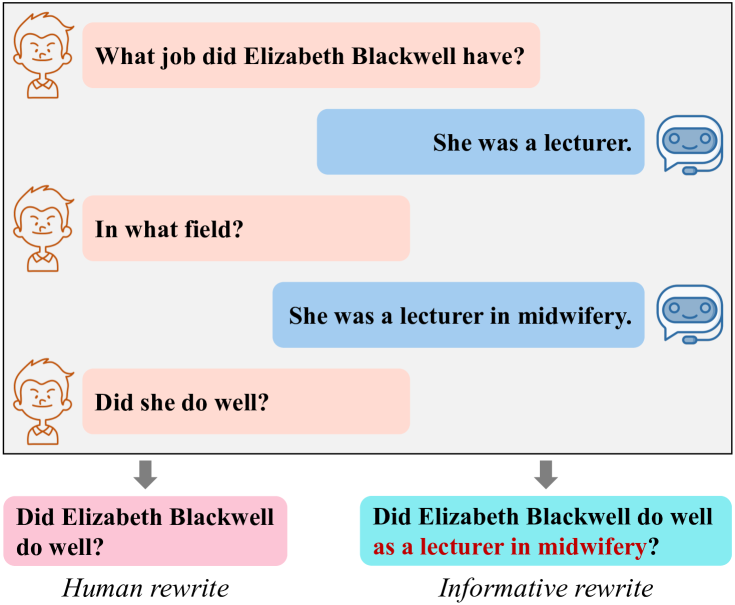
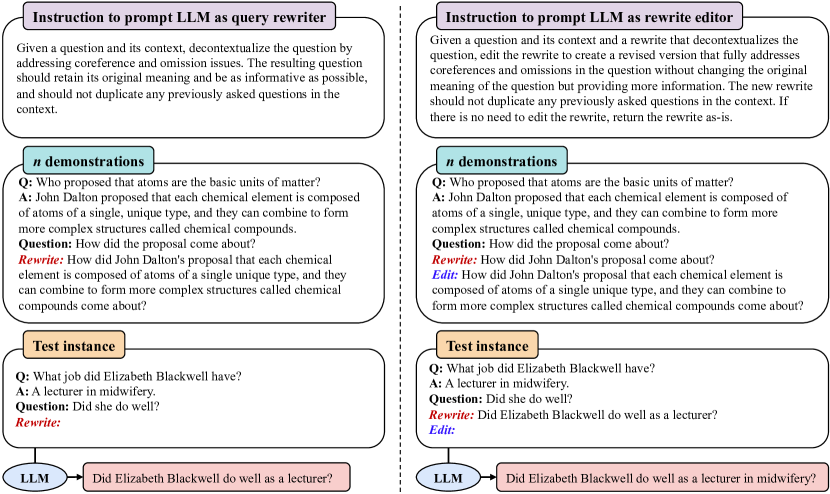
- Design a comprehensive instruction prompt that incorporates four key properties—clarity, informativeness, non-redundancy, and semantic fidelity—into zero-shot LLM query rewriting.
- Implement a few-shot prompting strategy with demonstrations to guide LLMs in generating high-quality rewrites.
- Introduce a two-stage 'rewrite-then-edit' process where an LLM acts as a rewrite editor to refine initial rewrites from smaller models or LLMs.
- Use distillation techniques to transfer the rewriting capabilities of large LLMs into smaller, faster models using LLM-generated rewrites as supervised labels.
- Evaluate the method on the QReCC dataset using both sparse and dense retrieval models to assess performance gains.
Experimental results
Research questions
- RQ1Can LLM-generated query rewrites outperform human-rewritten queries in terms of retrieval effectiveness, especially under sparse retrieval?
- RQ2What specific properties make a query rewrite well-formed and informative in the context of conversational search?
- RQ3How effective is the 'rewrite-then-edit' framework in improving the quality of LLM-generated rewrites compared to direct prompting?
- RQ4To what extent can the reasoning and rewriting capabilities of LLMs be distilled into smaller models while preserving performance?
- RQ5Does the use of instruction-tuned LLMs significantly improve retrieval performance over baseline human-rewritten queries?
Key findings
- Informative query rewrites generated by LLMs significantly outperform human-rewritten queries in retrieval effectiveness, particularly with sparse retrievers.
- The 'rewrite-then-edit' approach improves rewrite quality by enabling LLMs to refine initial outputs, leading to more contextually accurate and informative queries.
- The use of instruction-tuned LLMs incorporating four key rewrite properties results in rewrites that are more informative and less ambiguous than human-rewritten counterparts.
- Distillation of LLM-generated rewrites into smaller models preserves most of the performance gains while reducing inference latency.
- On the QReCC dataset, LLM-aided rewriting achieves substantial improvements in retrieval metrics such as Recall@10 and Mean Reciprocal Rank (MRR), especially under sparse retrieval settings.
Read this paper
Open the full text in the Nubint reader and ask about any passage as you read.
Read this paper on NubintThis review was generated by AI from the original paper. Please check the paper before citing it.