
[Paper Review] Enhancing IoT Security with CNN and LSTM-Based Intrusion Detection Systems
A CNN-LSTM hybrid intrusion detection model for IoT traffic, trained on CICIoT2023 data and validated on CICIDS2017, achieving high accuracy and low loss for binary benign/malicious classification.
Protecting Internet of things (IoT) devices against cyber attacks is imperative owing to inherent security vulnerabilities. These vulnerabilities can include a spectrum of sophisticated attacks that pose significant damage to both individuals and organizations. Employing robust security measures like intrusion detection systems (IDSs) is essential to solve these problems and protect IoT systems from such attacks. In this context, our proposed IDS model consists on a combination of convolutional neural network (CNN) and long short-term memory (LSTM) deep learning (DL) models. This fusion facilitates the detection and classification of IoT traffic into binary categories, benign and malicious activities by leveraging the spatial feature extraction capabilities of CNN for pattern recognition and the sequential memory retention of LSTM for discerning complex temporal dependencies in achieving enhanced accuracy and efficiency. In assessing the performance of our proposed model, the authors employed the new CICIoT2023 dataset for both training and final testing, while further validating the model's performance through a conclusive testing phase utilizing the CICIDS2017 dataset. Our proposed model achieves an accuracy rate of 98.42%, accompanied by a minimal loss of 0.0275. False positive rate(FPR) is equally important, reaching 9.17% with an F1-score of 98.57%. These results demonstrate the effectiveness of our proposed CNN-LSTM IDS model in fortifying IoT environments against potential cyber threats.
Motivation & Objective
- Motivate robust IoT security against diverse cyber attacks and the need for effective IDS in IoT environments.
- Develop a CNN-LSTM hybrid IDS to leverage spatial and temporal features for improved detection.
- Evaluate the model on CICIoT2023 and CICIDS2017 datasets to assess performance and generalization.
- Demonstrate performance through standard metrics (accuracy, loss, precision, recall, F1-score, FPR).
Proposed method
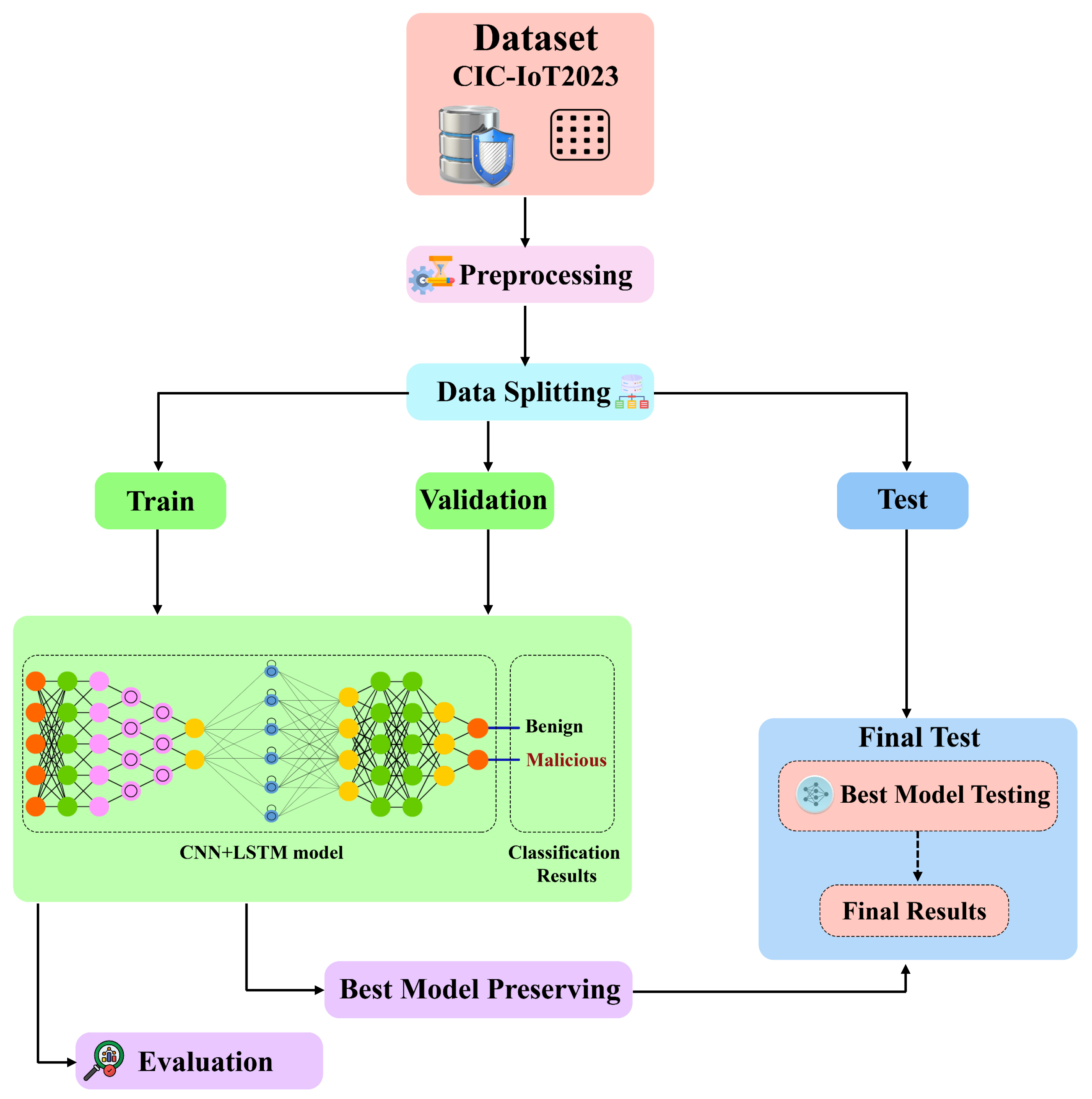
- Preprocess IoT traffic data into a 45-feature vector and convert labels to binary form.
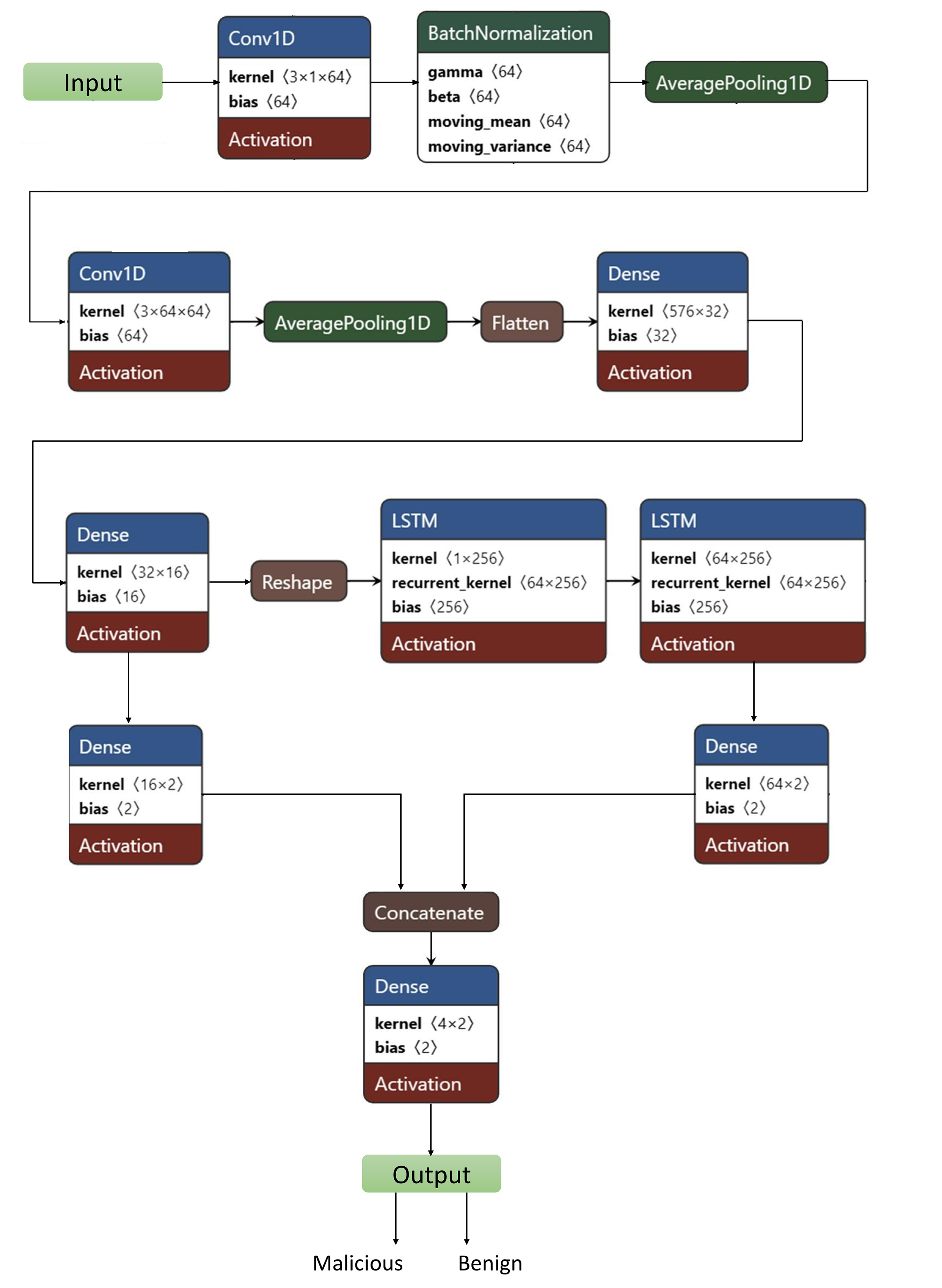
- Design a CNN-1D feature extractor with batch normalization and average pooling to capture spatial patterns.
- Combine CNN outputs with LSTM layers to model sequential dependencies and produce a binary benign/malicious decision.
- Train with 25 epochs on Adam optimizer using 80/20 train/validation split on CICIoT2023 subset; assess generalization on additional CICIoT2023 subsets and CICIDS2017.
- Evaluate performance using accuracy, loss, precision, recall, F1-score, and FPR; report ROC/confusion matrix analyses.
Experimental results
Research questions
- RQ1Can a CNN-LSTM hybrid model outperform single-model approaches for IoT intrusion detection in binary classification tasks?
- RQ2How well does the CNN-LSTM IDS generalize across different IoT traffic datasets (CICIoT2023 subsets and CICIDS2017)?
- RQ3What are the trade-offs between detection accuracy and false positive rate in the proposed approach?
- RQ4Does the model effectively leverage spatial-temporal features to differentiate benign from malicious IoT traffic?
Key findings
- The CNN-LSTM IDS achieves 98.42% accuracy with a loss of 0.0275 on CICIoT2023 first subset.
- Generalization tests on CICIoT2023 second subset yield 98.43% accuracy with 0.0275 loss and 9.17% FPR.
- On CICIDS2017, the model attains 97.45% accuracy, 0.06 loss, 97.17% precision, 97.15% recall, 97.07% F1-score, and 2.08% FPR.
- Confusion matrices indicate ~90% accuracy for normal traffic and ~99% accuracy for attacks.
- ROC analysis shows high true positive rates with low false positive rates, indicating strong discrimination between classes.
- Compared with state-of-the-art methods, the CNN-LSTM approach on CICIoT2023 and CICIDS2017 demonstrates superior overall performance across reported metrics.
Read this paper
Open the full text in the Nubint reader and ask about any passage as you read.
Read this paper on NubintThis review was generated by AI from the original paper. Please check the paper before citing it.