
[Paper Review] Enhancing LLMs for Impression Generation in Radiology Reports through a Multi-Agent System
This paper proposes RadCouncil, a multi-agent LLM framework that enhances radiology impression generation by integrating a Retrieval agent, Radiologist agent, and Reviewer agent. The system improves diagnostic accuracy, stylistic consistency, and clarity—demonstrating superior performance over single-agent models through iterative feedback and retrieval-augmented generation, with GPT-4 evaluation confirming significant qualitative gains.
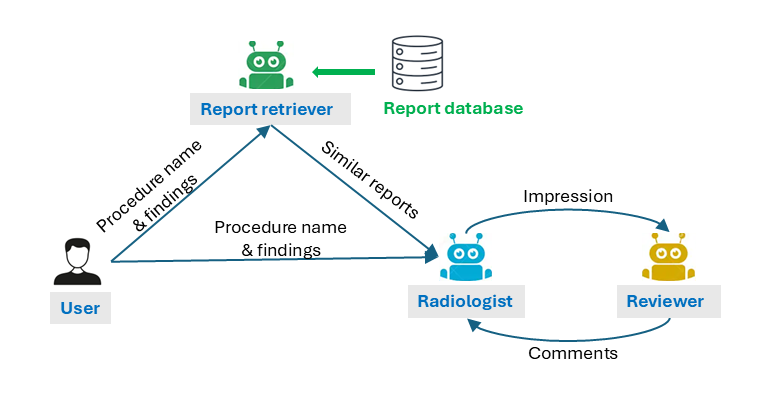
This study introduces "RadCouncil," a multi-agent Large Language Model (LLM) framework designed to enhance the generation of impressions in radiology reports from the finding section. RadCouncil comprises three specialized agents: 1) a "Retrieval" Agent that identifies and retrieves similar reports from a vector database, 2) a "Radiologist" Agent that generates impressions based on the finding section of the given report plus the exemplar reports retrieved by the Retrieval Agent, and 3) a "Reviewer" Agent that evaluates the generated impressions and provides feedback. The performance of RadCouncil was evaluated using both quantitative metrics (BLEU, ROUGE, BERTScore) and qualitative criteria assessed by GPT-4, using chest X-ray as a case study. Experiment results show improvements in RadCouncil over the single-agent approach across multiple dimensions, including diagnostic accuracy, stylistic concordance, and clarity. This study highlights the potential of utilizing multiple interacting LLM agents, each with a dedicated task, to enhance performance in specialized medical tasks and the development of more robust and adaptable healthcare AI solutions.
Motivation & Objective
- To address the limitations of single-agent LLMs in generating accurate and consistent radiology report impressions, particularly hallucinations and stylistic inconsistencies.
- To develop a scalable, modular framework that mimics clinical radiology workflows by integrating retrieval, generation, and peer review.
- To improve diagnostic precision and stylistic alignment with radiological reporting standards using retrieval-augmented generation and multi-agent feedback.
- To evaluate the effectiveness of a multi-agent system in reducing inconsistencies, especially in temporal and status-related conclusions.
- To explore the potential of multi-agent systems for robust, reliable, and adaptable healthcare AI applications beyond radiology.
Proposed method
- RadCouncil employs three specialized LLM agents: a Retrieval agent that uses vector similarity to fetch similar historical reports from a database.
- A Radiologist agent generates impressions based on the input finding section and retrieved exemplar reports, leveraging context from prior cases.
- A Reviewer agent evaluates the generated impression for consistency with findings, focusing on detecting errors such as incorrect 'unchanged' status claims.
- The system uses iterative feedback: if inconsistencies are detected, the Radiologist agent revises the impression based on the Reviewer’s feedback.
- The framework integrates retrieval-augmented generation (RAG) to enhance domain-specific knowledge and stylistic fidelity to radiological conventions.
- Performance is evaluated using BLEU, ROUGE, BERTScore, and qualitative assessment via GPT-4, with chest X-ray reports as the test case.
Experimental results
Research questions
- RQ1Can a multi-agent LLM framework improve the diagnostic accuracy and stylistic consistency of radiology impression generation compared to single-agent approaches?
- RQ2How effective is the integration of retrieval-augmented generation with a dedicated review agent in reducing hallucinations and inconsistencies?
- RQ3To what extent can a Reviewer agent detect and correct errors related to temporal status changes, such as incorrect 'unchanged' conclusions?
- RQ4How does the multi-agent architecture, with role specialization, enhance reliability and robustness in medical text generation?
- RQ5Can this framework be generalized to other clinical documentation tasks requiring coordination, expertise, and validation?
Key findings
- RadCouncil significantly outperformed single-agent baselines in quantitative metrics, with improvements in BLEU, ROUGE, and BERTScore, indicating better fluency and relevance.
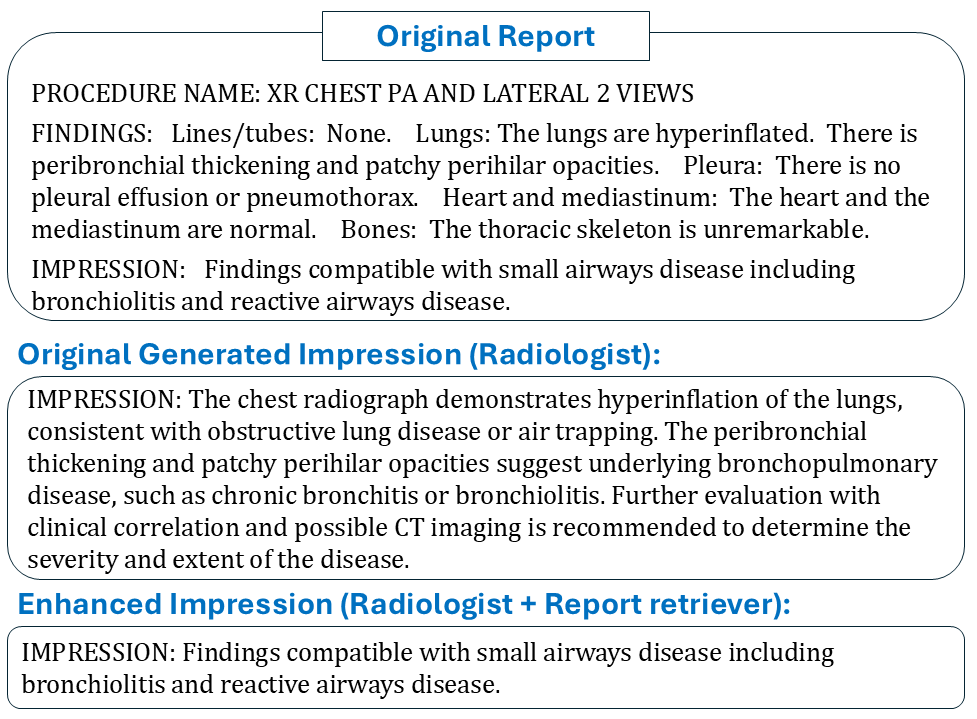
- GPT-4 evaluation confirmed that RadCouncil-generated impressions were more clinically accurate, stylistically consistent, and clearer than those from single-agent models.
- The Reviewer agent successfully identified and corrected inconsistencies in four out of five cases involving status misstatements, particularly in 'unchanged' conclusions.
- The Reviewer agent failed to detect inconsistencies related to 'Status' when the absence of prior comparison studies was not explicitly stated, indicating a need for better temporal reasoning.
- Retrieval-augmented generation enhanced stylistic alignment with radiological reporting standards and improved diagnostic precision, though it introduced new inconsistency risks.
- The multi-agent system demonstrated the feasibility of using specialized, collaborative agents to reduce hallucinations and improve reliability in medical LLM applications.
Better researchstarts right now
From reading papers to final review, dramatically reduce your research time.
No credit card · Free plan available
This review was created by AI and reviewed by human editors.