
[Paper Review] Enhancing Pipeline-Based Conversational Agents with Large Language Models
This paper proposes a hybrid approach to enhance pipeline-based conversational agents using large language models (LLMs) like GPT-4, improving both development and runtime capabilities without replacing existing systems. It demonstrates that LLMs can generate training data, extract entities and synonyms, enable contextual understanding, auto-correct inputs, create stylistically varied responses, and support closed-domain question answering and conversation summarization—boosting agent performance while preserving privacy and system integration.
The latest advancements in AI and deep learning have led to a breakthrough in large language model (LLM)-based agents such as GPT-4. However, many commercial conversational agent development tools are pipeline-based and have limitations in holding a human-like conversation. This paper investigates the capabilities of LLMs to enhance pipeline-based conversational agents during two phases: 1) in the design and development phase and 2) during operations. In 1) LLMs can aid in generating training data, extracting entities and synonyms, localization, and persona design. In 2) LLMs can assist in contextualization, intent classification to prevent conversational breakdown and handle out-of-scope questions, auto-correcting utterances, rephrasing responses, formulating disambiguation questions, summarization, and enabling closed question-answering capabilities. We conducted informal experiments with GPT-4 in the private banking domain to demonstrate the scenarios above with a practical example. Companies may be hesitant to replace their pipeline-based agents with LLMs entirely due to privacy concerns and the need for deep integration within their existing ecosystems. A hybrid approach in which LLMs' are integrated into the pipeline-based agents allows them to save time and costs of building and running agents by capitalizing on the capabilities of LLMs while retaining the integration and privacy safeguards of their existing systems.
Motivation & Objective
- To address the limitations of pipeline-based conversational agents in achieving human-like dialogue, particularly in contextual understanding and response variability.
- To explore how LLMs can be integrated into existing pipeline architectures to enhance development efficiency and operational performance without full system replacement.
- To evaluate the feasibility and benefits of using LLMs for generating training data, entity extraction, persona design, and runtime capabilities such as auto-correction and summarization.
- To provide a practical, privacy-preserving alternative to end-to-end LLM-based agents by leveraging LLMs as augmentative components within established conversational agent pipelines.
Proposed method
- Using GPT-4 to generate synthetic training data for intent classification and entity recognition in the private banking domain.
- Employing LLMs to extract domain-specific entities and synonyms, and to define agent personas and localization parameters.
- Integrating LLMs at runtime to auto-correct user utterances, rephrase responses, and generate disambiguation questions.
- Applying LLMs for contextualization, handling out-of-scope queries, and enabling closed-domain question-answering with predefined answers.
- Using LLMs to summarize ongoing conversations for handover to human agents or confirmation steps.
- Conducting informal experiments with GPT-4 across multiple use cases to validate the hybrid enhancement approach.
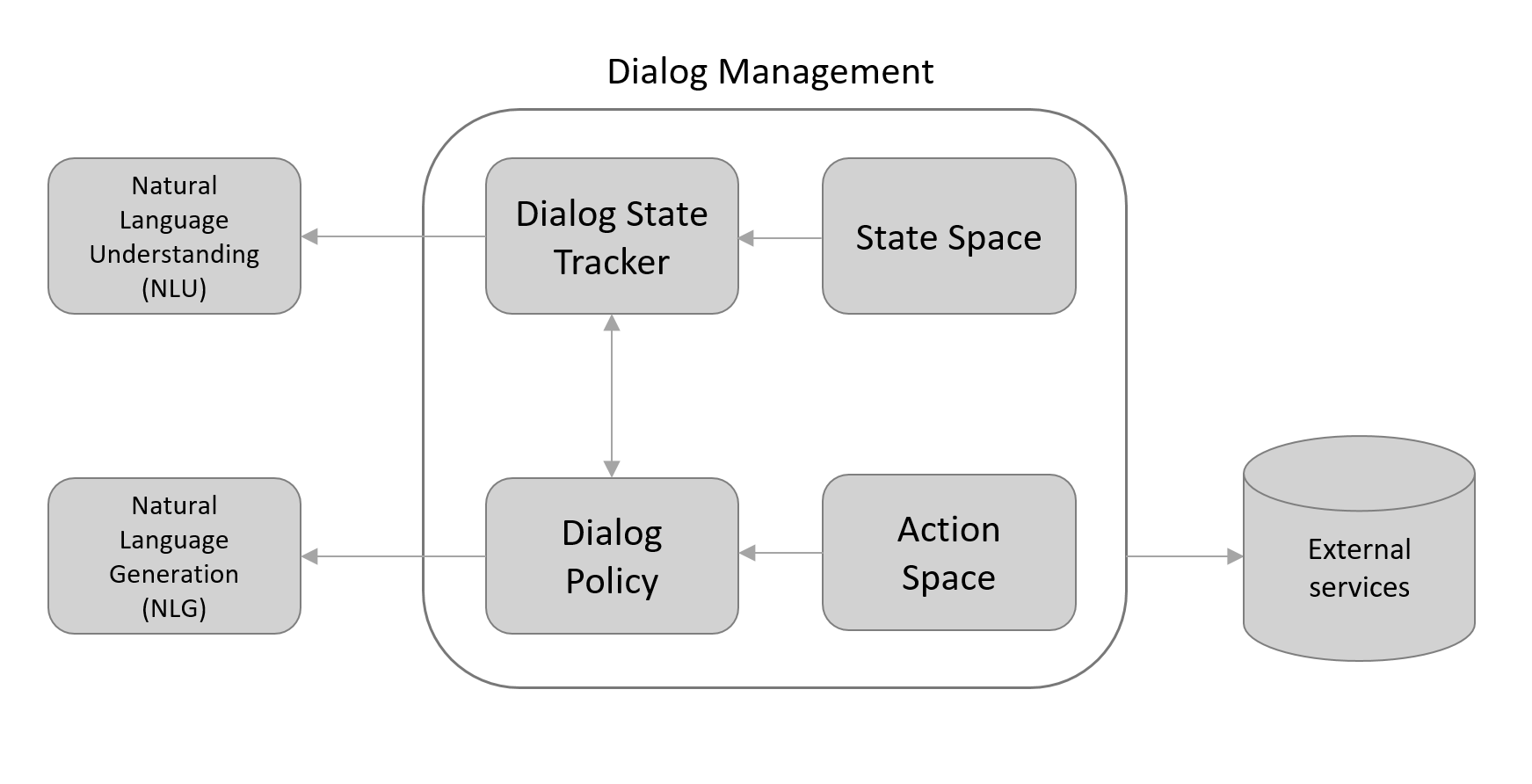
Experimental results
Research questions
- RQ1How can LLMs improve the development phase of pipeline-based conversational agents, particularly in training data generation and entity extraction?
- RQ2To what extent can LLMs enhance runtime capabilities such as contextual understanding, response variability, and out-of-scope handling?
- RQ3Can LLMs be effectively integrated into existing pipeline architectures without compromising system privacy or requiring full migration?
- RQ4What are the practical benefits of using LLMs for closed-domain question answering and conversation summarization in production agents?
- RQ5How does the hybrid integration of LLMs affect the maintainability and scalability of existing conversational agent systems?
Key findings
- LLMs significantly improved training data generation, enabling faster and more accurate intent classification and entity extraction in the private banking domain.
- GPT-4 successfully generated 10 stylistically varied, apologetic rephrasings of a misunderstood input, demonstrating effective response personalization and tone control.
- The model achieved 5 out of 5 correct responses in closed-domain question-answering tasks, indicating strong reliability when constrained to predefined answers.
- LLM-based conversation summarization produced concise, actionable summaries in the required format, supporting seamless handover to human agents.
- The hybrid approach enabled auto-correction of user inputs and effective handling of out-of-scope queries, reducing conversational breakdowns.
- The integration of LLMs into existing pipeline systems preserved data privacy and system stability while enhancing agent capabilities.
Better researchstarts right now
From reading papers to final review, dramatically reduce your research time.
No credit card · Free plan available
This review was created by AI and reviewed by human editors.