
[Paper Review] Enhancing Short-Term Wind Speed Forecasting using Graph Attention and Frequency-Enhanced Mechanisms
This paper proposes GFST-WSF, a novel graph-attentive, frequency-enhanced Transformer model for short-term wind speed forecasting that integrates Graph Attention Networks (GAT) with a modified FEDformer to capture complex spatio-temporal dependencies. By employing a dynamic complex adjacency matrix to model time-lagged spatial correlations among wind farms, the model achieves state-of-the-art performance, reducing MSE by up to 14% for 6-hour forecasts compared to existing deep learning methods.
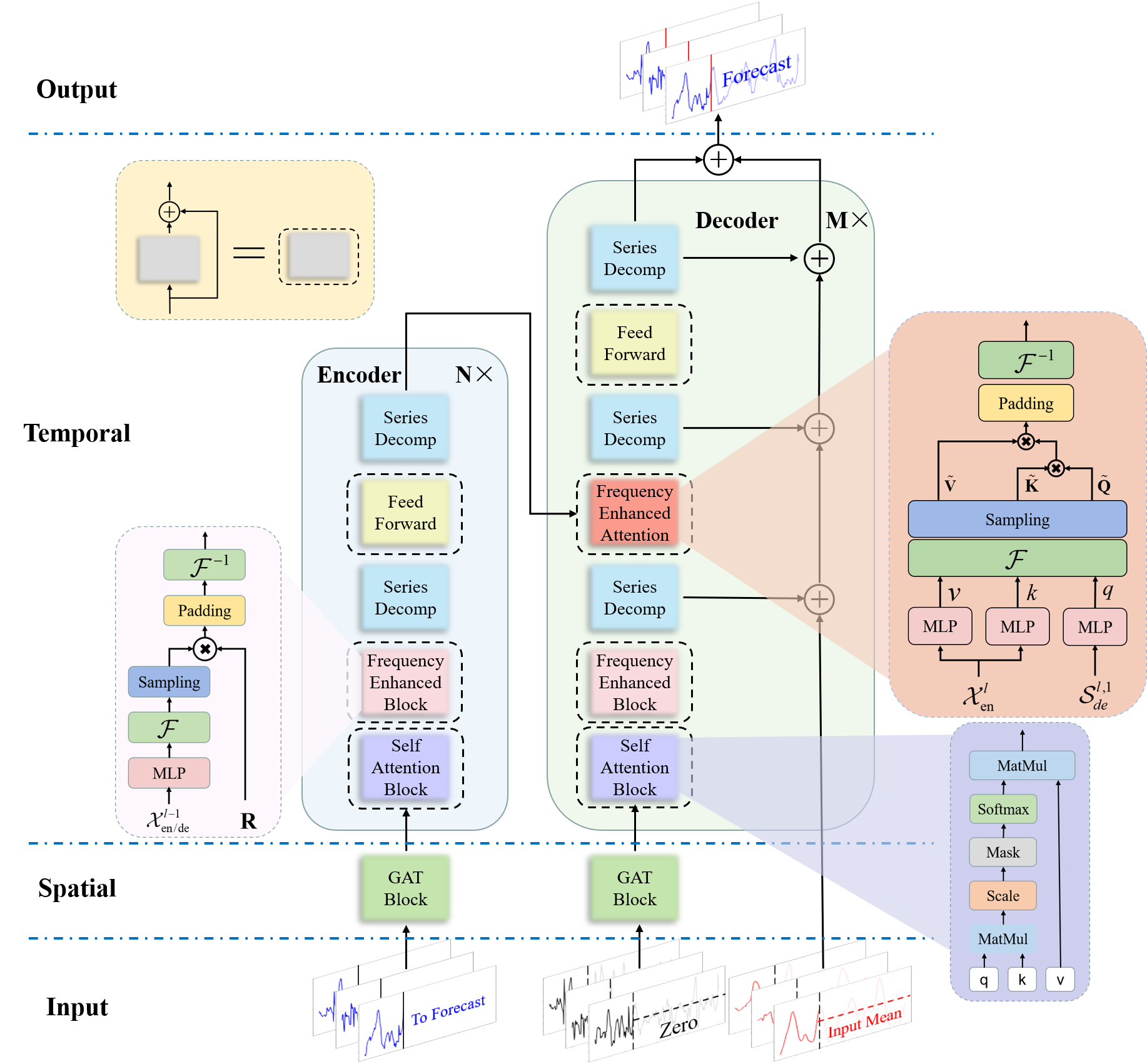
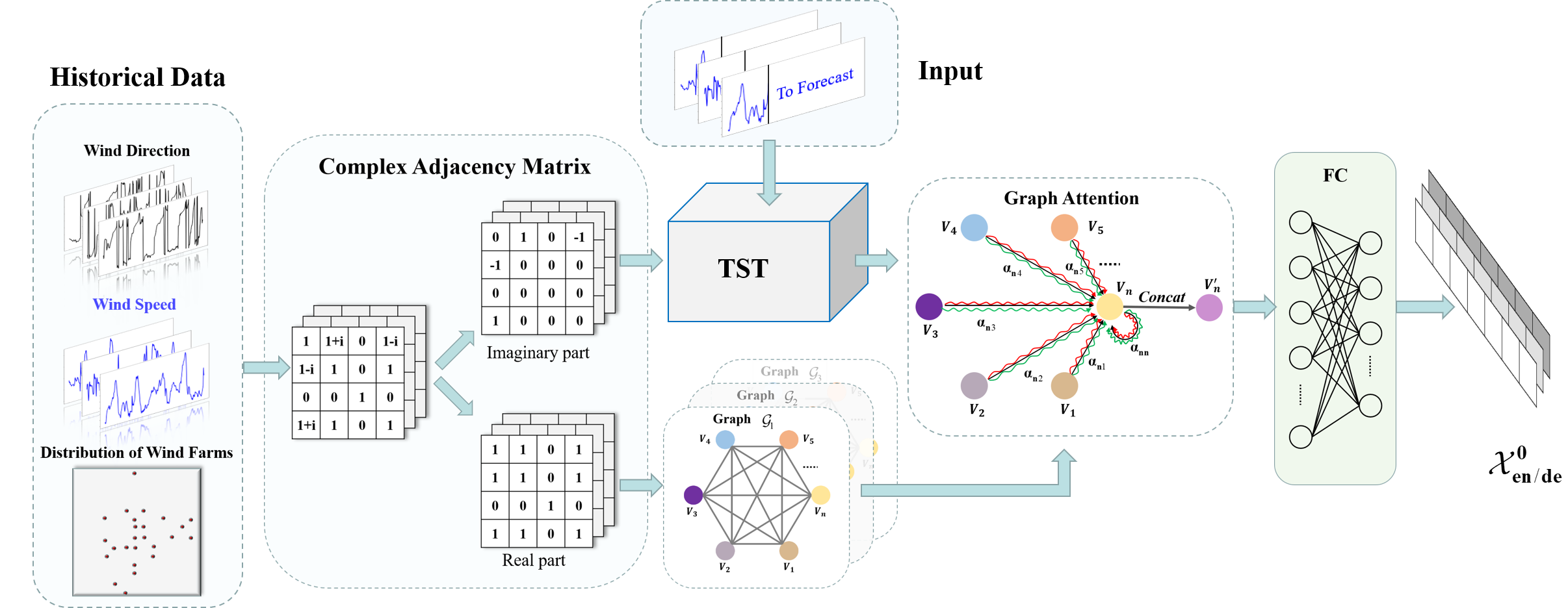
The safe and stable operation of power systems is greatly challenged by the high variability and randomness of wind power in large-scale wind-power-integrated grids. Wind power forecasting is an effective solution to tackle this issue, with wind speed forecasting being an essential aspect. In this paper, a Graph-attentive Frequency-enhanced Spatial-Temporal Wind Speed Forecasting model based on graph attention and frequency-enhanced mechanisms, i.e., GFST-WSF, is proposed to improve the accuracy of short-term wind speed forecasting. The GFST-WSF comprises a Transformer architecture for temporal feature extraction and a Graph Attention Network (GAT) for spatial feature extraction. The GAT is specifically designed to capture the complex spatial dependencies among wind speed stations to effectively aggregate information from neighboring nodes in the graph, thus enhancing the spatial representation of the data. To model the time lag in wind speed correlation between adjacent wind farms caused by geographical factors, a dynamic complex adjacency matrix is formulated and utilized by the GAT. Benefiting from the effective spatio-temporal feature extraction and the deep architecture of the Transformer, the GFST-WSF outperforms other baselines in wind speed forecasting for the 6-24 hours ahead forecast horizon in case studies.
Motivation & Objective
- To address the challenge of high variability and randomness in wind power by improving short-term wind speed forecasting accuracy.
- To model complex spatial dependencies among geographically distributed wind farms that are often overlooked in traditional single-farm forecasting models.
- To integrate temporal modeling via a frequency-enhanced Transformer (FEDformer) with spatial feature extraction using Graph Attention Networks (GAT).
- To develop a dynamic complex adjacency matrix that captures time-lagged wind speed correlations due to geographical factors.
- To enhance forecasting performance across 6-, 12-, and 24-hour horizons through synergistic spatio-temporal representation learning.
Proposed method
- The model uses a Transformer-based architecture with FEDformer for temporal feature extraction, enabling effective modeling of long-range dependencies in wind speed sequences.
- A Graph Attention Network (GAT) is employed to extract spatial features by modeling relationships between wind speed stations as a graph with learnable attention weights.
- A dynamic complex adjacency matrix is introduced to represent evolving spatial correlations, incorporating both wind speed similarity and time lags due to geographical wind propagation.
- The adjacency matrix is updated dynamically based on real-time wind speed and direction data, improving spatial representation accuracy.
- The model combines temporal and spatial encodings through a late fusion strategy, allowing joint optimization of spatio-temporal representations.
- The architecture leverages multi-head self-attention in the time domain and frequency-domain decomposition to enhance robustness to noise and uncertainty in wind data.
Experimental results
Research questions
- RQ1Can a deep learning model that jointly models temporal and spatial dependencies improve short-term wind speed forecasting accuracy compared to conventional baselines?
- RQ2How does incorporating a dynamic complex adjacency matrix that accounts for time-lagged correlations between wind farms affect forecasting performance?
- RQ3To what extent does combining FEDformer with GAT enhance representation learning in both time and frequency domains for wind speed sequences?
- RQ4Does the proposed GFST-WSF model maintain superior performance across multiple forecast horizons (6h, 12h, 24h)?
- RQ5What is the contribution of each component (GAT, FEDformer, dynamic adjacency) to the overall forecasting accuracy, as validated through ablation studies?
Key findings
- GFST-WSF achieved a 14% reduction in MSE for 6-hour forecasts and a 12% reduction for 12-hour forecasts compared to state-of-the-art models.
- The model reduced MSE by 8% for 24-hour forecasts, demonstrating consistent performance gains across longer horizons.
- Ablation studies confirmed that removing any component—GAT, FEDformer, or the dynamic adjacency matrix—significantly degraded forecasting performance.
- The model exhibited high training stability, with MSE and MAE standard deviations below 0.5% across 100 retraining instances, indicating robust convergence.
- FEDformer-based temporal modeling outperformed LSTM, especially as forecast horizon increased, highlighting the advantage of attention mechanisms in long-range sequence modeling.
- The integration of GAT with a dynamic adjacency matrix improved spatial feature learning, particularly in capturing time-lagged correlations between adjacent wind farms.
Read this paper
Open the full text in the Nubint reader and ask about any passage as you read.
Read this paper on NubintThis review was generated by AI from the original paper. Please check the paper before citing it.