
[Paper Review] Enhancing Social Recommendation with Adversarial Graph Convolutional Networks
This paper proposes ESRF, a deep adversarial graph convolutional network framework that enhances social recommendation by jointly learning implicit social relations and modeling heterogeneous social influence. By using a GCN-based autoencoder to augment sparse social data and an attentive GCN module to weigh relation strengths, ESRF outperforms state-of-the-art models on three real-world datasets, demonstrating robustness to sparsity and noise.
Social recommender systems are expected to improve recommendation quality by incorporating social information when there is little user-item interaction data. However, recent reports from industry show that social recommender systems consistently fail in practice. According to the negative findings, the failure is attributed to: (1) A majority of users only have a very limited number of neighbors in social networks and can hardly benefit from social relations; (2) Social relations are noisy but they are indiscriminately used; (3) Social relations are assumed to be universally applicable to multiple scenarios while they are actually multi-faceted and show heterogeneous strengths in different scenarios. Most existing social recommendation models only consider the homophily in social networks and neglect these drawbacks. In this paper we propose a deep adversarial framework based on graph convolutional networks (GCN) to address these problems. Concretely, for (1) and (2), a GCN-based autoencoder is developed to augment the relation data by encoding high-order and complex connectivity patterns, and meanwhile is optimized subject to the constraint of reconstructing the social profile to guarantee the validity of the identified neighborhood. After obtaining enough purified social relations for each user, a GCN-based attentive social recommendation module is designed to address (3) by capturing the heterogeneous strengths of social relations. Finally, we adopt adversarial training to unify all the components by playing a Minimax game and ensure a coordinated effort to enhance recommendation performance. Extensive experiments on multiple open datasets demonstrate the superiority of our framework and the ablation study confirms the importance and effectiveness of each component.
Motivation & Objective
- Address the poor performance of social recommender systems in practice due to sparse and noisy social relations.
- Overcome the limitations of existing models that treat all social relations uniformly, ignoring their heterogeneous influence across contexts.
- Improve recommendation quality in low-data regimes by discovering reliable implicit social connections beyond explicit links.
- Develop a unified framework that coordinates relation augmentation and recommendation through adversarial training.
- Ensure the validity of augmented relations by constraining the autoencoder to reconstruct user social profiles.
Proposed method
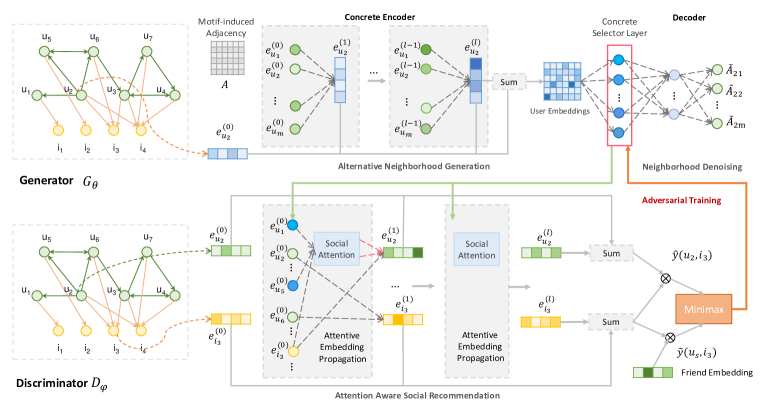
- Use a GCN-based autoencoder to learn high-order connectivity patterns and generate implicit social neighbors, constrained by reconstruction of user social profiles to ensure validity.
- Introduce a graph convolutional network with a learnable attention mechanism to model heterogeneous strengths of social relations, assigning different weights to neighbors based on relevance.
- Implement adversarial training between a generator (relation-augmented GCN) and a discriminator (recommendation-focused GCN), playing a minimax game to unify and optimize both components.
- Optimize the autoencoder to reconstruct user social profiles, ensuring that the augmented relations are meaningful and not random.
- Use a two-stage training process: first pre-train the autoencoder and attention module, then jointly fine-tune all components via adversarial loss.
- Apply a hyperparameter β to control the magnitude of adversarial training, balancing relation augmentation and recommendation accuracy.
Experimental results
Research questions
- RQ1How can we effectively augment sparse social relations in low-data regimes without introducing noise?
- RQ2To what extent can implicit social neighbors—discovered via high-order connectivity patterns—improve recommendation performance?
- RQ3How can we model the heterogeneous influence of social relations across different recommendation contexts?
- RQ4Does adversarial training between relation augmentation and recommendation modules lead to better performance than isolated optimization?
- RQ5How sensitive is the framework to hyperparameters such as the number of alternative neighbors (k), adversarial magnitude (β), and GCN depth?
Key findings
- ESRF significantly outperforms state-of-the-art social recommendation models on Last.fm, Douban, and Gowalla datasets, with improvements in both RMSE and MAE.
- The performance of ESRF peaks when k = 40, 30, and 50 for Last.fm, Douban, and Gowalla, respectively, indicating optimal augmentation levels before noise dominates.
- Adversarial training improves performance, but excessive magnitude (high β) degrades results, suggesting a trade-off between relation quality and recommendation accuracy.
- The model achieves best performance with 4, 3, and 4 GCN layers on Last.fm, Douban, and Gowalla, respectively, with diminishing returns beyond that depth.
- 32.44% of the identified alternative neighbors overlap with explicit social relations, indicating that the augmented neighbors are meaningful and connected to real social ties.
- Attention weights in the model show clear variation across neighbors per user, confirming that the framework successfully learns heterogeneous social influence strengths.
Read this paper
Open the full text in the Nubint reader and ask about any passage as you read.
Read this paper on NubintThis review was generated by AI from the original paper. Please check the paper before citing it.