
[Paper Review] Enhancing the Reasoning Ability of Multimodal Large Language Models via Mixed Preference Optimization
This paper introduces Mixed Preference Optimization (MPO), a novel method that enhances multimodal reasoning in open-source MLLMs by combining preference optimization with a new large-scale, automated dataset construction pipeline. MPO improves Chain-of-Thought reasoning performance without requiring a reward model, achieving 67.0 on MathVista—8.7 points above InternVL2-8B and on par with a 10× larger model—while also boosting text-only reasoning and instruction-following abilities.
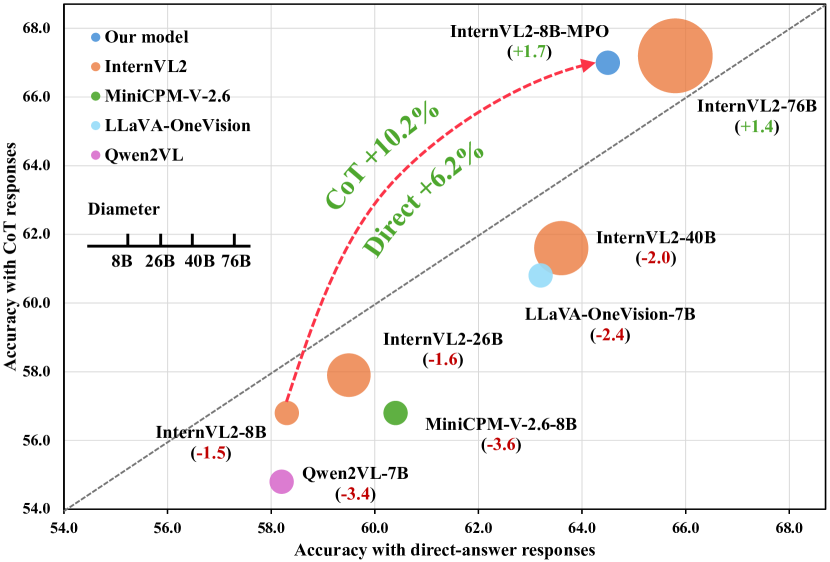
Existing open-source multimodal large language models (MLLMs) generally follow a training process involving pre-training and supervised fine-tuning. However, these models suffer from distribution shifts, which limit their multimodal reasoning, particularly in the Chain-of-Thought (CoT) performance. To address this, we introduce a preference optimization (PO) process to enhance the multimodal reasoning capabilities of MLLMs. Specifically, (1) on the data side, we design an automated preference data construction pipeline to create MMPR, a high-quality, large-scale multimodal reasoning preference dataset; and (2) on the model side, we explore integrating PO with MLLMs, developing a simple yet effective method, termed Mixed Preference Optimization (MPO), which boosts multimodal CoT performance. Our approach enhances the multimodal reasoning abilities of both InternVL2-8B and InternVL2-76B. Notably, our model, InternVL2-8B-MPO, achieves an accuracy of 67.0 on MathVista, outperforming InternVL2-8B by 8.7 points and achieving performance comparable to the 10$ imes$ larger InternVL2-76B. We hope this study could inspire further advancements in MLLMs. Code, data, and model are released.
Motivation & Objective
- To address the degradation in multimodal reasoning performance when using Chain-of-Thought (CoT) responses in open-source MLLMs.
- To overcome the distribution shift caused by supervised fine-tuning (SFT) that harms CoT reasoning due to teacher forcing during training.
- To develop a scalable, automated pipeline for constructing high-quality multimodal reasoning preference data without relying on costly human annotations.
- To design a preference optimization method that enhances both reasoning quality and instruction-following without requiring a reward model.
- To demonstrate that combining SFT with preference optimization significantly improves CoT reasoning, especially when using reference model constraints.
Proposed method
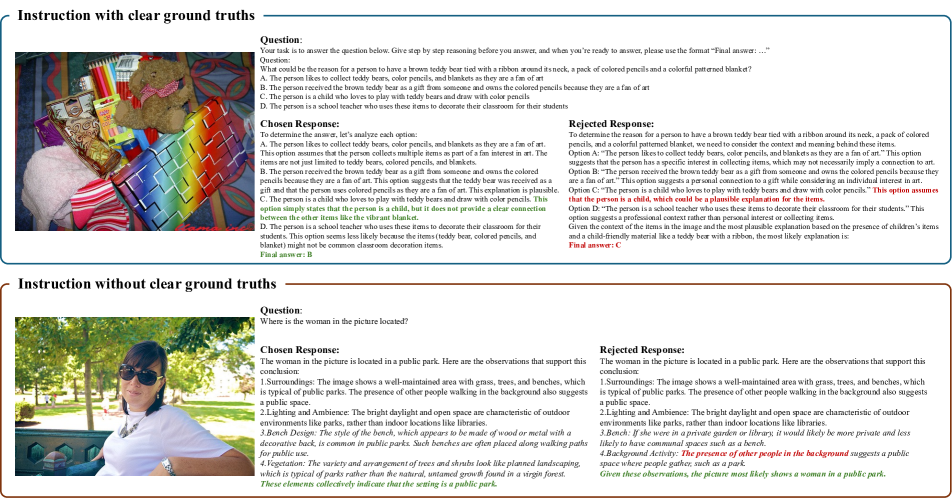
- Proposes an automated preference data construction pipeline that generates high-quality, large-scale multimodal reasoning preference data (MMPR) using LLMs as annotators.
- Introduces a continuation-based pipeline (DropoutNTP) for samples without clear ground truth, where truncated CoT responses are completed by the model to form rejected responses.
- Develops a correctness-based pipeline for samples with clear ground truth, sampling multiple solutions from the model and ranking them by correctness to form preference pairs.
- Designs Mixed Preference Optimization (MPO), a method that jointly optimizes for relative preference between response pairs and the absolute quality of individual responses using DPO and BCO losses.
- Employs a dual-loss strategy: DPO to learn preference rankings and BCO to improve absolute response quality, with a frozen reference model to prevent overfitting.
- Extends all PO methods with SFT loss to stabilize training and improve reasoning performance, showing that SFT is essential for effective CoT enhancement.
Experimental results
Research questions
- RQ1Can preference optimization effectively improve multimodal Chain-of-Thought reasoning in open-source MLLMs, despite distribution shift from SFT?
- RQ2How can high-quality multimodal reasoning preference data be constructed at scale without expensive human annotation?
- RQ3Does combining SFT with preference optimization lead to better CoT reasoning performance than SFT or PO alone?
- RQ4Which preference optimization algorithm—DPO, BCO, or their combination—yields the best reasoning performance when applied to multimodal reasoning tasks?
- RQ5To what extent does MPO improve not only multimodal reasoning but also text-only reasoning and instruction-following abilities?
Key findings
- InternVL2-8B-MPO achieves 67.0 accuracy on MathVista, an 8.7-point improvement over InternVL2-8B and performance comparable to the 10× larger InternVL2-76B.
- The model trained with MPO outperforms the SFT baseline by 5.2 points on TheoremQA and 4.1 points on IFEval, demonstrating improved text-only reasoning and instruction-following.
- All PO methods outperform SFT in both direct-answer and CoT settings, but only those combined with SFT loss significantly improve CoT reasoning performance.
- DPO and BCO variants combined in MPO yield the best CoT performance, with TR-DPO and ODPO performing worse due to unstable reference model updates or lack of reference model constraint.
- The use of a frozen reference model is critical for maintaining performance gains in CoT reasoning, as models with adaptive reference models (e.g., TR-DPO) degrade significantly.
- Despite no text-only data in MMPR, the MPO model generalizes to text-only benchmarks, showing that multimodal preference learning enhances broader language understanding.
Read this paper
Open the full text in the Nubint reader and ask about any passage as you read.
Read this paper on NubintThis review was generated by AI from the original paper. Please check the paper before citing it.