
[Paper Review] Ensemble Modeling for Time Series Forecasting: an Adaptive Robust Optimization Approach
This paper proposes an adaptive robust optimization (ARO) framework for time series forecasting ensembles, dynamically adjusting model weights in real time to improve accuracy and robustness. It achieves 16–26% lower RMSE and 14–28% lower CVaR than the best ensemble member in hindsight across real-world applications.
Accurate time series forecasting is critical for a wide range of problems with temporal data. Ensemble modeling is a well-established technique for leveraging multiple predictive models to increase accuracy and robustness, as the performance of a single predictor can be highly variable due to shifts in the underlying data distribution. This paper proposes a new methodology for building robust ensembles of time series forecasting models. Our approach utilizes Adaptive Robust Optimization (ARO) to construct a linear regression ensemble in which the models' weights can adapt over time. We demonstrate the effectiveness of our method through a series of synthetic experiments and real-world applications, including air pollution management, energy consumption forecasting, and tropical cyclone intensity forecasting. Our results show that our adaptive ensembles outperform the best ensemble member in hindsight by 16-26% in root mean square error and 14-28% in conditional value at risk and improve over competitive ensemble techniques.
Motivation & Objective
- Address the challenge of model drift in time series forecasting, where individual models degrade over time due to shifting data distributions.
- Improve forecasting robustness and accuracy by dynamically adjusting ensemble weights in response to new data and uncertainty.
- Develop a tractable, robust optimization framework that provides theoretical guarantees against worst-case errors.
- Demonstrate the method’s superiority over static and adaptive ensemble baselines in real-world forecasting tasks with high-stakes implications.
- Extend the approach to adaptive feature selection in multimodal time series applications, such as healthcare and climate modeling.
Proposed method
- Formulate the ensemble weighting problem as a multi-stage adaptive robust optimization (ARO) problem, where weights are updated at each time step based on revealed errors.
- Use an affine decision rule to parameterize the adaptive weights, transforming the non-convex min-max problem into a tractable second-order cone program (SOCP).
- Incorporate uncertainty sets around model prediction errors to ensure robustness against worst-case deviations.
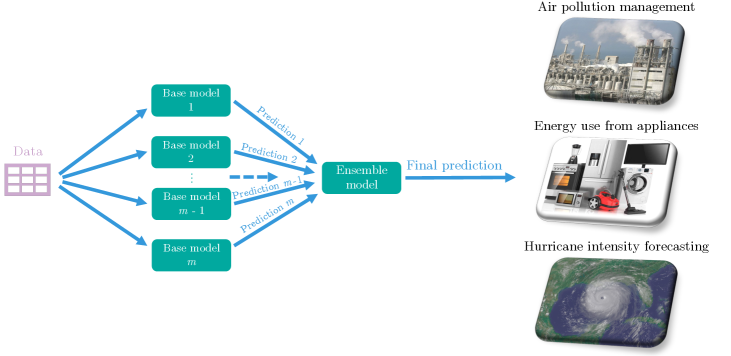
- Construct a linear regression ensemble where the final forecast is a weighted sum of base model predictions, with weights optimized via ARO.
- Apply equivalence theorems to reformulate the robust optimization problem into a convex, computationally efficient form for practical deployment.
- Integrate the method into real-world forecasting pipelines for energy, air quality, and tropical cyclone intensity prediction.
Experimental results
Research questions
- RQ1Can adaptive robust optimization improve the accuracy and robustness of time series forecasting ensembles compared to static or heuristic weighting schemes?
- RQ2How does the proposed ARO-based ensemble perform relative to the best individual model in hindsight across diverse real-world forecasting tasks?
- RQ3To what extent does the adaptive weighting mechanism mitigate the impact of model drift and reduce worst-case prediction errors?
- RQ4Can the ARO framework be extended to adaptive feature selection in multimodal time series data, such as in healthcare or climate applications?
- RQ5What is the impact of key hyperparameters (e.g., uncertainty set size, regularization) on the performance and stability of the adaptive ensemble?
Key findings
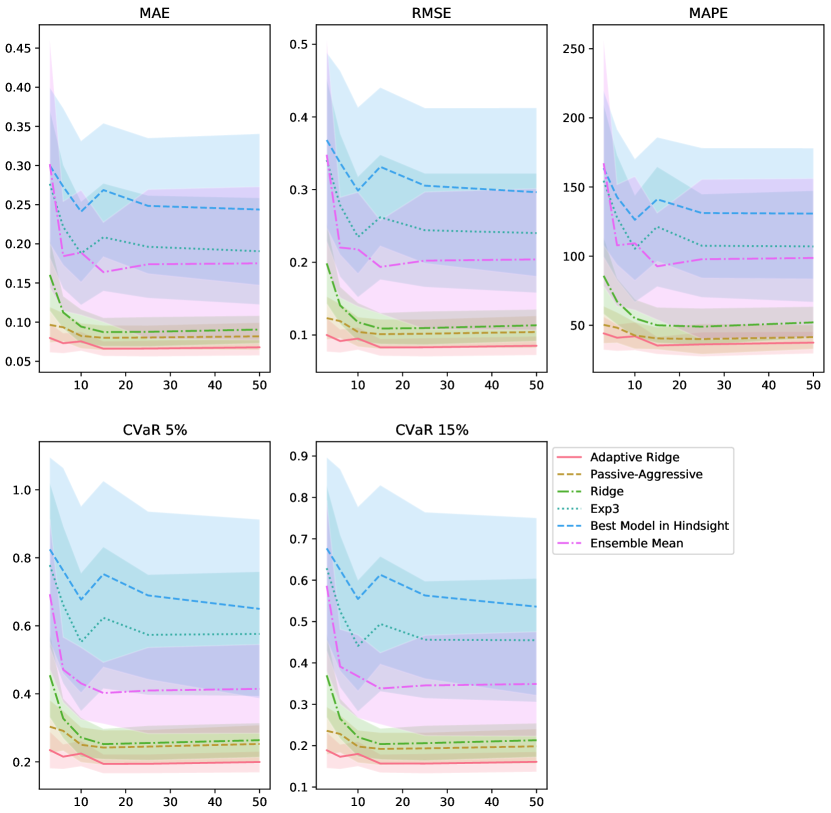
- The adaptive robust ensemble outperforms the best individual model in hindsight by 16–26% in root mean square error (RMSE) across all real-world forecasting tasks.
- The method reduces conditional value at risk (CVaR) by 14–28% compared to the best model in hindsight, indicating superior worst-case performance.
- Adaptive ridge regression, a variant of the proposed method, achieves 12% and 17% lower MAE than the official forecast (OFCL) in the North Atlantic and Eastern Pacific basins, respectively.
- The adaptive component provides a 4% MAE gain in the North Atlantic and 9% in the Eastern Pacific compared to static ridge regression.
- The method consistently outperforms standard ensembles like Ensemble Mean and Exp3, and matches or exceeds operational forecasts (FSSE, OFCL) in accuracy and robustness.
- Synthetic experiments confirm that the adaptive ensemble is resilient to model drift and maintains performance under varying uncertainty levels and data distributions.
Read this paper
Open the full text in the Nubint reader and ask about any passage as you read.
Read this paper on NubintThis review was generated by AI from the original paper. Please check the paper before citing it.