
[Paper Review] Environment Diversification with Multi-head Neural Network for Invariant Learning
This paper proposes EDNIL, a novel invariant learning framework that uses a multi-head neural network to automatically infer and diversify environments without requiring labeled environment data or strong assumptions about pre-trained models. By jointly optimizing environment inference and invariant representation learning, EDNIL achieves state-of-the-art robustness against distributional shifts, particularly improving performance on worst-case (misaligned) examples in bias-robustness benchmarks.
Neural networks are often trained with empirical risk minimization; however, it has been shown that a shift between training and testing distributions can cause unpredictable performance degradation. On this issue, a research direction, invariant learning, has been proposed to extract invariant features insensitive to the distributional changes. This work proposes EDNIL, an invariant learning framework containing a multi-head neural network to absorb data biases. We show that this framework does not require prior knowledge about environments or strong assumptions about the pre-trained model. We also reveal that the proposed algorithm has theoretical connections to recent studies discussing properties of variant and invariant features. Finally, we demonstrate that models trained with EDNIL are empirically more robust against distributional shifts.
Motivation & Objective
- To address the challenge of out-of-distribution generalization in machine learning, where training and test data distributions shift due to spurious correlations and biases.
- To eliminate reliance on manually labeled environment data, which is often unavailable or costly to obtain in real-world applications.
- To develop a joint optimization framework that simultaneously infers environments and learns invariant features, improving model robustness under distributional shifts.
- To provide a theoretically grounded, efficient, and initialization-insensitive method for invariant learning that works with diverse pre-trained models.
- To enhance fairness and reliability in real-world ML applications such as healthcare, autonomous driving, and social media by learning invariant predictors without access to sensitive attributes.
Proposed method
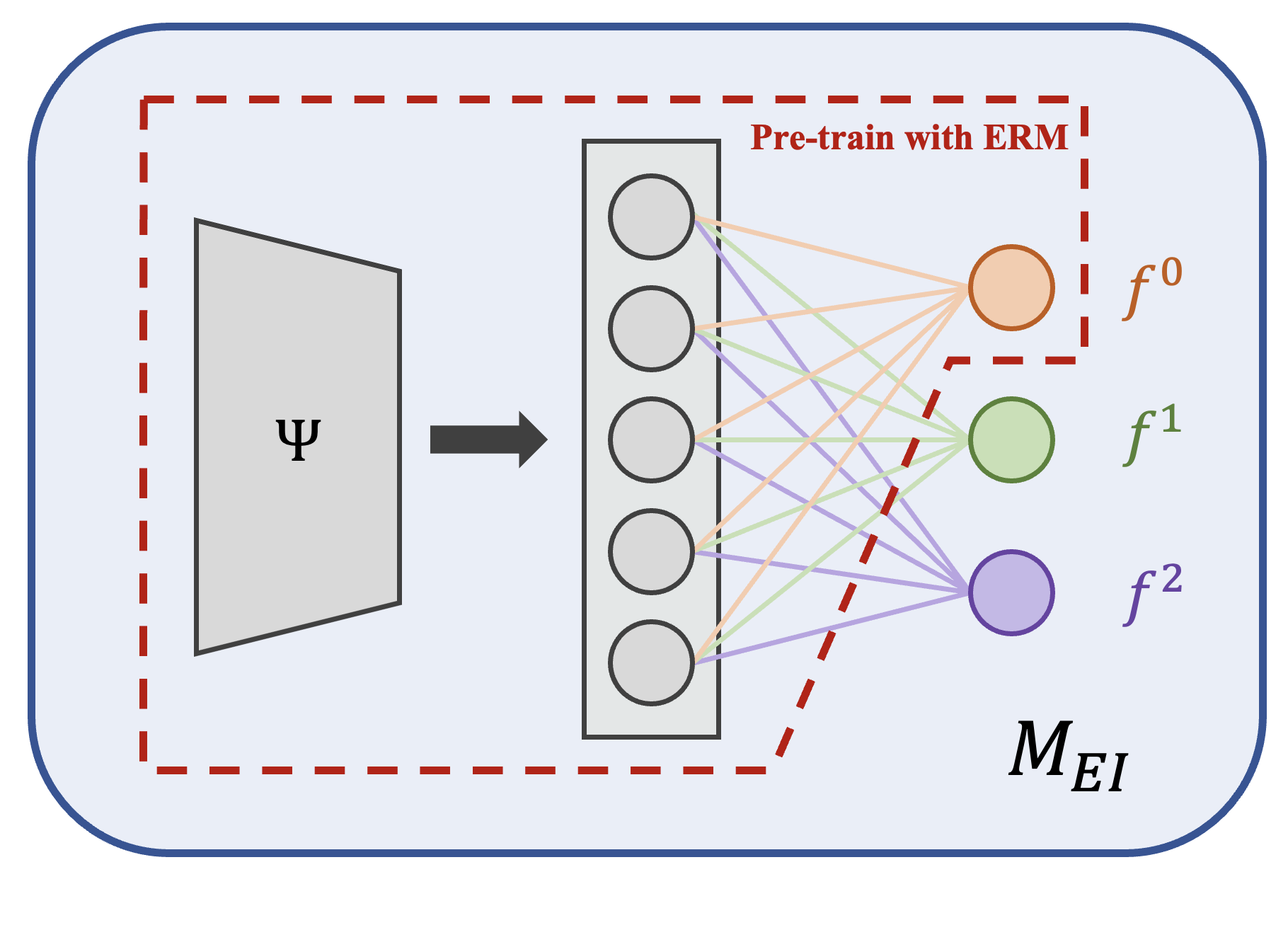
- EDNIL employs a multi-head neural network architecture where each head acts as a classifier for a distinct inferred environment, enabling automatic environment discovery without supervision.
- The framework jointly optimizes the environment inference heads and the main prediction head via a multi-task learning objective, promoting diversity among inferred environments.
- The method is functionally similar to a multi-class classifier, allowing efficient training and compatibility with off-the-shelf pre-trained models like ResNet and DistilBERT.
- It introduces a novel loss function that encourages invariant representations by penalizing model dependence on environment-specific (spurious) features.
- The architecture implicitly enforces diversity among inferred environments, aligning with theoretical findings on the benefits of diverse environments in invariant learning.
- The approach avoids strong assumptions about data or model initialization, making it robust to initialization choices and scalable to large datasets.

Experimental results
Research questions
- RQ1Can a multi-head neural network structure effectively infer and diversify environments in an unsupervised manner without requiring labeled environment data?
- RQ2How does joint optimization of environment inference and invariant learning improve robustness to distributional shifts compared to existing methods?
- RQ3To what extent can EDNIL outperform state-of-the-art invariant learning methods on worst-case (misaligned) examples in bias-robustness benchmarks?
- RQ4What is the theoretical connection between EDNIL’s learning objective and recent studies on ideal environments in invariant learning?
- RQ5Can EDNIL be effectively combined with diverse pre-trained models across different data types and bias strengths?
Key findings
- On the SNLI dataset, EDNIL achieved a worst-case (misaligned) accuracy of 54.5%, outperforming ERM (52.6%), EIIL (51.7%), and IRM (56.9%), demonstrating superior robustness to bias shifts.
- EDNIL consistently improved performance on the misaligned subset across multiple datasets and pre-trained models, indicating effective learning of invariant features.
- The method achieved state-of-the-art performance on the Adult-Confounded dataset, showing potential for fairer decision-making without access to sensitive attributes.
- EDNIL showed strong generalization across diverse data types and bias strengths, maintaining consistent improvements without requiring careful initialization or environment labeling.
- The framework’s theoretical connections to recent work on ideal environments suggest that its multi-head design naturally promotes the diversity of environments, which is crucial for invariant learning.
- EDNIL’s classifier-like structure enables efficient training and seamless integration with existing pre-trained models, enhancing practical applicability.
Read this paper
Open the full text in the Nubint reader and ask about any passage as you read.
Read this paper on NubintThis review was generated by AI from the original paper. Please check the paper before citing it.