
[Paper Review] Environmental Dependence of Type Ia Supernovae in Low-Redshift Galaxy Clusters
This study analyzes 102 Type Ia supernovae in low-redshift galaxy clusters using SALT3 light-curve fitting, revealing that inner-cluster SNe Ia have a significantly higher fraction of fast-evolving (low x₁) events—over 75%—compared to outer-cluster or field galaxies, suggesting intrinsic environmental differences beyond host-galaxy properties, with stellar population age likely driving this trend.
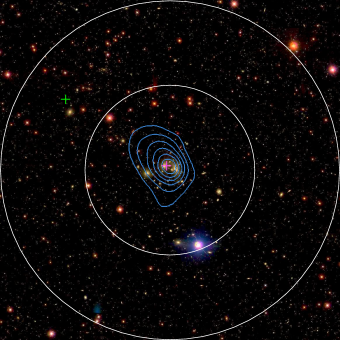
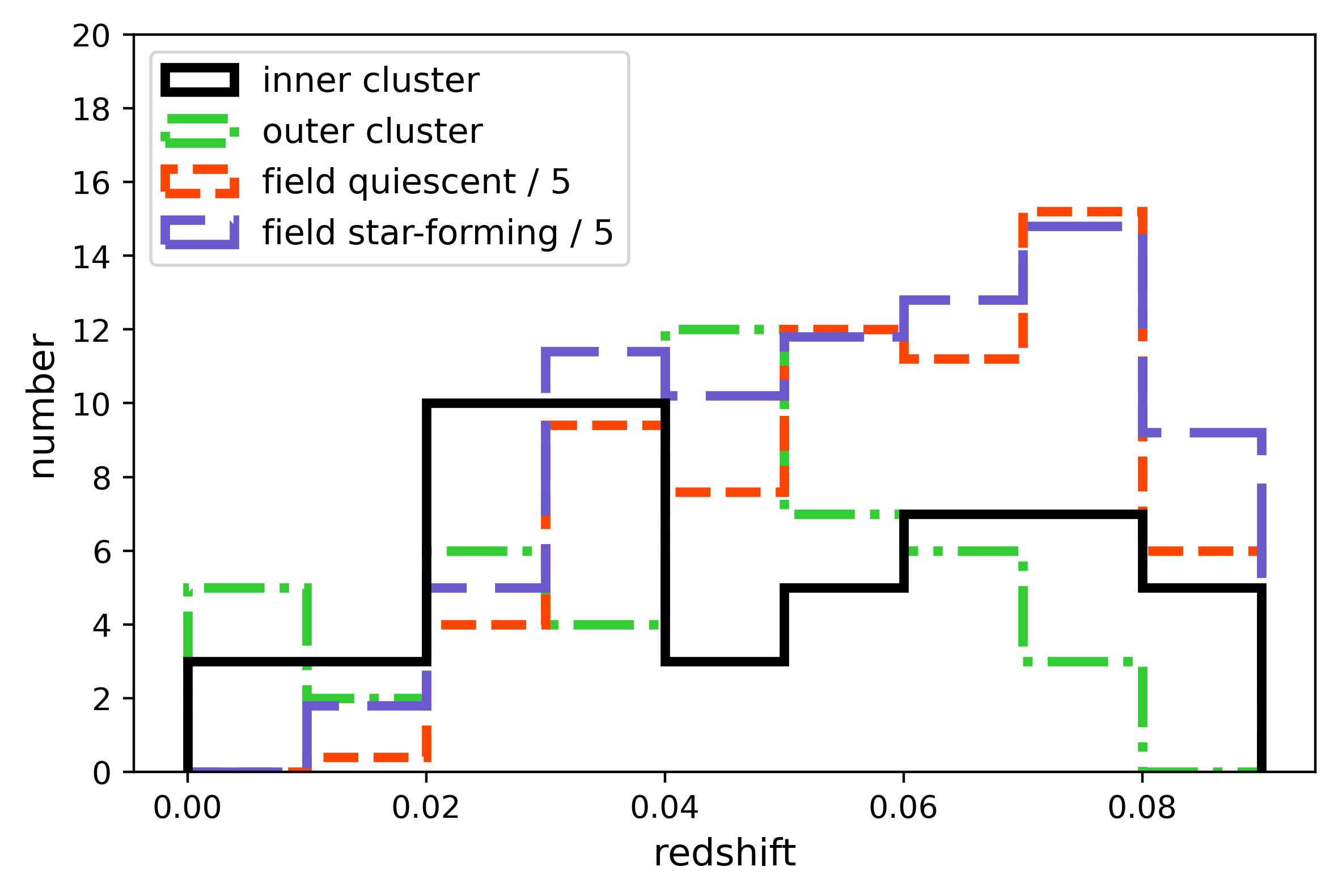
We present an analysis of 102 type Ia supernovae (SNe Ia) in nearby (z < 0.1), x-ray selected galaxy clusters. This is the largest such sample to date and is based on archival data primarily from ZTF and ATLAS. We divide our SNe Ia into an inner cluster sample projected within $r_{500}$ of the cluster center and an outer cluster sample projected between $r_{500}$ and $2\,r_{500}$. We compare these to field samples of SNe Ia at similar redshifts in both quiescent and star-forming host galaxies. Based on SALT3 fits to the light curves, we find that the inner cluster SNe Ia have a higher fraction of fast-evolving objects (SALT3 $x_1 < -1$) than the outer cluster or field quiescent samples. This implies an intrinsically different population of SNe Ia occurs in inner cluster environments, beyond known correlations based on host galaxy alone. Our cluster samples show a strongly bimodal $x_1$ distribution with a fast-evolving component that dominates the inner cluster objects ($\gtrsim$ 75%) but is just a small fraction of SNe Ia in field star-forming galaxies ($\lesssim$ 10%). We do not see strong evidence for variations in the color (SALT3 $c$) distributions among the samples and find only minor differences in SN Ia standardization parameters and Hubble residuals. We suggest that the age of the stellar population drives the observed distributions, with the oldest populations nearly exclusively producing fast-evolving SNe Ia.
Motivation & Objective
- To investigate whether Type Ia supernova (SN Ia) light-curve properties differ in dense cluster environments compared to field galaxies.
- To determine if environmental factors within galaxy clusters—beyond global host-galaxy properties—drive variations in SN Ia light curves.
- To assess whether the observed differences in SN Ia populations affect standardization parameters or Hubble residuals.
- To explore the role of stellar population age as a potential causal factor behind environmental dependencies in SN Ia properties.
Proposed method
- Used archival optical photometry from ZTF and ATLAS to construct a sample of 102 SNe Ia in x-ray-selected, low-redshift (z < 0.1) galaxy clusters.
- Classified SNe Ia into inner-cluster (r/r₅₀₀ < 1) and outer-cluster (1 ≤ r/r₅₀₀ < 2) samples based on projected distance from cluster center.
- Fitted light curves using the SALT3 model to derive x₁ (light-curve shape), c (color), and standardization parameters (α, β, M_B, σ_int).
- Compared distributions of x₁, c, and Hubble residuals across inner-cluster, outer-cluster, and field quiescent/star-forming host samples.
- Employed statistical analysis to assess significance of differences in x₁ and c distributions, and tested for correlations with host environment.
- Used Jupyter, Astropy, NumPy, and emcee for data processing, modeling, and posterior sampling to quantify uncertainties.
Experimental results
Research questions
- RQ1Do Type Ia supernovae in the inner regions of galaxy clusters exhibit different light-curve shape distributions compared to those in outer regions or in field galaxies?
- RQ2Is the observed environmental dependence in SN Ia properties explainable by host-galaxy type alone, or are cluster-specific effects present?
- RQ3Does the stellar population age in cluster environments drive the observed differences in SN Ia light-curve properties?
- RQ4Are there significant differences in SN Ia standardization parameters or Hubble residuals between cluster and field SN Ia samples?
- RQ5Can the bimodal x₁ distribution in inner-cluster SNe Ia be attributed to a distinct progenitor population linked to old stellar populations?
Key findings
- The inner-cluster SN Ia sample has a markedly higher fraction of fast-evolving SNe Ia (x₁ < -1) than the outer-cluster or field quiescent samples, with over 75% of inner-cluster SNe Ia falling into this category.
- The outer-cluster and field quiescent SN Ia samples show a much lower fraction of fast-evolving SNe Ia, consistent with a bimodal x₁ distribution dominated by slow-evolving events.
- Field star-forming SN Ia samples have less than 10% fast-evolving SNe Ia, indicating a stark contrast with the inner-cluster population.
- No strong differences were found in the color (SALT3 c) distributions across the cluster and field samples, suggesting color is not a primary driver of the observed x₁ differences.
- Standardization parameters (α, β, M_B) and intrinsic scatter (σ_int) show only minor differences between samples, with Hubble residual scatter slightly higher in the inner-cluster sample.
- The results suggest that the age of the stellar population is the most direct explanatory factor, with the oldest populations producing nearly exclusively fast-evolving SNe Ia.
Read this paper
Open the full text in the Nubint reader and ask about any passage as you read.
Read this paper on NubintThis review was generated by AI from the original paper. Please check the paper before citing it.