
[Paper Review] EPiC-ly Fast Particle Cloud Generation with Flow-Matching and Diffusion
The paper introduces two permutation-equivariant jet cloud generators, EPiC-JeDi (score-based diffusion) and EPiC-FM (flow-matching CNF), achieving state-of-the-art fidelity on JetNet top-jet datasets with fast generation. It also analyzes unconditional vs conditional generation and links diffusion and flow-based viewpoints within a unified continuous-time framework.
Jets at the LHC, typically consisting of a large number of highly correlated particles, are a fascinating laboratory for deep generative modeling. In this paper, we present two novel methods that generate LHC jets as point clouds efficiently and accurately. We introduce \epcjedi, which combines score-matching diffusion models with the Equivariant Point Cloud (EPiC) architecture based on the deep sets framework. This model offers a much faster alternative to previous transformer-based diffusion models without reducing the quality of the generated jets. In addition, we introduce \epcfm, the first permutation equivariant continuous normalizing flow (CNF) for particle cloud generation. This model is trained with {\it flow-matching}, a scalable and easy-to-train objective based on optimal transport that directly regresses the vector fields connecting the Gaussian noise prior to the data distribution. Our experiments demonstrate that \epcjedi and \epcfm both achieve state-of-the-art performance on the top-quark JetNet datasets whilst maintaining fast generation speed. Most notably, we find that the \epcfm model consistently outperforms all the other generative models considered here across every metric. Finally, we also introduce two new particle cloud performance metrics: the first based on the Kullback-Leibler divergence between feature distributions, the second is the negative log-posterior of a multi-model ParticleNet classifier.
Motivation & Objective
- Enhance jet cloud generation by exploiting permutation-equivariant architectures for fast, scalable sampling.
- Show that diffusion-based and flow-based continuous-time models can be unified under a single framework for jet generation.
- Benchmark against existing models on JetNet top-jet datasets to establish fidelity and speed gains.
- Investigate conditional versus unconditional generation and the impact of jet-level conditioning on performance.
Proposed method
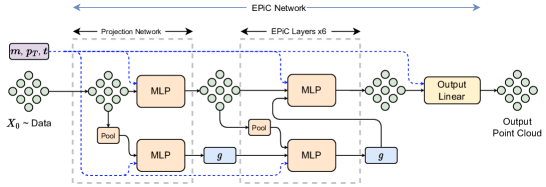
- Combine EPiC layers with score-matching diffusion for EPiC-JeDi to obtain fast, accurate jet clouds.
- Introduce EPiC-FM, the first permutation-equivariant CNF trained with flow-matching for straight, optimal-transport-like trajectories.
- Use an EPiC Network architecture with conditional information concatenated to every MLP input for both models.
- Represent jets as point clouds with relative hadronic coordinates and condition generation on jet-level observables such as pT and mass when needed.
- Employ a conditional normalizing flow (NormFlows) to generate joint jet properties like mass, pT, and constituent multiplicity for conditional setups.
- Discuss sampling options (ODE-based deterministic sampling and SDE-based stochastic sampling) and relate flow-matching to score-based objectives.
Experimental results
Research questions
- RQ1Can EPiC-JeDi (diffusion-based) and EPiC-FM (flow-matching CNF) achieve state-of-the-art fidelity for top-jet generation while maintaining fast sampling speeds?
- RQ2How do conditional and unconditional generation compare in terms of fidelity and efficiency for permutation-equivariant jet cloud models?
- RQ3What is the impact of using flow-matching versus score-matching objectives on training stability and sampling efficiency in this jet-physics setting?
- RQ4Do the proposed models generalize across different JetNet top-jet configurations (e.g., varying constituent counts) and conditioning schemes?
Key findings
- EPiC-FM consistently delivers superior fidelity across evaluated metrics compared to other models.
- Conditional EPiC-FM achieves the highest generative fidelity among the tested configurations.
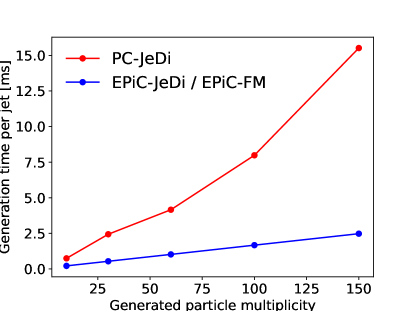
- EPiC-JeDi provides competitive performance with faster sampling than transformer-based diffusion models.
- Both EPiC-JeDi and EPiC-FM show strong performance on top-jet generation, with EPiC-FM often outperforming other baselines on multiple metrics.
- The study introduces two new particle cloud metrics: KL-divergence-based feature distributions and a multi-model NLP-based classifier benchmark.
Read this paper
Open the full text in the Nubint reader and ask about any passage as you read.
Read this paper on NubintThis review was generated by AI from the original paper. Please check the paper before citing it.