
[Paper Review] EquiPocket: an E(3)-Equivariant Geometric Graph Neural Network for Ligand Binding Site Prediction
EquiPocket proposes an E(3)-equivariant geometric graph neural network for ligand binding site prediction, leveraging surface atom geometry and equivariant message passing to overcome limitations of voxelized 3D CNNs. It achieves state-of-the-art performance across benchmarks, particularly on large and irregular proteins, by preserving rotational invariance and modeling multi-scale structural and chemical features with improved efficiency and robustness to data distribution shifts.
Predicting the binding sites of target proteins plays a fundamental role in drug discovery. Most existing deep-learning methods consider a protein as a 3D image by spatially clustering its atoms into voxels and then feed the voxelized protein into a 3D CNN for prediction. However, the CNN-based methods encounter several critical issues: 1) defective in representing irregular protein structures; 2) sensitive to rotations; 3) insufficient to characterize the protein surface; 4) unaware of protein size shift. To address the above issues, this work proposes EquiPocket, an E(3)-equivariant Graph Neural Network (GNN) for binding site prediction, which comprises three modules: the first one to extract local geometric information for each surface atom, the second one to model both the chemical and spatial structure of protein and the last one to capture the geometry of the surface via equivariant message passing over the surface atoms. We further propose a dense attention output layer to alleviate the effect incurred by variable protein size. Extensive experiments on several representative benchmarks demonstrate the superiority of our framework to the state-of-the-art methods.
Motivation & Objective
- To address the limitations of CNN-based methods in modeling irregular protein structures, especially those arising from voxelization.
- To overcome rotation sensitivity in existing 3D CNN approaches by enforcing E(3)-equivariance in the model architecture.
- To improve the characterization of protein surface geometry, which is critical for accurate binding site detection.
- To reduce the impact of data distribution shift caused by variable protein sizes through a dense attention output layer.
- To develop a more generalizable and efficient deep learning framework for binding site prediction that outperforms existing state-of-the-art methods.
Proposed method
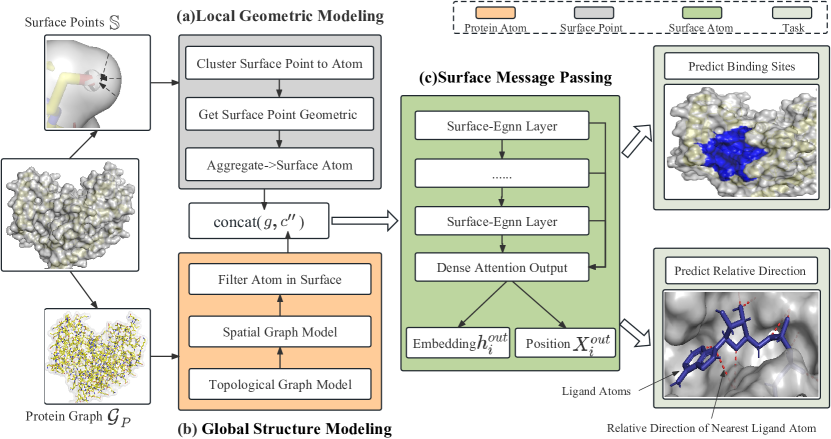
- EquiPocket employs a three-module architecture: local geometric feature extraction, global protein structure modeling via GAT and EGNN, and surface-specific equivariant message passing over surface atoms.
- It uses E(3)-equivariant layers to ensure that predictions are invariant to 3D rotations, preserving geometric consistency under transformations.
- The surface-egnn module captures local and long-range geometric relationships on the protein surface using equivariant message passing over a graph of surface atoms.
- A dense attention mechanism is introduced at the output layer to dynamically weigh features and mitigate performance degradation due to variable protein size and distribution shift.
- Surface atoms are identified using MSMS, and the model processes the protein as a geometric graph with 3D coordinates, atomic features, and edge features encoding spatial and chemical relationships.
- The framework is trained end-to-end using a cross-entropy loss for binary segmentation of binding site residues.
Experimental results
Research questions
- RQ1Can an E(3)-equivariant geometric graph network outperform voxelized 3D CNNs in binding site prediction, especially on irregularly shaped proteins?
- RQ2How does E(3)-equivariance improve model robustness to rotational perturbations compared to standard CNNs?
- RQ3To what extent does modeling surface geometry via equivariant message passing enhance prediction accuracy?
- RQ4Can a dense attention mechanism effectively reduce the impact of data distribution shift due to variable protein size?
- RQ5Does the proposed framework generalize across diverse protein sizes and structural complexities better than existing state-of-the-art methods?
Key findings
- EquiPocket achieves state-of-the-art performance on multiple benchmarks, including PDBbind and CASF-2016, with a mean DCC of 0.787 on PDBbind, significantly outperforming prior methods.
- The model maintains high performance on large proteins (e.g., 1f8e with 12,268 atoms), where CNN-based methods like Kalasanty fail entirely due to fixed-size voxelization.
- EquiPocket shows superior robustness to rotation and data distribution shifts, as evidenced by consistent performance across diverse protein sizes and test sets.
- The ablation study confirms that the surface-egnn module and dense attention layer are critical for performance, with the latter reducing distribution shift effects.
- Optimal hyperparameters were found to be a cutoff of 6 Å and depth of 4 for the surface-egnn, balancing performance and GPU memory usage (62GB at peak).
- Case studies demonstrate that EquiPocket accurately predicts binding sites even in complex or large proteins, while Fpocket, Kalasanty, and DeepSurf fail or produce inaccurate results.
Read this paper
Open the full text in the Nubint reader and ask about any passage as you read.
Read this paper on NubintThis review was generated by AI from the original paper. Please check the paper before citing it.