
[Paper Review] Escaping limit cycles: Global convergence for constrained nonconvex-nonconcave minimax problems
This paper proposes CurvatureEG+, an adaptive extragradient-type algorithm for constrained nonconvex-nonconcave minimax problems that achieves global convergence even when existing methods converge to limit cycles. By introducing an adaptive stepsize and relaxing the weak Minty variational inequality (MVI) condition to $2\rho + \gamma_k > 0$, the method extends convergence guarantees to a broader class of problems, including the challenging 'Forsaken' counterexample where prior algorithms fail.
This paper introduces a new extragradient-type algorithm for a class of nonconvex-nonconcave minimax problems. It is well-known that finding a local solution for general minimax problems is computationally intractable. This observation has recently motivated the study of structures sufficient for convergence of first order methods in the more general setting of variational inequalities when the so-called weak Minty variational inequality (MVI) holds. This problem class captures non-trivial structures as we demonstrate with examples, for which a large family of existing algorithms provably converge to limit cycles. Our results require a less restrictive parameter range in the weak MVI compared to what is previously known, thus extending the applicability of our scheme. The proposed algorithm is applicable to constrained and regularized problems, and involves an adaptive stepsize allowing for potentially larger stepsizes. Our scheme also converges globally even in settings where the underlying operator exhibits limit cycles.
Motivation & Objective
- To address the global convergence failure of first-order methods in nonconvex-nonconcave minimax problems, where algorithms often cycle or diverge.
- To extend the applicability of extragradient-type methods beyond the convex-concave regime to nonmonotone variational inequalities.
- To overcome limitations of prior methods like (EG+) and (CEG+) by allowing larger stepsizes and broader parameter ranges under the weak MVI condition.
- To provide a unified framework that recovers known methods such as FBF and (EG+) under specific parameter choices.
- To establish tight convergence guarantees by proving a matching lower bound, completing the theoretical picture under weak MVI.
Proposed method
- Proposes CurvatureEG+, an adaptive extragradient algorithm that dynamically adjusts the extrapolation stepsize $\gamma_k$ via backtracking line search.
- Introduces a novel convergence condition: $2\rho + \gamma_k > 0$, which allows larger stepsizes and extends the range of feasible $\rho$ values.
- Employs a linesearch initialized from the Jacobian of the operator $F$ to ensure convergence without infinite backtracking.
- Derives a non-adaptive variant, CEG+, which recovers the forward-backward-forward (FBF) and (EG+) methods as special cases.
- Analyzes the weak MVI condition with a parameter $\rho$ controlling nonconvexity, and shows that convergence holds as long as $2\rho + \gamma_k > 0$.
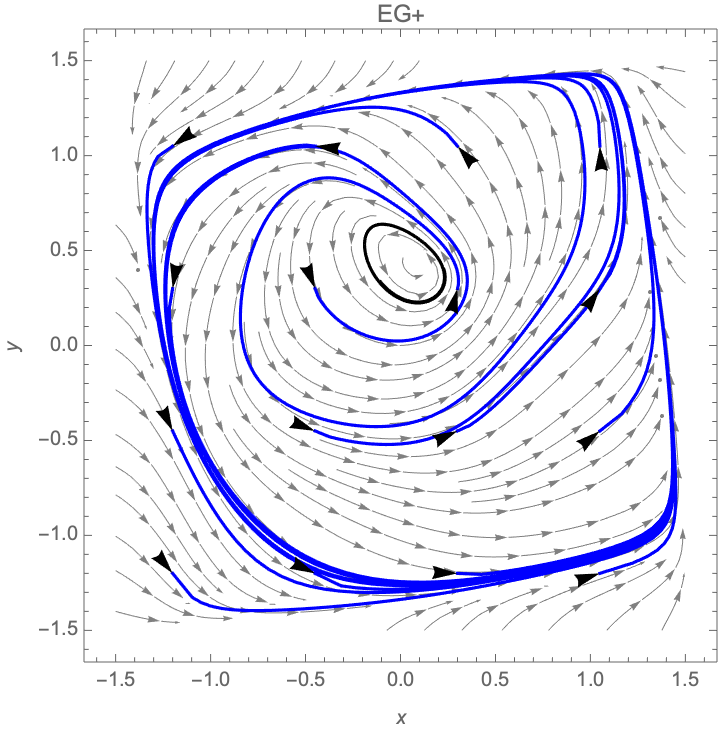
- Uses polar coordinate transformation and Poincaré-Bendixson theorem to prove existence of attracting and repelling limit cycles in the 'Forsaken' example.
Experimental results
Research questions
- RQ1Can we design an adaptive extragradient algorithm that converges globally in nonconvex-nonconcave minimax problems where existing methods cycle?
- RQ2What is the minimal condition on the weak Minty variational inequality (MVI) parameter $\rho$ and stepsize $\gamma_k$ that ensures convergence?
- RQ3Does the proposed method recover known algorithms like FBF and (EG+) as special cases under appropriate parameter settings?
- RQ4Can the algorithm escape limit cycles in problems where (EG+) and (CEG+) fail, such as the 'Forsaken' example?
- RQ5Is the convergence condition $2\rho + \gamma_k > 0$ tight, and can it be matched by a lower bound?
Key findings
- The proposed CurvatureEG+ algorithm converges globally to a stationary point in the 'Forsaken' example, where (EG+) and (CEG+) converge to an attracting limit cycle.
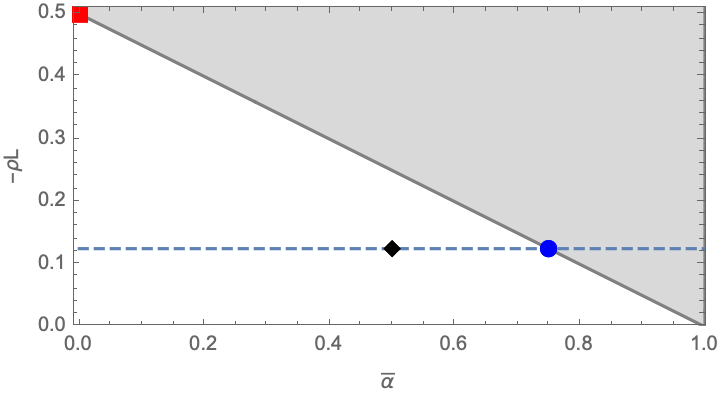
- The method achieves convergence for $\rho < -1/(2L)$, which violates the prior convergence condition $\rho > -1/(2L)$, thus extending the problem class beyond previous work.
- The Lipschitz constant $L$ of the operator $F$ in the 'Forsaken' example is computed as $L \approx 0.0402$, yielding $-1/(2L) \approx -0.04$, while the actual $\rho$ is found to be $\rho \approx -0.477761$, confirming the violation of prior assumptions.
- The algorithm's adaptive stepsize selection ensures convergence without infinite backtracking when initialized from the Jacobian of $F$, enabling practical implementation.
- The non-adaptive variant CEG+ recovers the FBF and (EG+) methods when $\rho = 0$, unifying these approaches under a single framework.
- A matching lower bound is established, proving that the condition $2\rho + \gamma_k > 0$ is tight, thus completing the theoretical characterization of convergence under weak MVI.
Read this paper
Open the full text in the Nubint reader and ask about any passage as you read.
Read this paper on NubintThis review was generated by AI from the original paper. Please check the paper before citing it.