
[Paper Review] Escaping the sentence-level paradigm in machine translation
The paper argues for document-level translation using standard Transformer models with high capacity, training on document-level samples from backtranslated data, and new generative evaluation metrics to assess document-context performance.
It is well-known that document context is vital for resolving a range of translation ambiguities, and in fact the document setting is the most natural setting for nearly all translation. It is therefore unfortunate that machine translation -- both research and production -- largely remains stuck in a decades-old sentence-level translation paradigm. It is also an increasingly glaring problem in light of competitive pressure from large language models, which are natively document-based. Much work in document-context machine translation exists, but for various reasons has been unable to catch hold. This paper suggests a path out of this rut by addressing three impediments at once: what architectures should we use? where do we get document-level information for training them? and how do we know whether they are any good? In contrast to work on specialized architectures, we show that the standard Transformer architecture is sufficient, provided it has enough capacity. Next, we address the training data issue by taking document samples from back-translated data only, where the data is not only more readily available, but is also of higher quality compared to parallel document data, which may contain machine translation output. Finally, we propose generative variants of existing contrastive metrics that are better able to discriminate among document systems. Results in four large-data language pairs (DE$ ightarrow$EN, EN$ ightarrow$DE, EN$ ightarrow$FR, and EN$ ightarrow$RU) establish the success of these three pieces together in improving document-level performance.
Motivation & Objective
- Argue that document context is crucial for resolving translation ambiguities and should move beyond sentence-level translation.
- Show that a standard Transformer with sufficient capacity can handle document-level translation.
- Demonstrate that document samples from backtranslated data are effective training material, while pure parallel document data can be harmful.
- Propose generative variants of contrastive evaluation to better assess document-level MT performance.
Proposed method
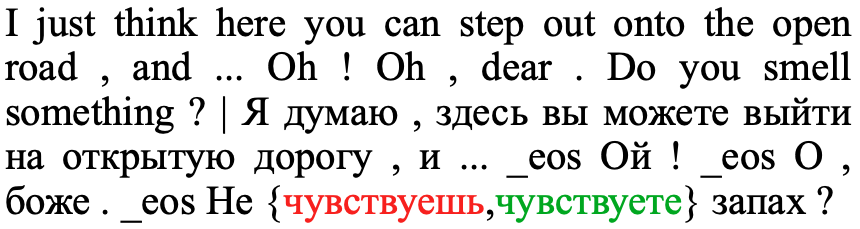
- Use a concatenative document-to-document training approach: concatenate adjacent sentences into pseudo-documents with a <sep> separator.
- Train standard Transformer models (12-layer encoder, 6-layer decoder) on mixed pools of parallel and backtranslated data with document-aware sampling.
- Evaluate with both contrastive and generative document-level test sets, plus standard sentence-level metrics (BLEU, COMET).
- Introduce generative variants of contrastive metrics (GenPro, ContraGen) to better capture document-level generation quality.
- Inspect analyses comparing document-context training from backtranslated data vs parallel data, and examine pronoun/gender-disambiguation phenomena.

Experimental results
Research questions
- RQ1Does document-level translation improve over sentence-level baselines when using standard Transformer architectures with sufficient capacity?
- RQ2Can document-level training data be effectively sourced from backtranslated monolingual data, and is parallel document data necessary or beneficial?
- RQ3Do contrastive document-level metrics align with generative capabilities of document-aware MT systems, and can they be improved with generative variants?
Key findings
- Document-level translation improves over sentence-level baselines when enough model capacity is provided.
- Training with document samples from backtranslated data is effective and often preferable to using parallel document data alone.
- Contrastive document-level metrics can indicate improvements, but generative metrics reveal clearer gains for document-context models, especially for pronoun/discourse phenomena.
- When evaluated on four language pairs, document-context models show consistent gains in document-level evaluation, while sentence-level metrics show varying or limited gains for context usage.
- Force-decoding target context and generative evaluation variants help distinguish between models with genuine document-generation ability vs. discriminative capabilities.
Read this paper
Open the full text in the Nubint reader and ask about any passage as you read.
Read this paper on NubintThis review was generated by AI from the original paper. Please check the paper before citing it.