
[Paper Review] EspalomaCharge: Machine learning-enabled ultra-fast partial charge assignment
EspalomaCharge uses a hybrid graph neural network and charge equilibration to predict AM1-BCC ELF10-like partial charges with O(N) scaling, enabling fast, conformer-independent charging for small molecules and biopolymers. It matches reference accuracy and integrates as drop-in replacements in common workflows.
Atomic partial charges are crucial parameters in molecular dynamics (MD) simulation, dictating the electrostatic contributions to intermolecular energies, and thereby the potential energy landscape. Traditionally, the assignment of partial charges has relied on surrogates of extit{ab initio} semiempirical quantum chemical methods such as AM1-BCC, and is expensive for large systems or large numbers of molecules. We propose a hybrid physical / graph neural network-based approximation to the widely popular AM1-BCC charge model that is orders of magnitude faster while maintaining accuracy comparable to differences in AM1-BCC implementations. Our hybrid approach couples a graph neural network to a streamlined charge equilibration approach in order to predict molecule-specific atomic electronegativity and hardness parameters, followed by analytical determination of optimal charge-equilibrated parameters that preserves total molecular charge. This hybrid approach scales linearly with the number of atoms, enabling, for the first time, the use of fully consistent charge models for small molecules and biopolymers for the construction of next-generation self-consistent biomolecular force fields. Implemented in the free and open source package exttt{espaloma\_charge}, this approach provides drop-in replacements for both AmberTools exttt{antechamber} and the Open Force Field Toolkit charging workflows, in addition to stand-alone charge generation interfaces. Source code is available at \url{https://github.com/choderalab/espaloma_charge}.
Motivation & Objective
- Develop a fast, accurate partial charge assignment method that is conformer-independent and scalable to large biomolecules.
- Leverage a graph neural network to predict atom-level electronegativity and hardness parameters for charge equilibration.
- Ensure the predicted charges sum to the total molecular charge (Q) via an analytical constrained solution.
- Provide easy integration with existing molecular mechanics workflows (AmberTools, Open Force Field Toolkit).
- Demonstrate that the method achieves AM1-BCC ELF10-quality charges at a fraction of the cost of QM-based approaches.
Proposed method
- Construct a graph neural network to produce continuous embeddings of atomic environments (Espaloma framework).
- Predict unconstrained electronegativity e_i and hardness s_i for each atom from GNN embeddings.
- Solve analytically for charges q_i by minimizing sum_i (e_i q_i + 0.5 s_i q_i^2) with the constraint sum_i q_i = Q (total molecular charge).
- Train on expanded SPICE dataset to reproduce AM1-BCC ELF10 charges with squared loss.
- Demonstrate O(N) runtime complexity and ability to batch-process large molecule sets.
- Provide Python API and CLI for integration with OpenFF Toolkit and Amber workflows.

Experimental results
Research questions
- RQ1How accurately can a ML surrogate reproduce AM1-BCC ELF10 charges across diverse chemical spaces?
- RQ2What is the computational scaling and speed of EspalomaCharge compared with AmberTools and OpenEye for large systems?
- RQ3Does EspalomaCharge generalize to biomolecules and drug-like compounds outside training distribution?
- RQ4Can EspalomaCharge deliver charges in a drop-in fashion within existing MM/MD workflows?
Key findings
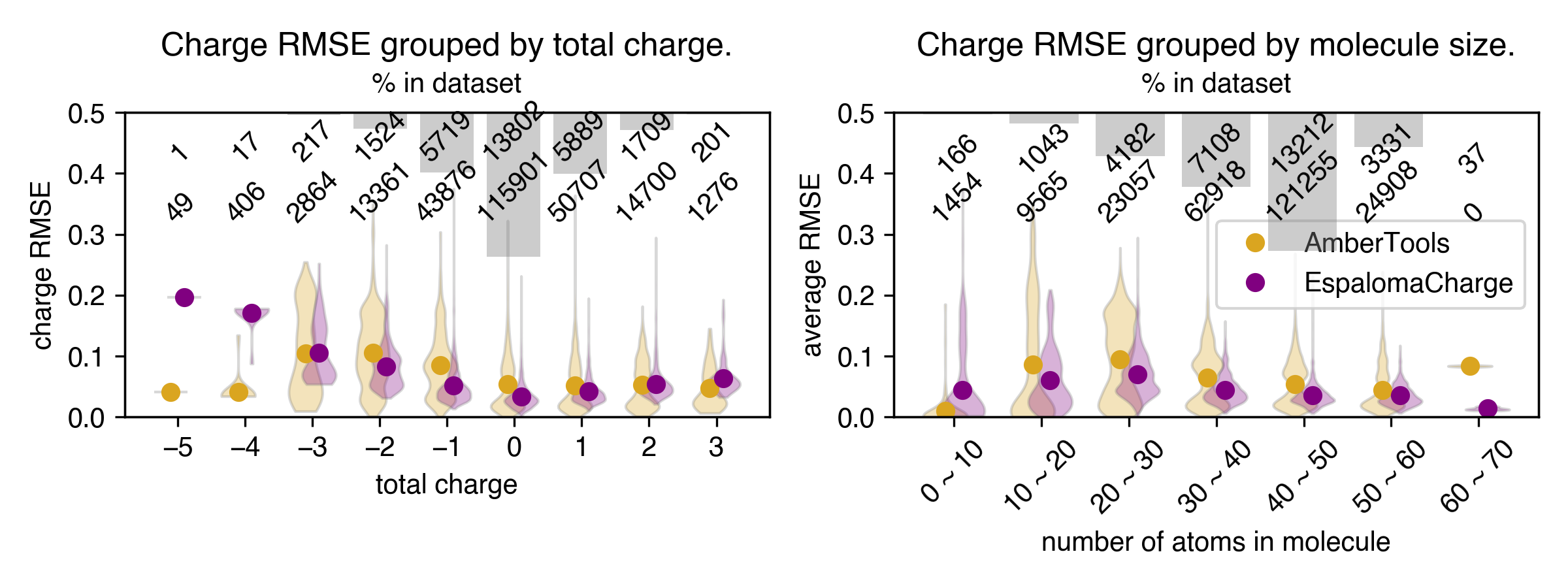
- EspalomaCharge reproduces AM1-BCC ELF10 charges with RMSE comparable to differences among AM1-BCC implementations (and often comparable to AmberTools vs OpenEye).
- On the SPICE test set, RMSE ≈ 0.0435 and walltime ≈ 93.10 s (EspalomaCharge) vs faster baselines, with OpenEye and AmberTools showing higher times in various contexts.
- Across multiple datasets (FDA-approved, ZINC250K, FreeSolv, PDB eXpo), EspalomaCharge achieves RMSE values in the 0.0110–0.0266 range, indicating robust accuracy across chemical spaces.
- EspalomaCharge runs in linear time with respect to atom count (O(N)) and is orders of magnitude faster than QM-based charging methods, enabling parameterization of biopolymers (hundreds of residues) in seconds.
- Batching many molecules in a single charge calculation yields substantial speed gains on CPU/GPU, approaching near-constant time for practical library sizes.
- Hydration free energy calculations using EspalomaCharge charges are statistically indistinguishable from AmberTools and OpenEye implementations in RMSE and R^2 compared to experiment.
Read this paper
Open the full text in the Nubint reader and ask about any passage as you read.
Read this paper on NubintThis review was generated by AI from the original paper. Please check the paper before citing it.