
[Paper Review] Estimate Deformation Capacity of Non-Ductile RC Shear Walls using Explainable Boosting Machine
This study develops a fully explainable machine learning model using Explainable Boosting Machines (EBM) to predict the deformation capacity of non-ductile RC shear walls with high accuracy and transparency. The model achieves an R² of 0.92 and a predicted-to-actual ratio of 1.05, offering reliable, interpretable predictions that align with physical behavior and outperform black-box models in both accuracy and interpretability.
Machine learning is becoming increasingly prevalent for tackling challenges in earthquake engineering and providing fairly reliable and accurate predictions. However, it is mostly unclear how decisions are made because machine learning models are generally highly sophisticated, resulting in opaque black-box models. Machine learning models that are naturally interpretable and provide their own decision explanation, rather than using an explanatory, are more accurate in determining what the model actually computes. With this motivation, this study aims to develop a fully explainable machine learning model to predict the deformation capacity of non-ductile reinforced concrete shear walls based on experimental data collected worldwide. The proposed Explainable Boosting Machines (EBM)-based model is an interpretable, robust, naturally explainable glass-box model, yet provides high accuracy comparable to its black-box counterparts. The model enables the user to observe the relationship between the wall properties and the deformation capacity by quantifying the individual contribution of each wall property as well as the correlations among them. The mean coefficient of determination R2 and the mean ratio of predicted to actual value based on the test dataset are 0.92 and 1.05, respectively. The proposed predictive model stands out with its overall consistency with scientific knowledge, practicality, and interpretability without sacrificing high accuracy.
Motivation & Objective
- Address the lack of reliable, interpretable models for predicting deformation capacity in non-ductile RC shear walls.
- Overcome the limitations of black-box machine learning models in earthquake engineering by ensuring model transparency and physical consistency.
- Develop a glass-box model that enables engineers to understand and validate the decision-making process behind deformation capacity predictions.
- Improve seismic performance assessment by replacing over-conservative code provisions with data-driven, accurate, and explainable predictions.
- Demonstrate that high accuracy can be achieved without sacrificing interpretability, enabling practical adoption in design and retrofitting.
Proposed method
- Utilize Explainable Boosting Machines (EBM), a glass-box, additive model that provides inherently interpretable predictions through individual feature contribution terms.
- Train the EBM model on a global dataset of experimental non-ductile RC shear wall tests, using wall properties as inputs and ultimate displacement as the output.
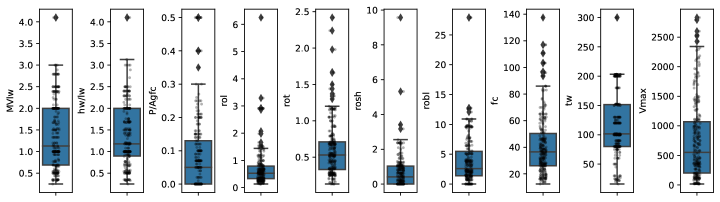
- Apply feature selection to identify the most influential parameters, including wall aspect ratio (M/Vl_w), thickness (t_w), axial load ratio (P/A_g f_c), and maximum shear force (V_max).
- Evaluate model performance using ten random train-test splits, computing R², relative error (RE), and prediction accuracy (PA) to ensure robustness.
- Compare EBM performance against black-box models (XGBoost, Gradient Boost, Random Forest) and glass-box models (Decision Tree, Ridge Linear Regression) using standardized metrics.
- Validate model interpretability by analyzing individual term contributions and detecting unexpected relationships (e.g., V_max having a positive impact in low-prediction cases), ensuring alignment with physical understanding.
Experimental results
Research questions
- RQ1Can an explainable machine learning model achieve high predictive accuracy for the deformation capacity of non-ductile RC shear walls while maintaining full interpretability?
- RQ2Which wall properties most significantly influence deformation capacity, and how do they contribute individually and interactively?
- RQ3How does the performance of the EBM model compare to black-box and glass-box models in terms of accuracy, robustness, and consistency with physical behavior?
- RQ4To what extent can the model be simplified by selecting only the most relevant features without sacrificing predictive power?
- RQ5Can the model’s predictions be trusted and validated by engineers due to transparent decision-making, reducing reliance on post-hoc explanation tools?
Key findings
- The EBM model achieves a mean coefficient of determination (R²) of 0.92 and a predicted-to-actual ratio of 1.05 on the test dataset, indicating high accuracy and minimal bias.
- The most influential predictors of deformation capacity are wall thickness (t_w), moment-to-shear ratio (M/Vl_w), axial load ratio (P/A_g f_c), and maximum shear force (V_max), with curvature type and concrete compressive strength being least relevant.
- The model maintains high performance even when reduced to only four key input variables, achieving R² = 0.92 and PA = 1.05, demonstrating practicality and low computational cost.
- EBM outperforms both black-box models (XGBoost, Gradient Boost, Random Forest) and glass-box models (Decision Tree, Ridge Linear Regression) across all performance metrics, with lower dispersion and greater robustness.
- The model’s predictions are physically consistent overall, with detectable exceptions (e.g., V_max having a positive effect in low-prediction cases) that can be meaningfully interpreted and validated by engineers.
- Unlike black-box models, the EBM does not require post-hoc explanation tools like SHAP or LIME, eliminating approximation errors and enabling direct, exact intelligibility of model decisions.

Read this paper
Open the full text in the Nubint reader and ask about any passage as you read.
Read this paper on NubintThis review was generated by AI from the original paper. Please check the paper before citing it.