
[Paper Review] Estimation of Conditional Average Treatment Effects with High-Dimensional Data
This paper proposes a two-stage machine learning approach to estimate the conditional average treatment effect (CATE) in high-dimensional settings under unconfoundedness. It uses high-dimensional nuisance function estimation via machine learning followed by low-dimensional local linear regression to produce a reduced-dimensional CATE function, with theoretical guarantees and uniform inference via multiplier bootstrap, demonstrating robust performance in simulations and empirical application to maternal smoking effects on birth weight.
Given the unconfoundedness assumption, we propose new nonparametric estimators for the reduced dimensional conditional average treatment effect (CATE) function. In the first stage, the nuisance functions necessary for identifying CATE are estimated by machine learning methods, allowing the number of covariates to be comparable to or larger than the sample size. The second stage consists of a low-dimensional local linear regression, reducing CATE to a function of the covariate(s) of interest. We consider two variants of the estimator depending on whether the nuisance functions are estimated over the full sample or over a hold-out sample. Building on Belloni at al. (2017) and Chernozhukov et al. (2018), we derive functional limit theory for the estimators and provide an easy-to-implement procedure for uniform inference based on the multiplier bootstrap. The empirical application revisits the effect of maternal smoking on a baby's birth weight as a function of the mother's age.
Motivation & Objective
- To address the challenge of estimating heterogeneous treatment effects when the number of covariates is large relative to sample size.
- To develop a nonparametric estimator for the conditional average treatment effect (CATE) that reduces high-dimensional covariates to a manageable function of the covariate(s) of interest.
- To ensure valid uniform inference for the CATE function despite high-dimensional nuisance parameters.
- To compare performance of full-sample and cross-fitting estimators under varying data dimensions and sparsity.
- To provide a practical, implementable procedure for constructing uniform confidence bands for the CATE function.
Proposed method
- First stage: Estimate high-dimensional nuisance functions (e.g., outcome and propensity score regressions) using machine learning methods, such as Lasso or other regularized estimators, to handle high-dimensional covariates.
- Second stage: Perform low-dimensional local linear regression on the estimated nuisance functions to obtain a reduced-dimensional CATE function of the variable(s) of interest.
- Two variants are proposed: one using the full sample for both stages, and another using cross-fitting (sample splitting) to reduce bias and improve inference.
- Theoretical framework builds on Belloni et al. (2017) and Chernozhukov et al. (2018), establishing functional limit theory for the estimators.
- Uniform inference is enabled via a multiplier bootstrap procedure to construct valid confidence bands for the entire CATE function.
- The method is robust to model misspecification through double robustness and handles both strict and approximate sparsity in high-dimensional data.
Experimental results
Research questions
- RQ1How can we consistently estimate the conditional average treatment effect (CATE) when the number of covariates is large or even larger than the sample size?
- RQ2What is the impact of using machine learning for nuisance function estimation on the finite-sample performance of CATE estimators in high-dimensional settings?
- RQ3How does cross-fitting improve the finite-sample properties and validity of uniform inference for the CATE function compared to full-sample estimation?
- RQ4To what extent do the proposed estimators maintain correct coverage for uniform confidence bands under varying degrees of sparsity and data dimensionality?
- RQ5How does the proposed method compare to existing double-robust approaches in terms of empirical coverage and critical value estimation?
Key findings
- The cross-fitting estimator achieves empirical coverage close to nominal levels (e.g., 95% and 99%) across all simulation designs, even with p=30 and N=500.
- The full-sample estimator shows slightly lower empirical coverage in high-dimensional settings (p=30, N=500), particularly at 90% confidence level, but remains close to nominal levels.
- The multiplier bootstrap procedure provides accurate critical values for uniform confidence bands, with mean critical values close to theoretical quantiles and low standard deviation of critical values.
- The Gumbel approximation for critical values performs well in high-dimensional settings, with coverage probabilities near 1.000 in most cases.
- The double-robust method (LOW) exhibits severe size distortions in high-dimensional models, with empirical coverage dropping to 0.014 at 99% confidence when p=30 and N=2000.
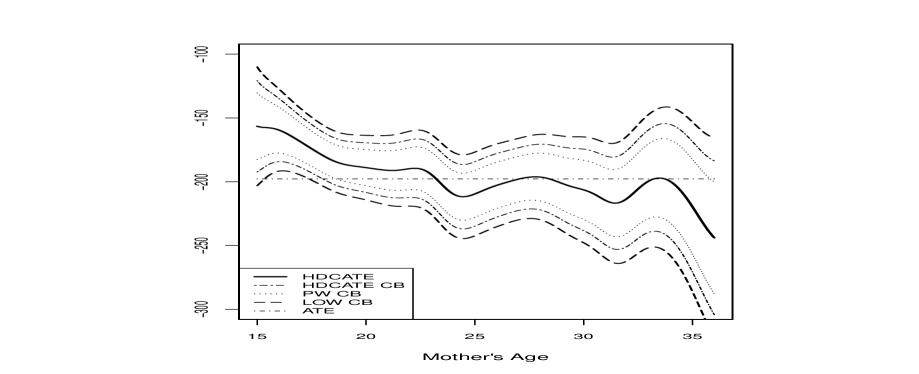
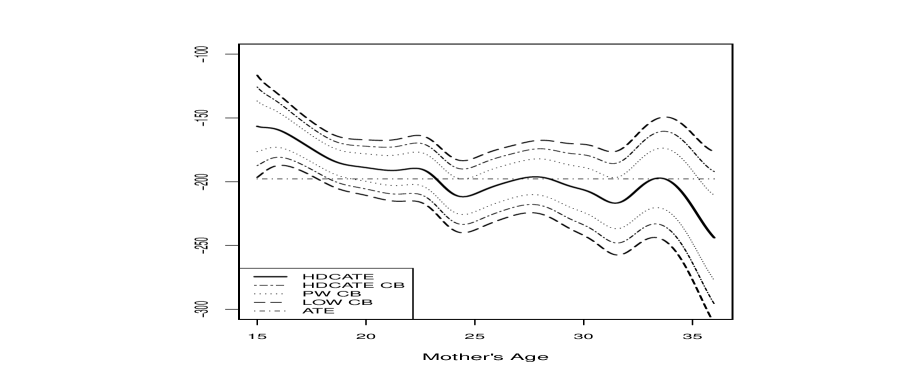
- Empirical application to maternal smoking and birth weight shows the method produces interpretable, smooth CATE curves that vary meaningfully with mother’s age, supporting the method’s practical utility.
Read this paper
Open the full text in the Nubint reader and ask about any passage as you read.
Read this paper on NubintThis review was generated by AI from the original paper. Please check the paper before citing it.