
[Paper Review] Ethical ChatGPT: Concerns, Challenges, and Commandments
The paper surveys ethical concerns and challenges of ChatGPT, and proposes stakeholder-specific commandments to guide responsible use and governance of large language models.
Large language models, e.g. ChatGPT are currently contributing enormously to make artificial intelligence even more popular, especially among the general population. However, such chatbot models were developed as tools to support natural language communication between humans. Problematically, it is very much a ``statistical correlation machine" (correlation instead of causality) and there are indeed ethical concerns associated with the use of AI language models such as ChatGPT, such as Bias, Privacy, and Abuse. This paper highlights specific ethical concerns on ChatGPT and articulates key challenges when ChatGPT is used in various applications. Practical commandments for different stakeholders of ChatGPT are also proposed that can serve as checklist guidelines for those applying ChatGPT in their applications. These commandment examples are expected to motivate the ethical use of ChatGPT.
Motivation & Objective
- Identify and categorize ethical concerns surrounding ChatGPT and large language models.
- Analyse challenges arising from ChatGPT's deployment across domains.
- Propose practical commandments for researchers, users, regulators, and ethicists to guide responsible use.
Proposed method
- Literature synthesis of ethical risks associated with LLMs and ChatGPT.
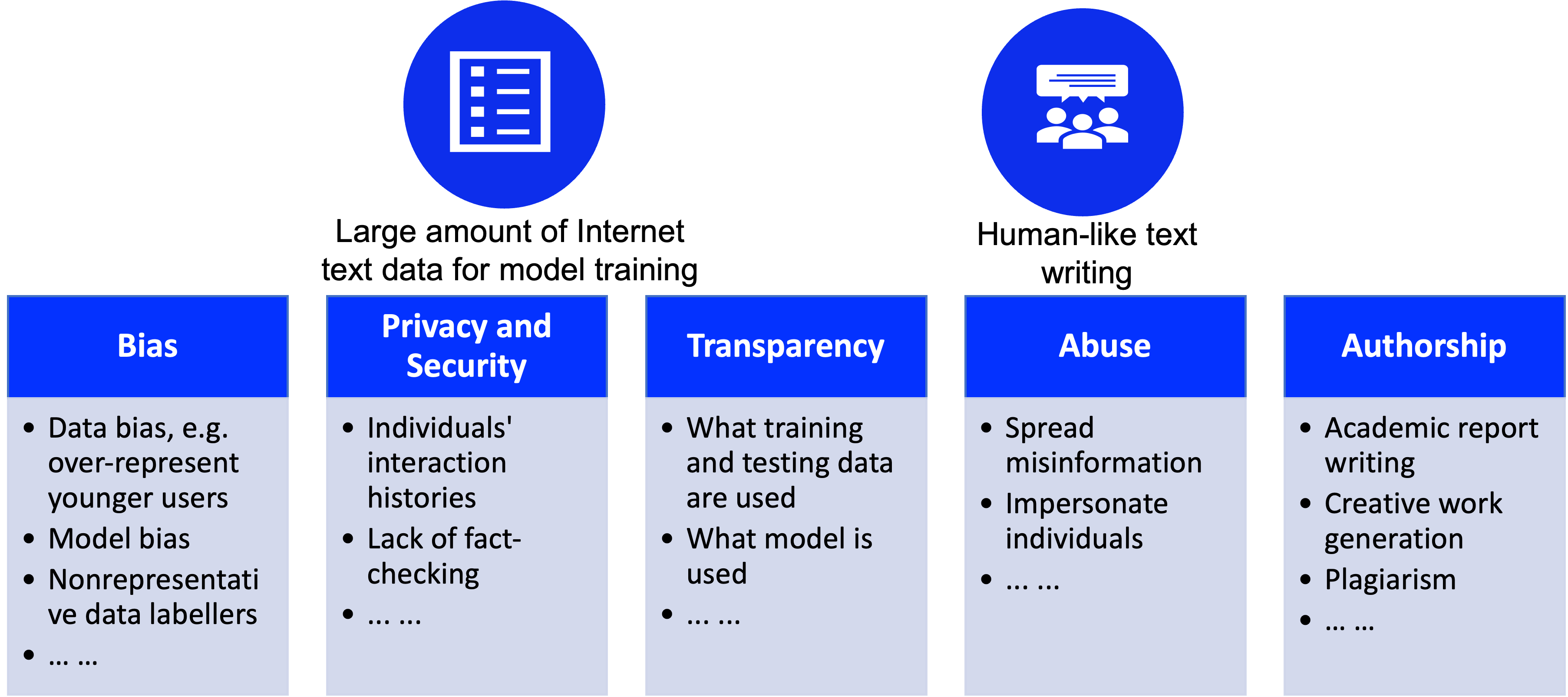
- Critical discussion of bias, privacy, information hazards, misinformation, abuse, transparency, and accountability.
- Articulation of stakeholder-specific commandments as practical guidelines.
Experimental results
Research questions
- RQ1What ethical concerns are salient for ChatGPT and similar LLMs?
- RQ2What key challenges arise when deploying ChatGPT in various applications?
- RQ3What practical commandments can guide different stakeholders toward responsible use of ChatGPT?
Key findings
- Bias and information integrity issues stem from training data and labeling practices.
- Privacy and security risks arise from user input and potential leakage through fine-tuning.
- Transparency is limited due to opaque model internals and randomness in responses.
- Abuse, including misinformation and impersonation, poses real threats to trust and safety.
- The paper proposes stakeholder-specific commandments to promote responsible use and calls for future work on fact-checking and justification of responses.
![Figure 2: Two main steps in building ChatGPT (adapted from [ 4 ] )](https://ar5iv.labs.arxiv.org/html/2305.10646/assets/chatgpt-phases.png)
Better researchstarts right now
From reading papers to final review, dramatically reduce your research time.
No credit card · Free plan available
This review was created by AI and reviewed by human editors.