
[Paper Review] eVAE: Evolutionary Variational Autoencoder
eVAE proposes a novel evolutionary variational autoencoder that integrates variational genetic algorithms into VAEs to dynamically balance reconstruction and representation learning without hyperparameter tuning. By employing variational mutation, simulated binary crossover, and inner-outer-joint training, eVAE mitigates KL vanishing, improves disentanglement, and achieves superior image generation and reconstruction quality compared to state-of-the-art methods.
The surrogate loss of variational autoencoders (VAEs) poses various challenges to their training, inducing the imbalance between task fitting and representation inference. To avert this, the existing strategies for VAEs focus on adjusting the tradeoff by introducing hyperparameters, deriving a tighter bound under some mild assumptions, or decomposing the loss components per certain neural settings. VAEs still suffer from uncertain tradeoff learning.We propose a novel evolutionary variational autoencoder (eVAE) building on the variational information bottleneck (VIB) theory and integrative evolutionary neural learning. eVAE integrates a variational genetic algorithm into VAE with variational evolutionary operators including variational mutation, crossover, and evolution. Its inner-outer-joint training mechanism synergistically and dynamically generates and updates the uncertain tradeoff learning in the evidence lower bound (ELBO) without additional constraints. Apart from learning a lossy compression and representation of data under the VIB assumption, eVAE presents an evolutionary paradigm to tune critical factors of VAEs and deep neural networks and addresses the premature convergence and random search problem by integrating evolutionary optimization into deep learning. Experiments show that eVAE addresses the KL-vanishing problem for text generation with low reconstruction loss, generates all disentangled factors with sharp images, and improves the image generation quality,respectively. eVAE achieves better reconstruction loss, disentanglement, and generation-inference balance than its competitors.
Motivation & Objective
- Address the dynamic tradeoff between representation compression and task fitting in VAEs, which remains unstable under varying data and network settings.
- Overcome limitations of existing VAE methods that rely on fixed hyperparameters or constrained architectures to balance reconstruction and inference.
- Develop a self-tuning mechanism that adapts the ELBO tradeoff in real time using evolutionary operators, avoiding manual tuning and premature convergence.
- Integrate variational information bottleneck theory with evolutionary learning to enable robust, adaptive optimization in deep generative models.
- Improve generation-inference balance and representation quality in VAEs through probabilistic, evolutionary search in latent space.
Proposed method
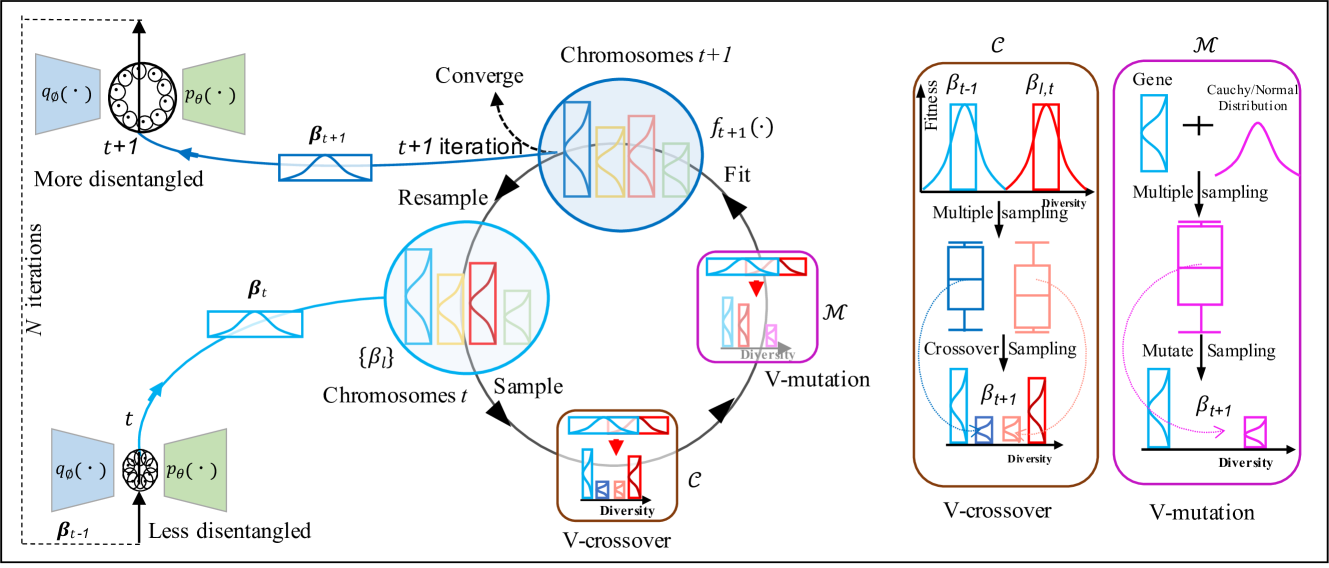
- Introduce a variational genetic algorithm (VGA) that evolves hyperparameters within the VAE's evidence lower bound (ELBO) objective using probabilistic chromosome representation.
- Design a Cauchy-based variational mutation operator to enable stable, non-uniform exploration of the hyperparameter space and avoid random search.
- Implement a simulated binary crossover (SBX) operator to combine promising hyperparameter configurations and accelerate convergence.
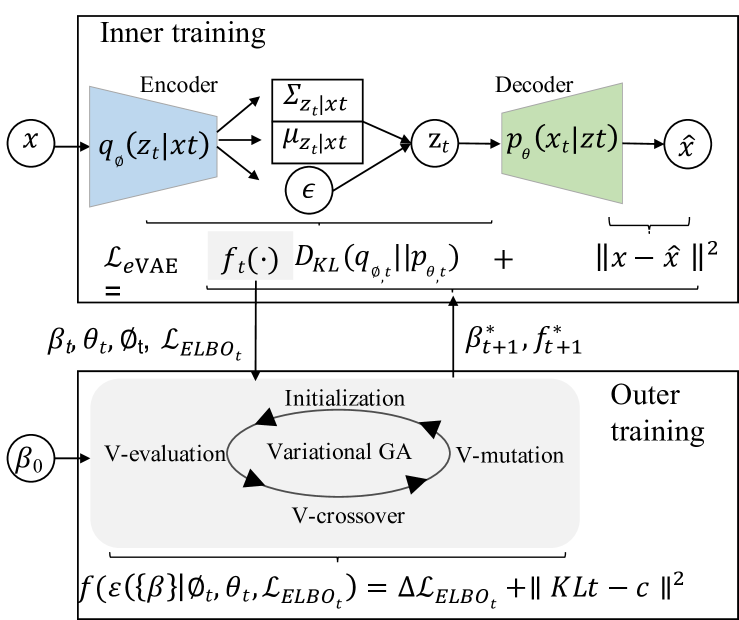
- Develop an inner-outer-joint training mechanism that alternately optimizes the VAE’s generative model and the evolutionary search for optimal tradeoff parameters.
- Apply variational inference under the information bottleneck framework to ensure that the latent representation balances compression and reconstruction fidelity.
- Use probabilistic chromosome selection to maintain diversity and prevent premature convergence during evolutionary optimization of the VAE objective.
Experimental results
Research questions
- RQ1Can evolutionary optimization dynamically balance the reconstruction and representation learning tradeoff in VAEs without fixed hyperparameters?
- RQ2How does integrating variational genetic algorithms improve the stability and performance of VAEs in handling KL vanishing and mode collapse?
- RQ3To what extent can evolutionary operators like SBX and Cauchy mutation enhance disentanglement and generation quality in VAEs?
- RQ4Does the inner-outer-joint training mechanism in eVAE outperform standard VAE training and existing annealing or control-based methods in terms of reconstruction and disentanglement?
- RQ5Can eVAE generalize across diverse data types and architectures without architectural or hyperparameter constraints?
Key findings
- eVAE achieves significantly lower reconstruction loss than baseline VAEs, including β-VAE, InfoVAE, and ControlVAE, across multiple datasets.
- The model generates sharper, more disentangled images by effectively balancing the KL divergence and reconstruction terms through evolutionary tuning.
- eVAE mitigates the KL-vanishing problem in text generation by dynamically adjusting the tradeoff, resulting in improved likelihood and generation diversity.
- The inner-outer-joint training mechanism enables stable convergence and avoids premature convergence, as evidenced by consistent performance across training runs.
- eVAE outperforms state-of-the-art methods in both disentanglement and generation-inference balance, as measured by standard metrics like MIG and FID.
- The integration of SBX and Cauchy mutation leads to more efficient search in hyperparameter space, reducing reliance on random or heuristic tuning.
Read this paper
Open the full text in the Nubint reader and ask about any passage as you read.
Read this paper on NubintThis review was generated by AI from the original paper. Please check the paper before citing it.