
[Paper Review] Evaluating ChatGPT as a Question Answering System: A Comprehensive Analysis and Comparison with Existing Models
This paper evaluates ChatGPT as a Question Answering System (QAS) using SQuAD, NewsQA, and PersianQuAD datasets in English and Persian. It finds that while ChatGPT performs well on simple factual questions, it underperforms compared to task-specific models, especially on complex 'how' and 'why' questions, and exhibits significant hallucination when answers are not in context, though performance improves with prompt engineering and provided context.
In the current era, a multitude of language models has emerged to cater to user inquiries. Notably, the GPT-3.5 Turbo language model has gained substantial attention as the underlying technology for ChatGPT. Leveraging extensive parameters, this model adeptly responds to a wide range of questions. However, due to its reliance on internal knowledge, the accuracy of responses may not be absolute. This article scrutinizes ChatGPT as a Question Answering System (QAS), comparing its performance to other existing QASs. The primary focus is on evaluating ChatGPT's proficiency in extracting responses from provided paragraphs, a core QAS capability. Additionally, performance comparisons are made in scenarios without a surrounding passage. Multiple experiments, exploring response hallucination and considering question complexity, were conducted on ChatGPT. Evaluation employed well-known Question Answering (QA) datasets, including SQuAD, NewsQA, and PersianQuAD, across English and Persian languages. Metrics such as F-score, exact match, and accuracy were employed in the assessment. The study reveals that, while ChatGPT demonstrates competence as a generative model, it is less effective in question answering compared to task-specific models. Providing context improves its performance, and prompt engineering enhances precision, particularly for questions lacking explicit answers in provided paragraphs. ChatGPT excels at simpler factual questions compared to "how" and "why" question types. The evaluation highlights occurrences of hallucinations, where ChatGPT provides responses to questions without available answers in the provided context.
Motivation & Objective
- To assess ChatGPT’s effectiveness as a Question Answering System (QAS) in extracting answers from provided context paragraphs.
- To compare ChatGPT’s performance against task-specific question answering models in both factual and non-factual question types.
- To investigate the impact of context, prompt engineering, and question complexity on response accuracy and hallucination rates.
- To evaluate hallucination prevalence in ChatGPT when answering questions without available answers in the provided context.
- To analyze performance across multilingual datasets, including English (SQuAD, NewsQA) and Persian (PersianQuAD), using standard QA metrics.
Proposed method
- Evaluated ChatGPT using standard Question Answering (QA) datasets: SQuAD 1.1, SQuAD 2.0, NewsQA, and PersianQuAD.
- Applied standard evaluation metrics: F1 score, Exact Match (EM), and recall to measure answer accuracy and span precision.
- Conducted experiments in two settings: with and without context paragraphs to assess context dependency.
- Used Jaccard similarity between questions and answers to quantify question difficulty and analyze performance across similarity levels.
- Implemented two-step prompt engineering to improve precision, especially for questions lacking explicit answers in context.
- Analyzed response patterns across question types, including factoid (factual) and non-factoid (inference-based) questions.

Experimental results
Research questions
- RQ1How does ChatGPT’s performance in question answering compare to task-specific models when context is provided?
- RQ2To what extent does providing a context paragraph improve ChatGPT’s answer accuracy and reduce hallucination?
- RQ3How does question complexity—measured via Jaccard similarity between question and answer—impact ChatGPT’s F1 score across different datasets?
- RQ4What is the rate of hallucination in ChatGPT when answering questions without available answers in the provided context?
- RQ5How does performance vary between simple factual questions and complex 'how' and 'why' questions?
Key findings
- ChatGPT achieved a peak F1 score of 0.83 on SQuAD 1.1 for questions with a Jaccard similarity of 0.5, indicating optimal performance at moderate complexity.
- On SQuAD 2.0, ChatGPT reached a maximum F1 score of 0.78 at a Jaccard similarity of 0.3, suggesting stronger performance on less similar, more complex questions.
- In the PersianQuAD dataset, ChatGPT achieved a peak F1 score of 0.78 for questions with a Jaccard similarity of 0.09, indicating capability on low-similarity, complex queries.
- On NewsQA, F1 scores showed periodic behavior with increasing difficulty, indicating no monotonic relationship between difficulty and performance.
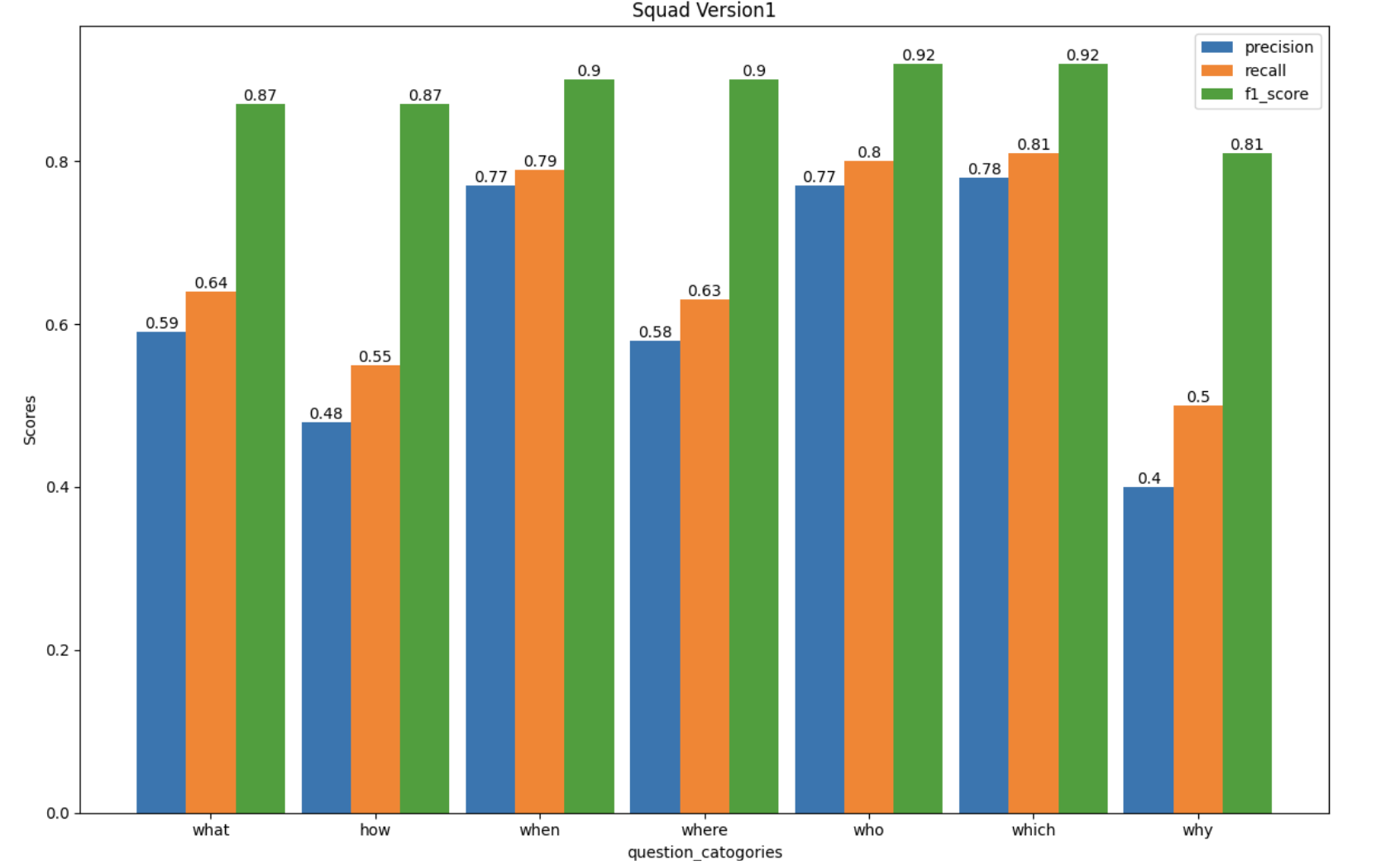
- ChatGPT demonstrated higher accuracy on simple factual questions compared to 'how' and 'why' questions, which require deeper reasoning and inference.
- Hallucination was frequently observed when no answer existed in the provided context, with the model generating plausible but incorrect responses.
Read this paper
Open the full text in the Nubint reader and ask about any passage as you read.
Read this paper on NubintThis review was generated by AI from the original paper. Please check the paper before citing it.