
[Paper Review] Evaluating Large Language Models for Public Health Classification and Extraction Tasks
The paper evaluates open-weight LLMs (7–70B) on 17 public health classification/extraction tasks across burden, risk factors, and interventions, comparing zero-shot prompts and few-shot prompts, with GPT-4 as a benchmark on subset tasks.
Advances in Large Language Models (LLMs) have led to significant interest in their potential to support human experts across a range of domains, including public health. In this work we present automated evaluations of LLMs for public health tasks involving the classification and extraction of free text. We combine six externally annotated datasets with seven new internally annotated datasets to evaluate LLMs for processing text related to: health burden, epidemiological risk factors, and public health interventions. We evaluate eleven open-weight LLMs (7-123 billion parameters) across all tasks using zero-shot in-context learning. We find that Llama-3.3-70B-Instruct is the highest performing model, achieving the best results on 8/16 tasks (using micro-F1 scores). We see significant variation across tasks with all open-weight LLMs scoring below 60% micro-F1 on some challenging tasks, such as Contact Classification, while all LLMs achieve greater than 80% micro-F1 on others, such as GI Illness Classification. For a subset of 11 tasks, we also evaluate three GPT-4 and GPT-4o series models and find comparable results to Llama-3.3-70B-Instruct. Overall, based on these initial results we find promising signs that LLMs may be useful tools for public health experts to extract information from a wide variety of free text sources, and support public health surveillance, research, and interventions.
Motivation & Objective
- Assess how open-weight LLMs perform on a broad suite of public health free-text classification and extraction tasks.
- Identify factors driving performance differences across models, tasks, and data sources.
- Provide a baseline for future fine-tuning of public-health–specific LLMs and for controlled deployment.
- Offer comparison against GPT-4 on a subset of tasks to gauge private-model parity.
Proposed method
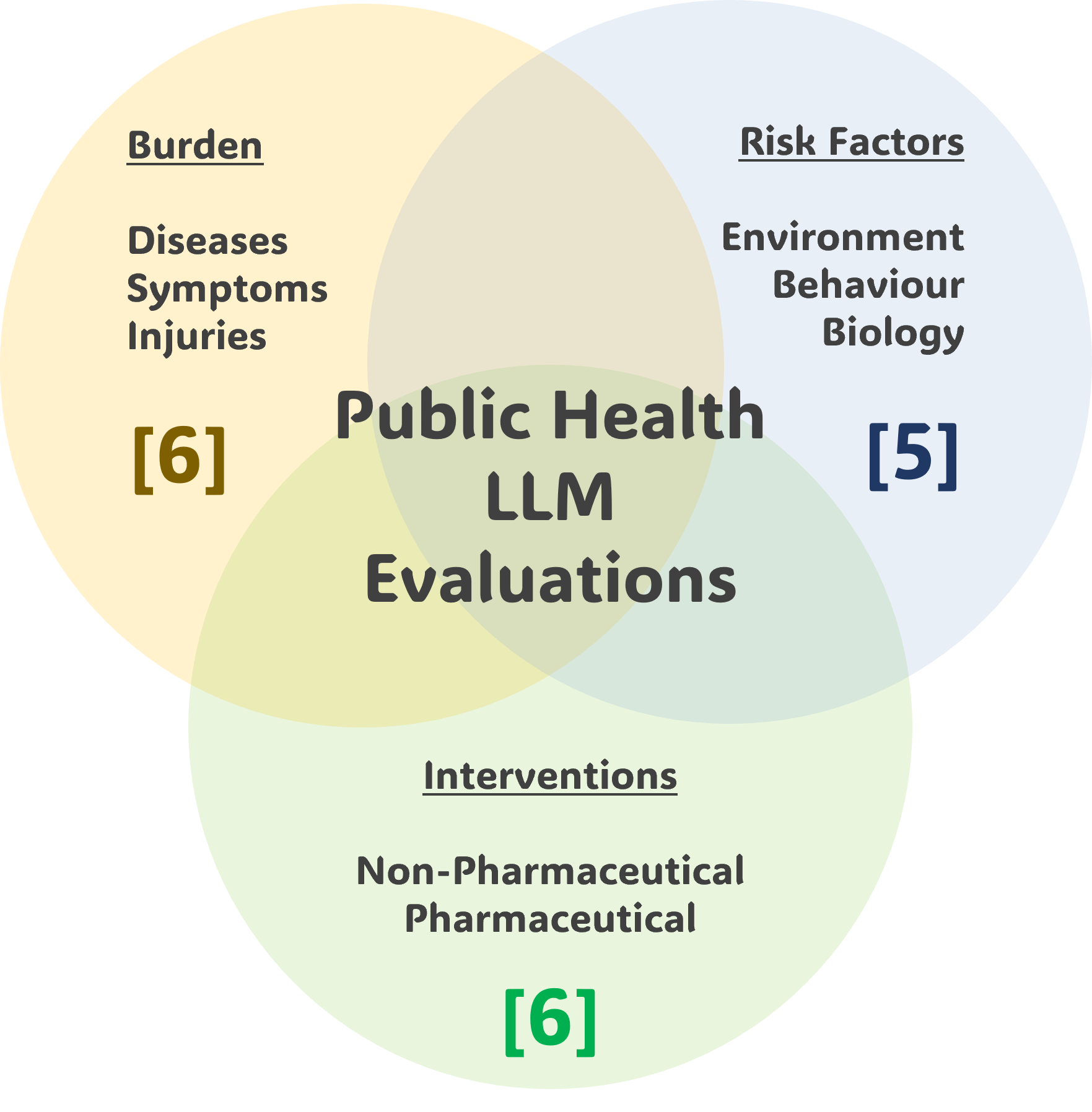
- Compile 17 public health tasks across three sub-domains (burden, risk factors, interventions) from 13 external and 7 internal datasets.
- Evaluate five open-weight LLMs (7–70B) using zero-shot prompting with a standardized prompting/post-processing framework.
- Use an internal LLM API on UKHSA HPC resources to ensure data governance and reproducibility.
- Compare zero-shot results and select few-shot prompts (10-shot/7-shot) on hardest tasks.
- Compute micro-F1 (primary) and macro-F1 scores; use exact-match for extractions and post-process outputs to align with ground-truth labels.
- Include GPT-4 results on 12 tasks for external benchmarking.
Experimental results
Research questions
- RQ1How do open-weight LLMs perform on a broad set of public health classification and extraction tasks under zero-shot prompting?
- RQ2What is the impact of task type, data source, and model size on performance?
- RQ3Do few-shot prompts significantly improve performance on challenging public health tasks?
- RQ4How does GPT-4 compare to top open-weight models on a subset of tasks?
- RQ5Which tasks remain challenging for current LLMs and require future improvements?
Key findings
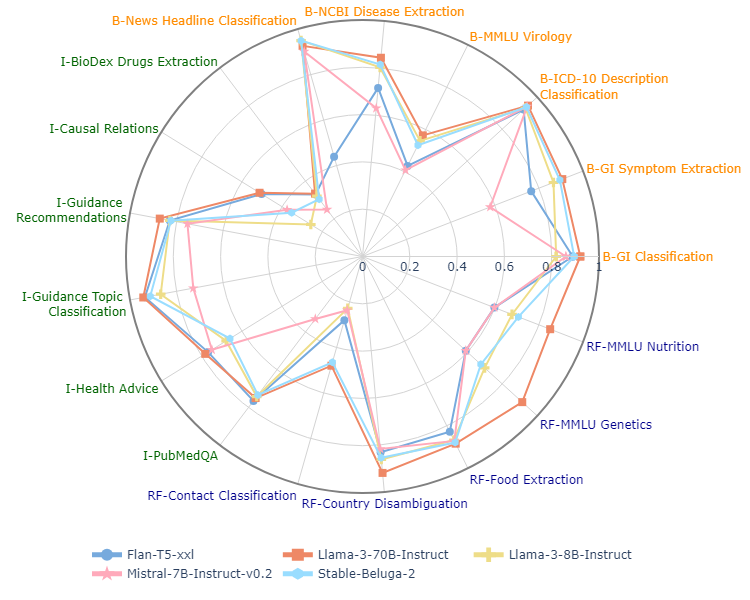
- Llama-3-70B-Instruct achieves the highest micro-F1 on 15 of 17 tasks under zero-shot prompts.
- Some tasks remain challenging for all open-weight models (e.g., BioDex Drugs Extraction, Contact Classification, MMLU Virology) with micro-F1 below 60%.
- GPT-4 matches or outperforms open-weight models on about half of the 12 tasks examined, but is outperformed by Llama-3-70B-Instruct on several others.
- Few-shot prompting yields substantial improvements (often >15 percentage points in micro-F1) on hard tasks like Contact Classification and Health Causal Claims Classification, across models except Flan-T5-xxl.
- Model size and architecture (e.g., moving from Llama-3-8B-Instruct to Llama-3-70B-Instruct) can yield 10+ point micro-F1 gains on key tasks (e.g., MMLU Genetics, MMLU Nutrition, Health Advice, Causal Relation).
- Overall, open-weight LLMs show promise for structuring public health free text and supporting surveillance, with caveats on specialized knowledge tasks.
Read this paper
Open the full text in the Nubint reader and ask about any passage as you read.
Read this paper on NubintThis review was generated by AI from the original paper. Please check the paper before citing it.