
[Paper Review] Evaluating Large Language Models on a Highly-specialized Topic, Radiation Oncology Physics
The study assesses four large language models on a 100-question radiation oncology physics exam, comparing them to medical physicists and non-experts, and explores prompt strategies, explain-first prompting, and deductive reasoning tests.
We present the first study to investigate Large Language Models (LLMs) in answering radiation oncology physics questions. Because popular exams like AP Physics, LSAT, and GRE have large test-taker populations and ample test preparation resources in circulation, they may not allow for accurately assessing the true potential of LLMs. This paper proposes evaluating LLMs on a highly-specialized topic, radiation oncology physics, which may be more pertinent to scientific and medical communities in addition to being a valuable benchmark of LLMs. We developed an exam consisting of 100 radiation oncology physics questions based on our expertise at Mayo Clinic. Four LLMs, ChatGPT (GPT-3.5), ChatGPT (GPT-4), Bard (LaMDA), and BLOOMZ, were evaluated against medical physicists and non-experts. ChatGPT (GPT-4) outperformed all other LLMs as well as medical physicists, on average. The performance of ChatGPT (GPT-4) was further improved when prompted to explain first, then answer. ChatGPT (GPT-3.5 and GPT-4) showed a high level of consistency in its answer choices across a number of trials, whether correct or incorrect, a characteristic that was not observed in the human test groups. In evaluating ChatGPTs (GPT-4) deductive reasoning ability using a novel approach (substituting the correct answer with "None of the above choices is the correct answer."), ChatGPT (GPT-4) demonstrated surprising accuracy, suggesting the potential presence of an emergent ability. Finally, although ChatGPT (GPT-4) performed well overall, its intrinsic properties did not allow for further improvement when scoring based on a majority vote across trials. In contrast, a team of medical physicists were able to greatly outperform ChatGPT (GPT-4) using a majority vote. This study suggests a great potential for LLMs to work alongside radiation oncology experts as highly knowledgeable assistants.
Motivation & Objective
- Motivate evaluation of LLMs on a highly specialized topic to avoid data-rich exam biases.
- Develop a 100-question radiation oncology physics exam reflecting residency curriculum.
- Compare multiple LLMs against medical physicists and non-experts.
- Investigate prompts, explain-then-answer strategies, and deductive reasoning capabilities.
Proposed method
- Design a 100-question multiple-choice exam covering basic physics, measurements, treatment planning, imaging, brachytherapy, advanced planning, and QA/safety.
- Test four LLMs (ChatGPT GPT-3.5, ChatGPT GPT-4, Bard LaMDA, BLOOMZ) across five trials (BLOOMZ once).
- Use initialization and instructions prompts to control response format and run questions in batches with 20-per-batch when possible.
- Compare LLM scores to two human groups: medical physicists and non-experts, using mean scores, standard deviation, and average trial correlations.
- Evaluate consistency of LLMs vs humans, and apply majority-vote aggregation to assess group performance.
- Examine improving GPT-4 accuracy by asking explanations first, then answers, and test deductive reasoning by replacing correct answers with a None of the above transformation.
Experimental results
Research questions
- RQ1Can LLMs accurately answer a highly-specialized radiation oncology physics exam compared with medical physicists and non-experts?
- RQ2Do prompt design and explain-first prompting improve GPT-4 accuracy on specialized medical physics content?
- RQ3Do LLMs exhibit deductive reasoning abilities when faced with context-reduced questions?
- RQ4Is majority-vote collaboration among humans or LLMs beneficial for improving accuracy?
- RQ5What are emergent properties in LLM deductive reasoning in highly specialized domains?
Key findings
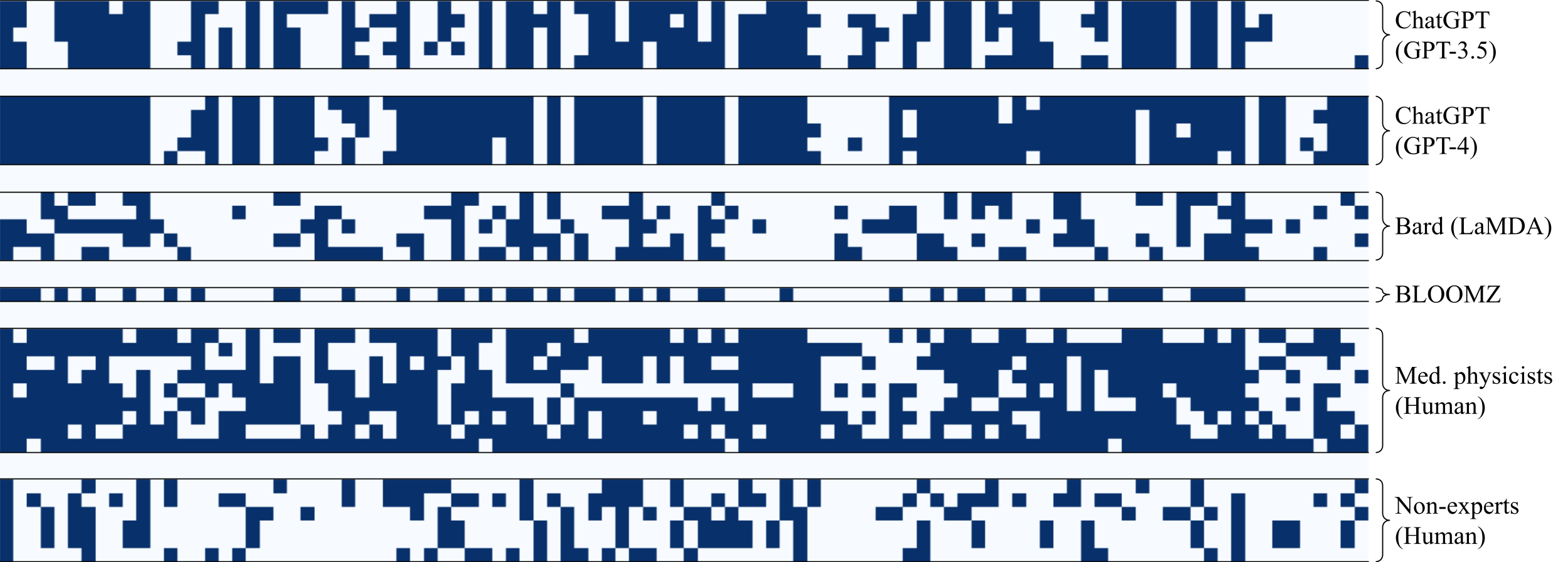
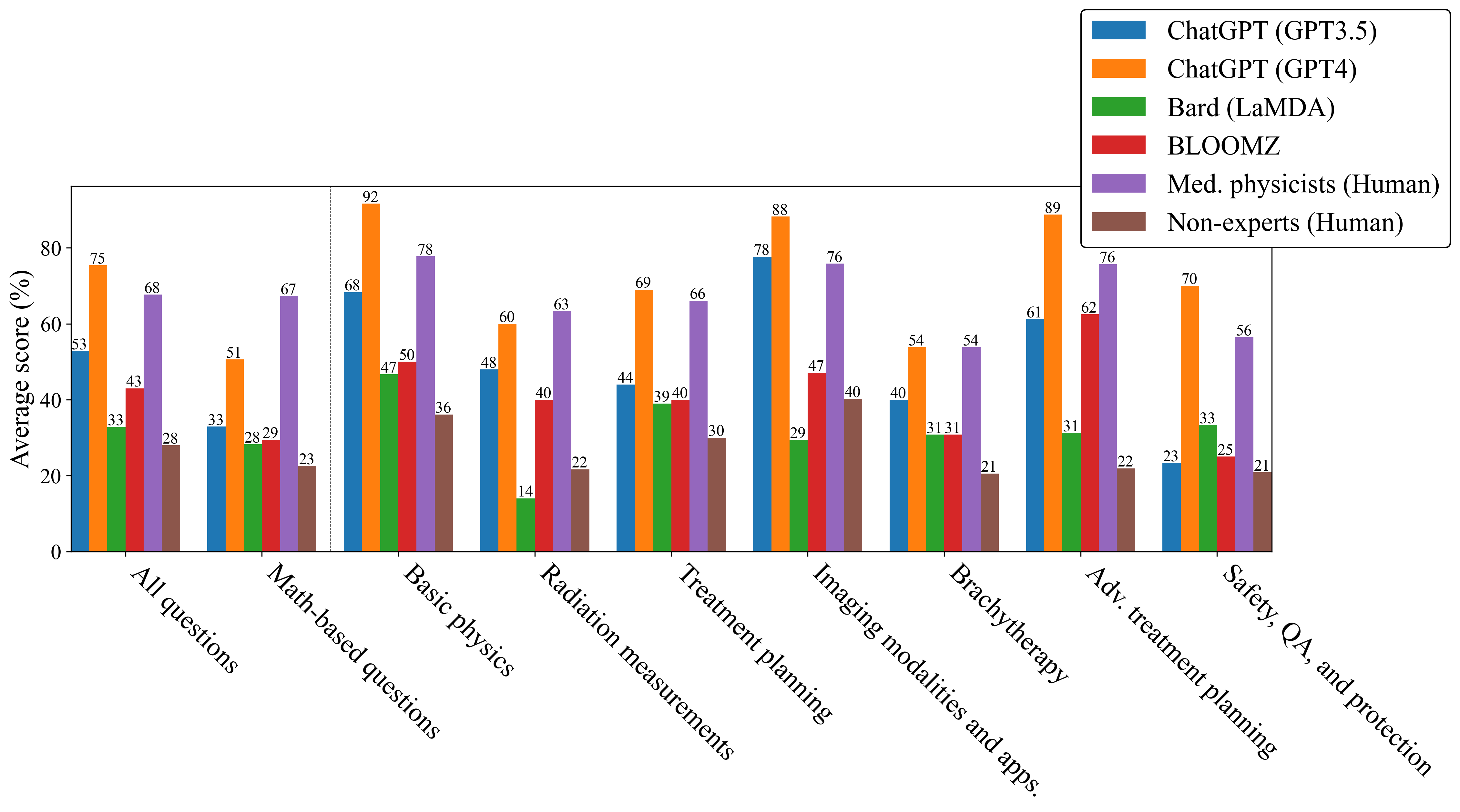
- GPT-4 outperformed all other LLMs and medical physicists on average for the 100-question exam.
- Prompting GPT-4 to explain first, then answer, improved overall accuracy by about 5 percentage points.
- GPT-4 showed notable deductive reasoning in a test where correct answers were replaced with None of the above, achieving 55% overall with explain-then-answer prompting.
- Humans using majority vote substantially outperformed individual LLMs, with medical physicists gaining a 23% boost.
- LLMs exhibited high consistency across trials, whereas non-experts resembled random guessing; medical physicists benefited from group agreement.
Read this paper
Open the full text in the Nubint reader and ask about any passage as you read.
Read this paper on NubintThis review was generated by AI from the original paper. Please check the paper before citing it.