
[Paper Review] Evaluating LLMs at Detecting Errors in LLM Responses
This paper introduces ReaLMistake, the first benchmark for evaluating error detection in LLM responses using objective, realistic, and diverse errors across four categories: reasoning correctness, instruction-following, context-faithfulness, and parameterized knowledge. Evaluated on 900 expert-annotated instances from GPT-4 and Llama 2 70B, the study reveals that even top LLMs like GPT-4 and Claude 3 detect errors with very low recall, and LLM-based detectors significantly underperform humans, with unreliable explanations and poor robustness to prompt variations.
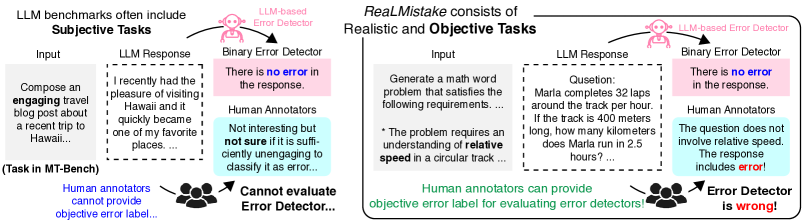
With Large Language Models (LLMs) being widely used across various tasks, detecting errors in their responses is increasingly crucial. However, little research has been conducted on error detection of LLM responses. Collecting error annotations on LLM responses is challenging due to the subjective nature of many NLP tasks, and thus previous research focuses on tasks of little practical value (e.g., word sorting) or limited error types (e.g., faithfulness in summarization). This work introduces ReaLMistake, the first error detection benchmark consisting of objective, realistic, and diverse errors made by LLMs. ReaLMistake contains three challenging and meaningful tasks that introduce objectively assessable errors in four categories (reasoning correctness, instruction-following, context-faithfulness, and parameterized knowledge), eliciting naturally observed and diverse errors in responses of GPT-4 and Llama 2 70B annotated by experts. We use ReaLMistake to evaluate error detectors based on 12 LLMs. Our findings show: 1) Top LLMs like GPT-4 and Claude 3 detect errors made by LLMs at very low recall, and all LLM-based error detectors perform much worse than humans. 2) Explanations by LLM-based error detectors lack reliability. 3) LLMs-based error detection is sensitive to small changes in prompts but remains challenging to improve. 4) Popular approaches to improving LLMs, including self-consistency and majority vote, do not improve the error detection performance. Our benchmark and code are provided at https://github.com/psunlpgroup/ReaLMistake.
Motivation & Objective
- To address the lack of benchmarks for evaluating binary error detection in LLM responses, especially those involving objective, realistic, and diverse errors.
- To overcome the limitations of prior benchmarks that rely on subjective or trivial tasks (e.g., word sorting) or limited error types (e.g., faithfulness in summarization).
- To design tasks that elicit naturally occurring, objectively assessable errors in strong LLMs like GPT-4 and Llama 2 70B.
- To evaluate the performance of 12 LLM-based error detectors on a realistic, expert-annotated benchmark.
- To investigate the reliability, robustness, and limitations of LLM-based error detection methods.
Proposed method
- Design three NLG tasks—Math Word Problem Generation, Fine-grained Fact Verification, and Answerability Classification—that systematically elicit errors in four error categories: reasoning correctness, instruction-following, context-faithfulness, and parameterized knowledge.
- Collect 900 expert-annotated instances of LLM responses from GPT-4-0613 and Llama 2 70B, each with a binary error label, error category, and detailed explanation.
- Use the ReaLMistake benchmark to evaluate 12 LLM-based error detectors using standardized prompt templates, including variations to test robustness.
- Apply standard LLM improvement techniques such as self-consistency and majority voting to assess their impact on error detection performance.
- Conduct manual analysis of detector outputs to evaluate the reliability of explanations and binary labels.
- Ensure objectivity by avoiding ambiguous or subjective evaluation criteria, focusing on verifiable factual and logical inconsistencies.
Experimental results
Research questions
- RQ1Can LLM-based error detectors reliably detect errors in LLM responses, especially when the errors are objectively assessable?
- RQ2How does the performance of LLM-based error detectors compare to human-level accuracy in detecting errors in LLM outputs?
- RQ3To what extent do explanations provided by LLM-based error detectors reflect accurate reasoning about the errors?
- RQ4How sensitive are LLM-based error detectors to small prompt variations, and can this sensitivity be mitigated?
- RQ5Do established LLM improvement strategies such as self-consistency and majority voting enhance the performance of LLM-based error detectors?
Key findings
- Top LLMs like GPT-4 and Claude 3 detect errors in LLM responses with very low recall, indicating poor performance on the binary error detection task.
- All LLM-based error detectors evaluated perform significantly worse than human experts in identifying errors in LLM responses.
- Explanations provided by LLM-based error detectors are often unreliable, with incorrect reasoning even when the binary label is correct.
- LLM-based error detection is highly sensitive to small prompt variations, and performance does not improve with standard LLM optimization techniques like self-consistency or majority voting.
- The benchmark ReaLMistake successfully captures diverse, realistic, and objectively assessable errors across four key categories in LLM responses.
- The study reveals a critical gap in current LLM-based error detection, highlighting the need for more robust and reliable methods for ensuring LLM output quality.

Read this paper
Open the full text in the Nubint reader and ask about any passage as you read.
Read this paper on NubintThis review was generated by AI from the original paper. Please check the paper before citing it.