
[Paper Review] Evaluating Search Engines and Large Language Models for Answering Health Questions
This study evaluates search engines, large language models (LLMs), and retrieval-augmented generation (RAG) for answering health questions. It finds that while LLMs outperform traditional search engines in accuracy, their performance heavily depends on prompt quality; RAG significantly improves LLM reliability by grounding responses in retrieved web evidence, suggesting that smaller, retrieval-augmented models may outperform larger, ungrounded ones.
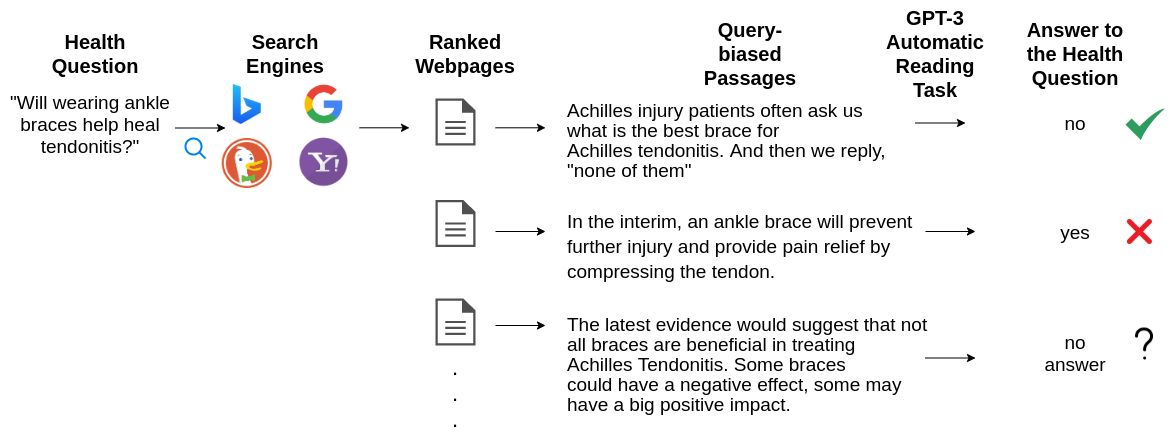
Search engines (SEs) have traditionally been primary tools for information seeking, but the new Large Language Models (LLMs) are emerging as powerful alternatives, particularly for question-answering tasks. This study compares the performance of four popular SEs, seven LLMs, and retrieval-augmented (RAG) variants in answering 150 health-related questions from the TREC Health Misinformation (HM) Track. Results reveal SEs correctly answer between 50 and 70% of questions, often hindered by many retrieval results not responding to the health question. LLMs deliver higher accuracy, correctly answering about 80% of questions, though their performance is sensitive to input prompts. RAG methods significantly enhance smaller LLMs' effectiveness, improving accuracy by up to 30% by integrating retrieval evidence.
Motivation & Objective
- To assess the effectiveness of traditional search engines in retrieving accurate answers to health questions across ranked result positions.
- To evaluate the reliability of LLMs in answering medical questions and compare performance across different models.
- To investigate how input prompts and in-context examples influence LLM performance on health-related queries.
- To examine whether integrating search engine results into LLM prompting improves answer accuracy through retrieval-augmented generation (RAG).
- To explore the potential of lightweight LLMs enhanced by web retrieval as a more efficient alternative to large, computationally expensive models.
Proposed method
- Evaluated four search engines—Google, Bing, Yahoo!, and DuckDuckGo—on their ability to retrieve relevant health-related webpages.
- Used state-of-the-art passage retrieval and reading comprehension models to automatically extract answers from top-ranked search results.
- Compared multiple LLMs (including GPT-3.5, GPT-4, and smaller models) on binary health question answering tasks.
- Applied in-context learning by providing few-shot examples to assess their impact on LLM performance.
- Implemented a retrieval-augmented generation (RAG) strategy, where LLMs were prompted with evidence retrieved from search engines.
- Used automatic evaluation metrics to assess correctness of answers, with plans for future human validation.
Experimental results
Research questions
- RQ1RQ1: To what extent do search engines retrieve results that help to answer medical questions? Does the correctness of the information provided drop as we go down in the search engine result page?
- RQ2RQ2: Are LLMs reliable in providing accurate medical answers? How do different models compare in terms of their effectiveness in providing responses to medical questions?
- RQ3RQ3: Does the given context influence the capabilities of LLMs in providing the right answers? Do these models exhibit improvements when presented with a few in-context examples?
- RQ4RQ4: Do LLMs improve their performance when fed with web retrieval results?
Key findings
- LLMs consistently outperformed traditional search engines in answering health questions, with GPT-4 achieving the highest accuracy among the models tested.
- The correctness of information from search engine results did not significantly decline as users scrolled down the ranked list, challenging assumptions about result quality degradation.
- LLM performance was highly sensitive to prompt design, with in-context learning improving accuracy but not eliminating hallucinations or inconsistencies with medical consensus.
- Retrieval-augmented generation (RAG) significantly enhanced LLM performance, with smaller models reaching the accuracy levels of larger models when grounded in retrieved evidence.
- RAG-based prompting led to highly effective information seeking, suggesting that lightweight, retrieval-grounded LLMs could be a more efficient alternative to large, standalone models.
- The study highlights the importance of evidence grounding in LLMs, especially in high-stakes domains like healthcare, where reliability is critical.
Read this paper
Open the full text in the Nubint reader and ask about any passage as you read.
Read this paper on NubintThis review was generated by AI from the original paper. Please check the paper before citing it.