
[Paper Review] Evaluating Similitude and Robustness of Deep Image Denoising Models via Adversarial Attack
This paper proposes denoising-PGD and L2-denoising-PGD adversarial attack methods to evaluate robustness in deep image denoising models while preserving noise distribution. It reveals high transferability across diverse denoising models, indicating strong local similitude, and identifies data-driven non-blind models as most robust, with BM3D showing inherent resistance to adversarial perturbations.
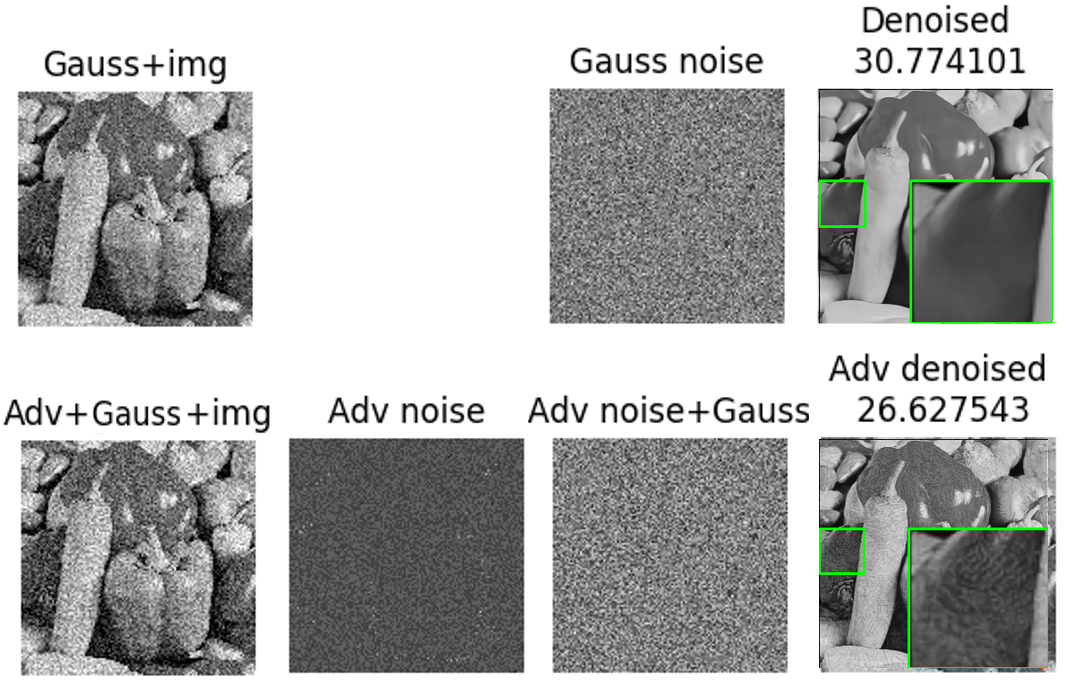
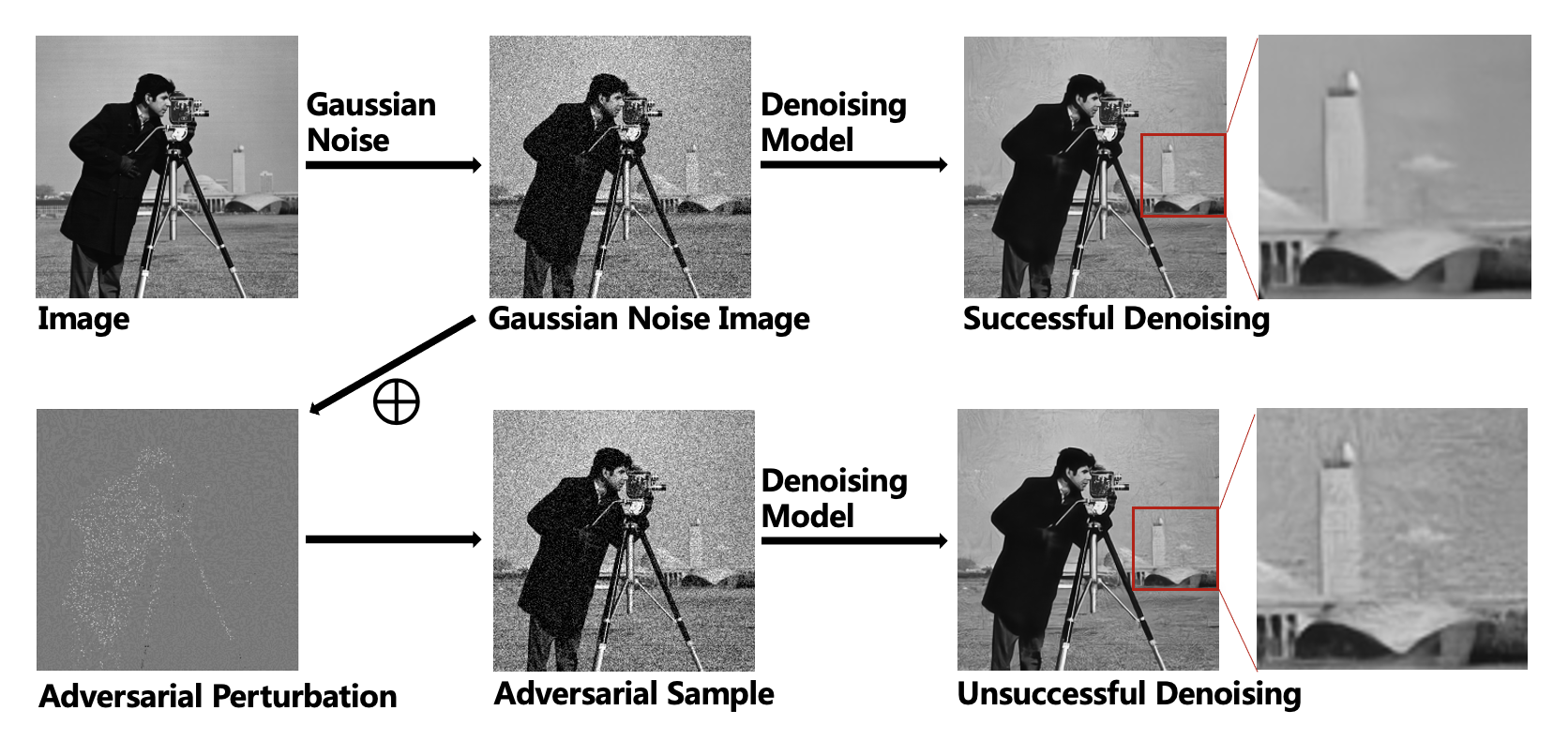
Deep neural networks (DNNs) have shown superior performance comparing to traditional image denoising algorithms. However, DNNs are inevitably vulnerable while facing adversarial attacks. In this paper, we propose an adversarial attack method named denoising-PGD which can successfully attack all the current deep denoising models while keep the noise distribution almost unchanged. We surprisingly find that the current mainstream non-blind denoising models (DnCNN, FFDNet, ECNDNet, BRDNet), blind denoising models (DnCNN-B, Noise2Noise, RDDCNN-B, FAN), plug-and-play (DPIR, CurvPnP) and unfolding denoising models (DeamNet) almost share the same adversarial sample set on both grayscale and color images, respectively. Shared adversarial sample set indicates that all these models are similar in term of local behaviors at the neighborhood of all the test samples. Thus, we further propose an indicator to measure the local similarity of models, called robustness similitude. Non-blind denoising models are found to have high robustness similitude across each other, while hybrid-driven models are also found to have high robustness similitude with pure data-driven non-blind denoising models. According to our robustness assessment, data-driven non-blind denoising models are the most robust. We use adversarial training to complement the vulnerability to adversarial attacks. Moreover, the model-driven image denoising BM3D shows resistance on adversarial attacks.
Motivation & Objective
- To investigate the vulnerability of deep image denoising models to adversarial attacks.
- To develop an adversarial attack method that maintains the original noise distribution, ensuring experimental validity.
- To assess the transferability of adversarial samples across different types of denoising models (non-blind, blind, plug-and-play, unfolding).
- To quantify the local behavioral similarity (robustness similitude) among denoising models using adversarial perturbations.
- To evaluate the robustness of model-driven methods like BM3D in comparison to data-driven and hybrid-driven models.
Proposed method
- Proposes denoising-PGD, an adversarial attack that iteratively perturbs noisy images using gradient updates on the denoiser’s loss function.
- Introduces L2-denoising-PGD, which enforces an L2 constraint on perturbations to preserve the Gaussian noise distribution and improve experimental rigor.
- Uses a random Gaussian perturbation initialization before each PGD iteration to enhance transferability while maintaining noise distribution fidelity.
- Applies a clipping operation to ensure perturbations remain within image range and to stabilize training dynamics.
- Employs a Wasserstein distance metric to quantitatively compare the noise distribution of adversarial samples with ground-truth Gaussian noise.
- Measures robustness similitude as the degree of shared adversarial sample sets across models, indicating local behavioral similarity.
Experimental results
Research questions
- RQ1Can adversarial attacks be effectively applied to deep image denoising models while preserving the original noise distribution?
- RQ2To what extent do different types of deep denoising models (non-blind, blind, plug-and-play, unfolding) share adversarial samples, indicating behavioral similitude?
- RQ3How does the robustness similitude vary across different model categories, particularly between data-driven and hybrid-driven models?
- RQ4Do model-driven methods like BM3D exhibit inherent resistance to adversarial attacks compared to deep learning-based models?
- RQ5What is the relationship between architectural similarity and adversarial transferability in image denoising models?
Key findings
- The L2-denoising-PGD attack maintains noise distribution fidelity, with a Wasserstein distance of 0.0017 to Gaussian noise, significantly lower than denoising-PGD’s 0.0024.
- All tested deep denoising models—non-blind (DnCNN, FFDNet, etc.), blind (DnCNN-B, Noise2Noise, etc.), plug-and-play (DPIR, CurvPnP), and unfolding (DeamNet)—share nearly identical adversarial sample sets on both grayscale and color images.
- Data-driven non-blind denoising models exhibit the highest robustness similitude, indicating strong local behavioral similarity across models.
- Hybrid-driven models (e.g., DPIR, CurvPnP) also show high robustness similitude with pure data-driven non-blind models, suggesting shared decision boundaries.
- The classical model-driven method BM3D demonstrates strong resistance to adversarial attacks, outperforming deep learning-based models in robustness.
- Adversarial training improves robustness, and the high transferability of adversarial samples suggests that the adversarial region forms a continuous, shared subspace across models.
Read this paper
Open the full text in the Nubint reader and ask about any passage as you read.
Read this paper on NubintThis review was generated by AI from the original paper. Please check the paper before citing it.