
[Paper Review] Evaluating the Ripple Effects of Knowledge Editing in Language Models
This paper introduces RippleEdits, a benchmark to evaluate the ripple effects of knowledge editing in language models—i.e., unintended or missed logical consequences when a single fact is edited. It finds that current parametric editing methods fail to consistently propagate edits to related facts, while a simple in-context editing baseline outperforms them, highlighting a promising new direction for future research.
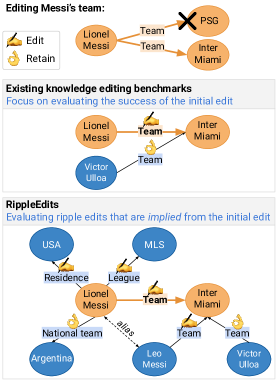
Modern language models capture a large body of factual knowledge. However, some facts can be incorrectly induced or become obsolete over time, resulting in factually incorrect generations. This has led to the development of various editing methods that allow updating facts encoded by the model. Evaluation of these methods has primarily focused on testing whether an individual fact has been successfully injected, and if similar predictions for other subjects have not changed. Here we argue that such evaluation is limited, since injecting one fact (e.g. ``Jack Depp is the son of Johnny Depp'') introduces a ``ripple effect'' in the form of additional facts that the model needs to update (e.g.``Jack Depp is the sibling of Lily-Rose Depp''). To address this issue, we propose a novel set of evaluation criteria that consider the implications of an edit on related facts. Using these criteria, we then construct RippleEdits, a diagnostic benchmark of 5K factual edits, capturing a variety of types of ripple effects. We evaluate prominent editing methods on RippleEdits, showing that current methods fail to introduce consistent changes in the model's knowledge. In addition, we find that a simple in-context editing baseline obtains the best scores on our benchmark, suggesting a promising research direction for model editing.
Motivation & Objective
- To address the limitation in existing knowledge editing evaluations that focus only on the target fact and ignore related factual implications.
- To identify and formalize the 'ripple effect'—logical consequences of a single edit that should also be updated in the model’s knowledge.
- To develop a comprehensive benchmark, RippleEdits, that tests how well editing methods handle these ripple effects across diverse factual relationships.
- To evaluate state-of-the-art parametric editing methods on this benchmark and compare them with a simple in-context editing baseline.
- To uncover systematic failures in current editing methods and guide future research toward more robust, logically consistent editing.
Proposed method
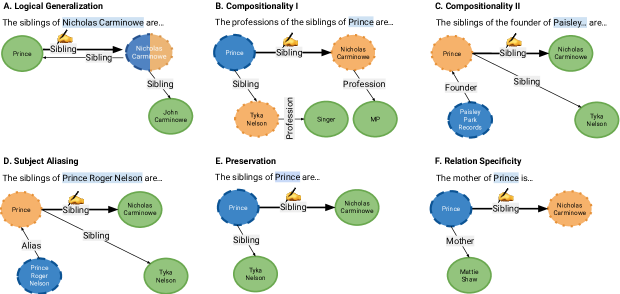
- Propose six evaluation criteria to test ripple effects, including logical reasoning, subject aliasing, relation specificity, and multi-hop fact composition.
- Construct RippleEdits, a diagnostic benchmark of 5,000 factual edits with associated test queries probing ripple effects.
- Use Wikidata as a knowledge source to generate edits and related factual queries, including metadata on entity popularity and edit recency.
- Evaluate three prominent parametric editing methods (ROME, ICE) and a simple in-context editing baseline across five recent LMs (GPT-2, GPT-Neo, LLaMA, GPT-3).
- Classify failure modes into 'no effect', 'abstaining', and 'noise' to analyze where and why editing fails.
- Use quantitative metrics such as accuracy on ripple-effect queries and error type distributions to compare method performance.
Experimental results
Research questions
- RQ1To what extent do current knowledge editing methods successfully propagate edits to logically related facts (ripple effects)?
- RQ2How do different editing methods perform on complex, multi-hop factual reasoning tasks that depend on the edited fact?
- RQ3Does the performance of editing methods vary with model size or entity frequency, and if so, how?
- RQ4Can a simple in-context editing approach outperform complex parametric editing methods in capturing ripple effects?
- RQ5What are the dominant failure modes (e.g., no change, abstention, noise) in current editing methods when applied to ripple-effect evaluation?
Key findings
- Current parametric editing methods like ROME and ICE fail to consistently update related facts, with over 68% of failures resulting in incorrect changes rather than no effect.
- The in-context editing baseline outperforms all parametric methods on RippleEdits, achieving the highest accuracy across all evaluated models.
- Larger models (e.g., LLaMA) handle ripple effects better than smaller ones (e.g., GPT-2), indicating a positive correlation between model scale and ripple-effect robustness.
- Editing frequent entities leads to more logical reasoning errors, suggesting that high-frequency entities may be more prone to misinference in ripple-effect scenarios.
- For GPT-3, the in-context editing baseline suffers from high abstention rates (49%) on LG-type queries, which may explain its lower performance compared to LLaMA.
- In 200 sampled failures, ROME introduced incorrect changes in 31–45% of cases, while ICE caused the model to abstain in 65–71% of failures, indicating different failure profiles.
Better researchstarts right now
From reading papers to final review, dramatically reduce your research time.
No credit card · Free plan available
This review was created by AI and reviewed by human editors.