
[Paper Review] Evaluating tree-based imputation methods as an alternative to MICE PMM for drawing inference in empirical studies
The paper compares tree-based imputation methods (MICE RF, missRanger, MIXGBoost) to MICE PMM in a realistic NEPS-based simulation and finds RF-based imputations often perform best for coefficient estimation, Type I error, and power, with caveats at higher missingness.
Dealing with missing data is an important problem in statistical analysis that is often addressed with imputation procedures. The performance and validity of such methods are of great importance for their application in empirical studies. While the prevailing method of Multiple Imputation by Chained Equations (MICE) with Predictive Mean Matching (PMM) is considered standard in the social science literature, the increase in complex datasets may require more advanced approaches based on machine learning. In particular, tree-based imputation methods have emerged as very competitive approaches. However, the performance and validity are not completely understood, particularly compared to the standard MICE PMM. This is especially true for inference in linear models. In this study, we investigate the impact of various imputation methods on coefficient estimation, Type I error, and power, to gain insights that can help empirical researchers deal with missingness more effectively. We explore MICE PMM alongside different tree-based methods, such as MICE with Random Forest (RF), Chained Random Forests with and without PMM (missRanger), and Extreme Gradient Boosting (MIXGBoost), conducting a realistic simulation study using the German National Educational Panel Study (NEPS) as the original data source. Our results reveal that Random Forest-based imputations, especially MICE RF and missRanger with PMM, consistently perform better in most scenarios. Standard MICE PMM shows partially increased bias and overly conservative test decisions, particularly with non-true zero coefficients. Our results thus underscore the potential advantages of tree-based imputation methods, albeit with a caveat that all methods perform worse with an increased missingness, particularly missRanger.
Motivation & Objective
- Assess how different imputation methods affect coefficient estimation in linear models with missing data.
- Compare bias, Type I error, and power across methods: MICE PMM, MICE RF, missRanger, and MIXGBoost.
- Evaluate performance on a realistic, NEPS-based simulated dataset with varying missingness rates.
Proposed method
- Simulate NEPS-based longitudinal data with 12,410 complete cases across 5 waves for income as the outcome.
- Impute missing data using MICE PMM, MICE RF, missRanger (with and without PMM), and MIXGBoost.
- Evaluate imputation impact on OLS regression coefficients, Type I error, and power.
- Use the IPM (Imputation Performance Metric) to summarize mixed data types (numeric and categorical).
- Replicate the simulation 1200 times and analyze 1000 successful replications.
- Highlight differences in performance across missingness levels and data patterns.
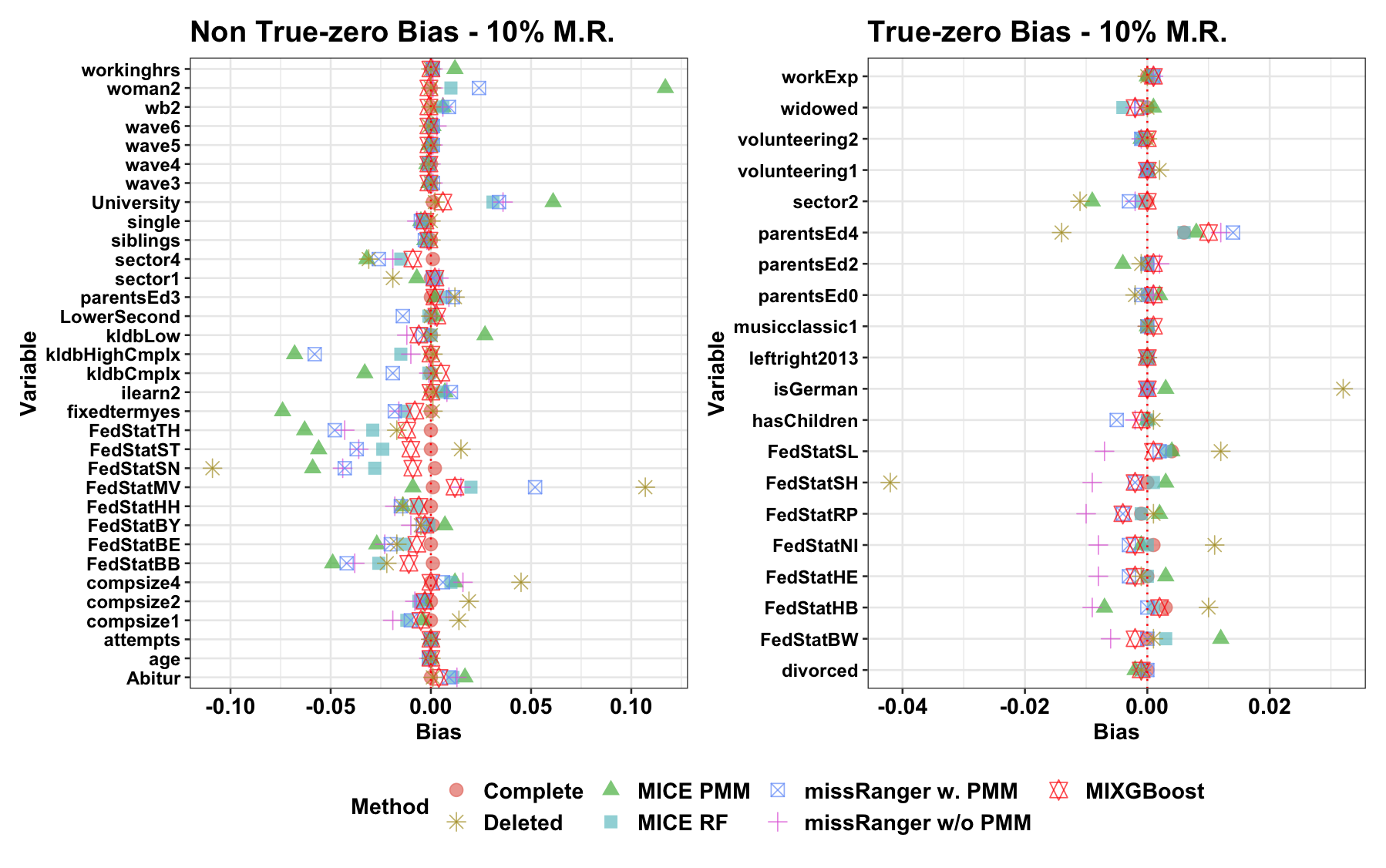
Experimental results
Research questions
- RQ1How do tree-based imputation methods compare to MICE PMM in terms of coefficient bias in linear models?
- RQ2What are the effects of imputation method on Type I error and statistical power across scenarios?
- RQ3Do RF-based tree imputation methods (MICE RF, missRanger) consistently outperform MICE PMM under MAR missingness?
- RQ4What influence does increasing missingness have on the performance of each imputation approach?
Key findings
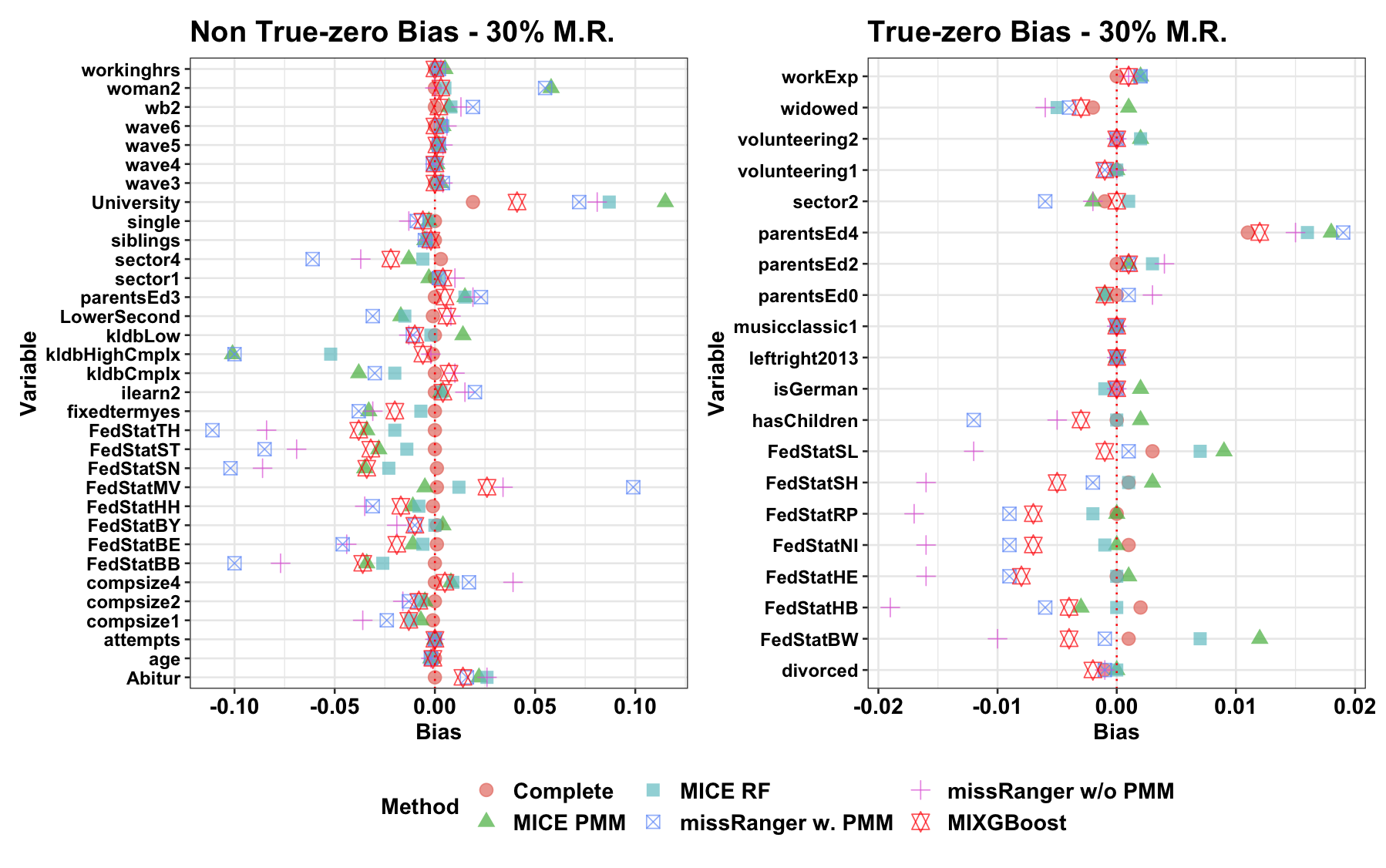
- Random Forest–based imputations, especially MICE RF and missRanger with PMM, consistently perform better in most scenarios.
- Standard MICE PMM shows partially increased bias and overly conservative test decisions, particularly with non-true zero coefficients.
- MissRanger’s performance degrades with higher missingness levels.
- All methods’ performance declines as missingness increases, with missRanger being most affected.
- Tree-based methods can handle mixed data types and complex interactions better than MICE PMM in many settings.
Read this paper
Open the full text in the Nubint reader and ask about any passage as you read.
Read this paper on NubintThis review was generated by AI from the original paper. Please check the paper before citing it.