
[Paper Review] Evaluating Weakly Supervised Object Localization Methods Right
This paper challenges the validity of current evaluations in weakly supervised object localization (WSOL), arguing that existing protocols implicitly use full supervision during hyperparameter tuning, leading to misleading performance gains. The authors propose a new evaluation protocol using a small, held-out set with full supervision for hyperparameter search, showing that CAM remains state-of-the-art and that few-shot learning baselines outperform recent WSOL methods under fair conditions.
Weakly-supervised object localization (WSOL) has gained popularity over the last years for its promise to train localization models with only image-level labels. Since the seminal WSOL work of class activation mapping (CAM), the field has focused on how to expand the attention regions to cover objects more broadly and localize them better. However, these strategies rely on full localization supervision to validate hyperparameters and for model selection, which is in principle prohibited under the WSOL setup. In this paper, we argue that WSOL task is ill-posed with only image-level labels, and propose a new evaluation protocol where full supervision is limited to only a small held-out set not overlapping with the test set. We observe that, under our protocol, the five most recent WSOL methods have not made a major improvement over the CAM baseline. Moreover, we report that existing WSOL methods have not reached the few-shot learning baseline, where the full-supervision at validation time is used for model training instead. Based on our findings, we discuss some future directions for WSOL.
Motivation & Objective
- To identify flaws in current evaluation protocols for weakly supervised object localization (WSOL), where full supervision is implicitly used during hyperparameter tuning.
- To propose a new, well-posed WSOL evaluation protocol that limits full supervision to a small, held-out set not overlapping with the test set.
- To fairly compare recent WSOL methods against the CAM baseline and few-shot learning baselines under identical conditions.
- To demonstrate that existing WSOL methods have not made significant progress beyond CAM when evaluation bias is removed.
- To advocate for a shift in future WSOL research toward hybrid learning paradigms combining weak and full supervision.
Proposed method
- Propose a new evaluation protocol where a small, held-out set with full instance-level annotations is used exclusively for hyperparameter tuning, not for model training.
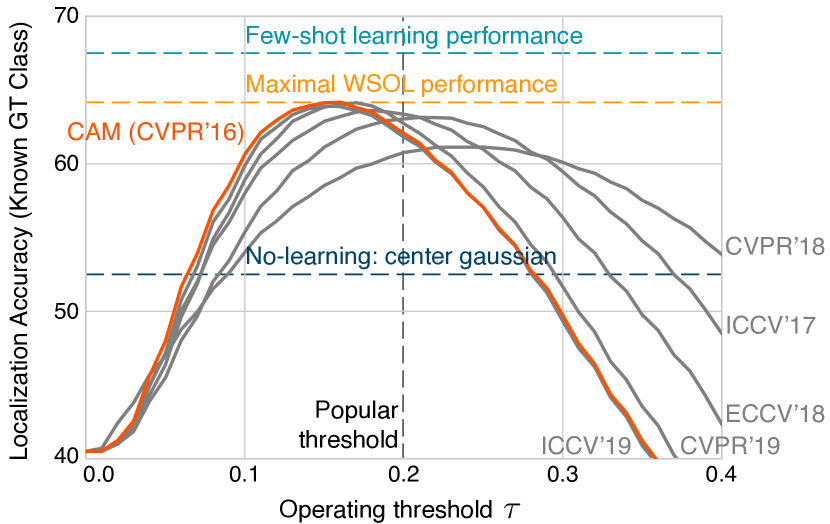
- Use a fixed, oracle threshold τ (determined via grid search on the held-out set) to generate object bounding boxes from score maps, eliminating bias from arbitrary threshold choices.
- Evaluate WSOL methods on three datasets (CUB, ImageNet, OpenImages) using three backbone architectures (VGG, Inception, ResNet) under the new protocol.
- Introduce MaxBoxAccV2 as a revised evaluation metric to improve fairness and consistency in performance comparison.
- Compare WSOL methods against a few-shot learning (FSL) baseline that uses 10 fully-annotated samples per class during training, simulating direct use of full supervision.
- Conduct extensive ablation studies across 30 hyperparameter trials per method to assess sensitivity and stability.
Experimental results
Research questions
- RQ1To what extent do current WSOL evaluation protocols introduce implicit full supervision that biases performance gains?
- RQ2Does the performance of recent WSOL methods significantly exceed the CAM baseline when evaluated under a fair, well-posed protocol?
- RQ3How does the performance of WSOL methods compare to a few-shot learning baseline that uses full supervision during training?
- RQ4What is the impact of hyperparameter choice and threshold selection (τ) on WSOL performance, and how can it be standardized for fair comparison?
- RQ5Are the reported improvements in WSOL methods due to architectural innovation or due to differences in validation protocol and threshold selection?
Key findings
- Under the proposed evaluation protocol, the CAM baseline outperforms all five recent WSOL methods on all three datasets (CUB, ImageNet, OpenImages), indicating no significant progress beyond CAM.
- The performance of WSOL methods is highly sensitive to hyperparameter choice, with ACoL and ADL showing greater instability than CAM.
- The few-shot learning baseline—using 10 fully-annotated samples per class during training—consistently outperforms all current WSOL methods, even when the latter use implicit full supervision in validation.
- The commonly used threshold τ = 0.2 is not optimal for all methods and datasets, and performance varies significantly with τ, highlighting the need for method- and dataset-specific threshold calibration.
- Score map distributions vary significantly across methods (e.g., ACoL produces flatter maps), and visual inspection alone is insufficient to predict optimal IoU performance.
- On CUB, random hyperparameter selection often leads to performance worse than a center-Gaussian baseline, indicating high risk of failure without proper tuning.

Read this paper
Open the full text in the Nubint reader and ask about any passage as you read.
Read this paper on NubintThis review was generated by AI from the original paper. Please check the paper before citing it.