
[Paper Review] Evaluation of BERT and ALBERT Sentence Embedding Performance on Downstream NLP Tasks
This paper evaluates BERT and ALBERT sentence embedding models for downstream NLP tasks, proposing Sentence-ALBERT (SALBERT) and a CNN-based sentence embedding architecture. Despite fewer parameters, ALBERT-based models achieve competitive performance, with the CNN architecture improving SALBERT by up to 8 points in Spearman’s correlation on STS benchmarks—significantly more than the 1-point gain for BERT models.
Contextualized representations from a pre-trained language model are central to achieve a high performance on downstream NLP task. The pre-trained BERT and A Lite BERT (ALBERT) models can be fine-tuned to give state-ofthe-art results in sentence-pair regressions such as semantic textual similarity (STS) and natural language inference (NLI). Although BERT-based models yield the [CLS] token vector as a reasonable sentence embedding, the search for an optimal sentence embedding scheme remains an active research area in computational linguistics. This paper explores on sentence embedding models for BERT and ALBERT. In particular, we take a modified BERT network with siamese and triplet network structures called Sentence-BERT (SBERT) and replace BERT with ALBERT to create Sentence-ALBERT (SALBERT). We also experiment with an outer CNN sentence-embedding network for SBERT and SALBERT. We evaluate performances of all sentence-embedding models considered using the STS and NLI datasets. The empirical results indicate that our CNN architecture improves ALBERT models substantially more than BERT models for STS benchmark. Despite significantly fewer model parameters, ALBERT sentence embedding is highly competitive to BERT in downstream NLP evaluations.
Motivation & Objective
- To evaluate the performance of BERT and ALBERT sentence embeddings on downstream NLP tasks such as semantic textual similarity (STS) and natural language inference (NLI).
- To investigate whether ALBERT, with fewer parameters, can achieve competitive sentence embedding performance compared to BERT.
- To explore the effectiveness of alternative sentence embedding architectures—specifically siamese networks and CNNs—on top of BERT and ALBERT.
- To determine whether the CNN-based architecture improves sentence embeddings more significantly for ALBERT than for BERT, given ALBERT’s parameter-sharing instability.
- To assess the impact of fine-tuning on mixed training data (STSb and NLI) for improved generalization across STS tasks (2012–2016).
Proposed method
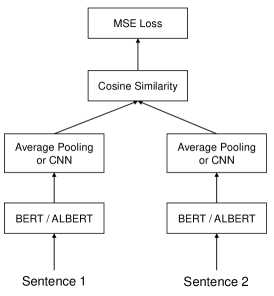
- Proposes Sentence-ALBERT (SALBERT) by replacing BERT with ALBERT in the siamese and triplet network architecture of Sentence-BERT (SBERT).
- Introduces a CNN-based sentence embedding module that processes token embeddings from BERT or ALBERT to generate fixed-size sentence vectors.
- Employs average pooling and [CLS] token pooling as baseline sentence embedding methods for comparison.
- Fine-tunes all models on combined STSb and NLI (MultiNLI/SNLI) training sets to improve generalization on STS tasks.
- Uses Spearman’s rank correlation as the primary evaluation metric on the STS benchmark suite (STS12–STS16).
- Analyzes the effect of model architecture and pre-training objectives (e.g., SOP vs. NSP) on downstream performance stability and accuracy.
Experimental results
Research questions
- RQ1How do sentence embedding models based on ALBERT compare to those based on BERT in terms of performance on STS and NLI tasks?
- RQ2To what extent does introducing a CNN-based architecture for sentence embedding improve performance on BERT and ALBERT models?
- RQ3Why does the CNN architecture yield a larger performance gain for ALBERT than for BERT, despite ALBERT’s lower initial performance?
- RQ4Does fine-tuning on both STSb and NLI datasets lead to better generalization across multiple STS tasks (2012–2016) compared to fine-tuning on STSb alone?
- RQ5How does the instability introduced by ALBERT’s parameter-sharing mechanism affect sentence embedding quality, and can it be mitigated by architectural modifications like CNN?
Key findings
- The CNN-based sentence embedding architecture improves ALBERT-based models by up to 8 points in Spearman’s rank correlation on the STS benchmark, compared to only 1 point for BERT-based models.
- Despite having significantly fewer parameters, ALBERT-based sentence embeddings are highly competitive with BERT-based models on downstream NLP tasks.
- SALBERT (ALBERT with siamese architecture) underperforms SBERT (BERT with siamese architecture), but this gap is closed when the CNN architecture is applied.
- The CNN architecture improves the performance of SALBERT by 2 points on average across STS12–STS16, while having minimal impact on BERT-based models.
- Fine-tuning on both STSb and NLI datasets yields the best performance on STSb, outperforming fine-tuning on STSb or NLI alone.
- The instability caused by ALBERT’s parameter-sharing mechanism may be mitigated by the CNN architecture, explaining the disproportionate performance gain over BERT.
Read this paper
Open the full text in the Nubint reader and ask about any passage as you read.
Read this paper on NubintThis review was generated by AI from the original paper. Please check the paper before citing it.