
[Paper Review] Evaluation of ChatGPT Feedback on ELL Writers' Coherence and Cohesion
This study evaluates ChatGPT-generated feedback on coherence and cohesion for ELL essays, finding that without task-specific training the feedback is mostly abstract and sometimes inaccurate, though some prompt variations show strong alignment with human scoring.
Since its launch in November 2022, ChatGPT has had a transformative effect on education where students are using it to help with homework assignments and teachers are actively employing it in their teaching practices. This includes using ChatGPT as a tool for writing teachers to grade and generate feedback on students' essays. In this study, we evaluated the quality of the feedback generated by ChatGPT regarding the coherence and cohesion of the essays written by English Language Learners (ELLs) students. We selected 50 argumentative essays and generated feedback on coherence and cohesion using the ELLIPSE rubric. During the feedback evaluation, we used a two-step approach: first, each sentence in the feedback was classified into subtypes based on its function (e.g., positive reinforcement, problem statement). Next, we evaluated its accuracy and usability according to these types. Both the analysis of feedback types and the evaluation of accuracy and usability revealed that most feedback sentences were highly abstract and generic, failing to provide concrete suggestions for improvement. The accuracy in detecting major problems, such as repetitive ideas and the inaccurate use of cohesive devices, depended on superficial linguistic features and was often incorrect. In conclusion, ChatGPT, without specific training for the feedback generation task, does not offer effective feedback on ELL students' coherence and cohesion.
Motivation & Objective
- Assess methods to evaluate the accuracy and usability of coherence/cohesion feedback.
- Determine whether ChatGPT, without task-specific tuning, can provide accurate and useful feedback to ELL learners.
- Characterize the linguistic types and usefulness of ChatGPT feedback.
- Compare ChatGPT feedback to human expert feedback using a standardized rubric (ELLIPSE cohesion rubric).
- Analyze cost and practicality of deploying ChatGPT-based feedback in ELL contexts.
Proposed method
- Two-step analysis of each feedback sentence by function (e.g., positive reinforcement, problem statement, explicit example, indirect suggestion).
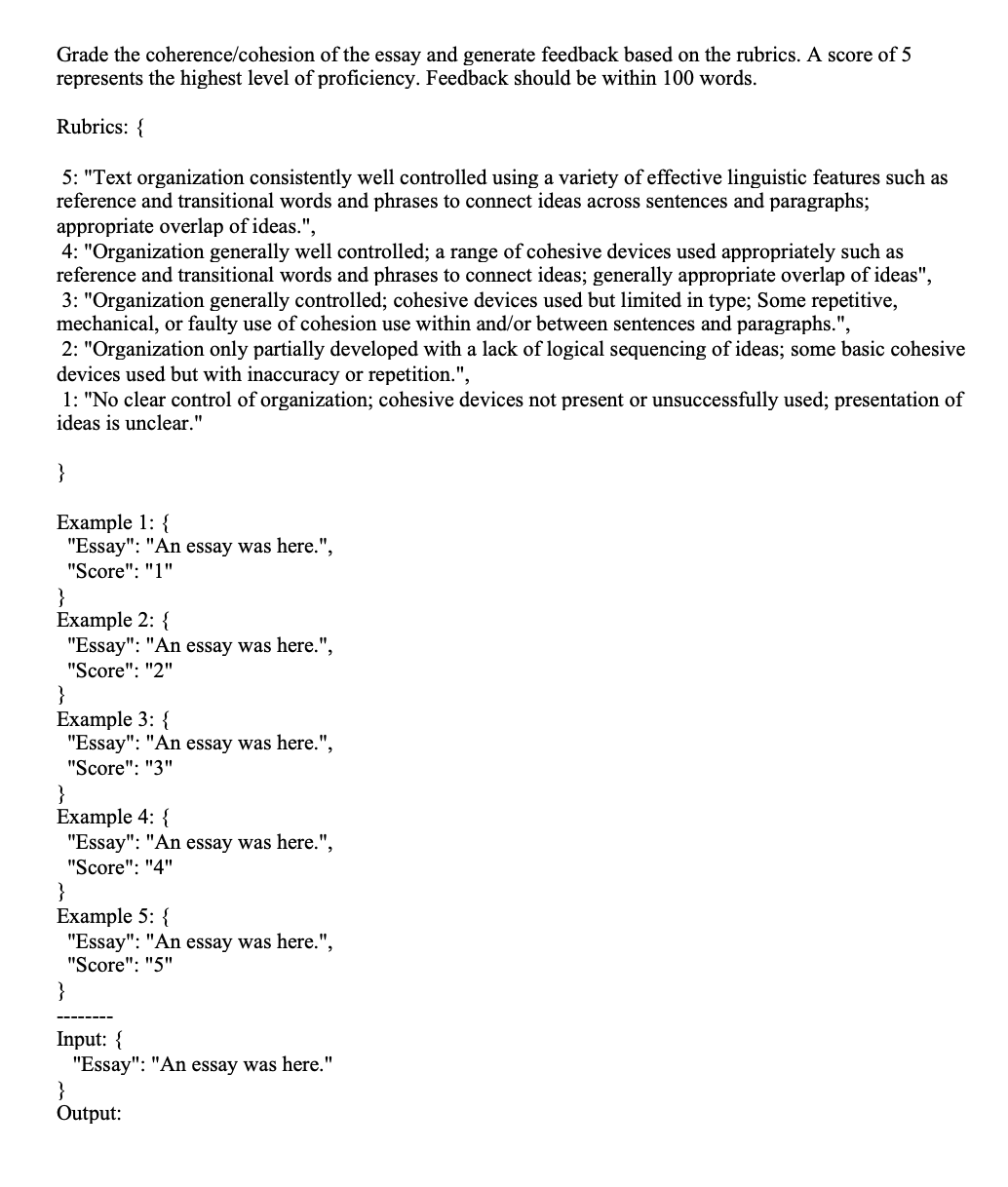
- Use of ELLIPSE cohesion rubric to generate feedback on 50 grade-12 ELL essays from the dataset.
- Fine-grained evaluation of accuracy via mapping feedback sentences to rubric types and comparing to human judgments.
- Holistic comparison of ChatGPT feedback against expert feedback on four example essays.
- Experimentation with GPT-4 prompts (default and personalized) to assess score agreement with human judges (kappa, Pearson correlation).
- Cost analysis of API usage for different prompt configurations.
Experimental results
Research questions
- RQ1RQ1: What approach can evaluate the accuracy and usability of coherence/cohesion feedback?
- RQ2RQ2: Can ChatGPT provide accurate and useful coherence/cohesion feedback for ELL students without task-specific prompt tuning?
- RQ3RQ3: How does prompt design (default vs. personalized) affect alignment with human scores and feedback usefulness?
Key findings
- Most feedback sentences were abstract and generic and lacked concrete improvement suggestions.
- Accuracy in detecting major problems (e.g., repetitive ideas, inappropriate cohesive devices) depended on superficial linguistic features and was often incorrect.
- Prompt design influenced scoring alignment: personalized prompts yielded higher exact/adjacent agreement and higher Pearson correlations with human scores than the default prompt.
- Prompts with sample essays reduced scoring performance and increased cost.
- Average feedback length was 4.1 sentences (about 62 words), with 3–6 sentences per essay and no strong link between length and cohesion score.
- Explicit examples were common (average ~1.21 per essay); positive reinforcement was less frequent and often unhelpful for low-proficiency essays.
Read this paper
Open the full text in the Nubint reader and ask about any passage as you read.
Read this paper on NubintThis review was generated by AI from the original paper. Please check the paper before citing it.