
[Paper Review] Evaluation of really good grammatical error correction
This study evaluates Grammatical Error Correction (GEC) systems for Swedish using human-annotated post-edits and multiple metrics, revealing that GPT-3 in a few-shot setting significantly outperforms prior systems despite Swedish comprising only 0.11% of its training data. The key contribution is a human post-editing framework that exposes biases in automatic evaluation metrics and highlights the need for context-aware, human-in-the-loop evaluation of high-performing LLM-based GEC systems.
Although rarely stated, in practice, Grammatical Error Correction (GEC) encompasses various models with distinct objectives, ranging from grammatical error detection to improving fluency. Traditional evaluation methods fail to fully capture the full range of system capabilities and objectives. Reference-based evaluations suffer from limitations in capturing the wide variety of possible correction and the biases introduced during reference creation and is prone to favor fixing local errors over overall text improvement. The emergence of large language models (LLMs) has further highlighted the shortcomings of these evaluation strategies, emphasizing the need for a paradigm shift in evaluation methodology. In the current study, we perform a comprehensive evaluation of various GEC systems using a recently published dataset of Swedish learner texts. The evaluation is performed using established evaluation metrics as well as human judges. We find that GPT-3 in a few-shot setting by far outperforms previous grammatical error correction systems for Swedish, a language comprising only 0.11% of its training data. We also found that current evaluation methods contain undesirable biases that a human evaluation is able to reveal. We suggest using human post-editing of GEC system outputs to analyze the amount of change required to reach native-level human performance on the task, and provide a dataset annotated with human post-edits and assessments of grammaticality, fluency and meaning preservation of GEC system outputs.
Motivation & Objective
- To evaluate the performance of diverse GEC systems—rule-based, MT-based, and LLM-based—on Swedish learner texts.
- To identify and analyze biases in traditional reference-based evaluation metrics that favor conservative error correction over fluency and overall text improvement.
- To demonstrate that human post-editing of GEC outputs is a more reliable and revealing evaluation method than automatic metrics.
- To provide a new dataset annotated with human post-edits, grammaticality, fluency, and meaning preservation scores for future GEC evaluation.
Proposed method
- The study uses a recently published dataset of Swedish learner texts, including minimal, fluent, and free human corrections as reference points.
- It applies both reference-based metrics (e.g., GLEU) and reference-free metrics (e.g., SOME, Scribendi) to compare system outputs.
- Human annotators evaluate system outputs on grammaticality, fluency, and meaning preservation using a 5-point scale.
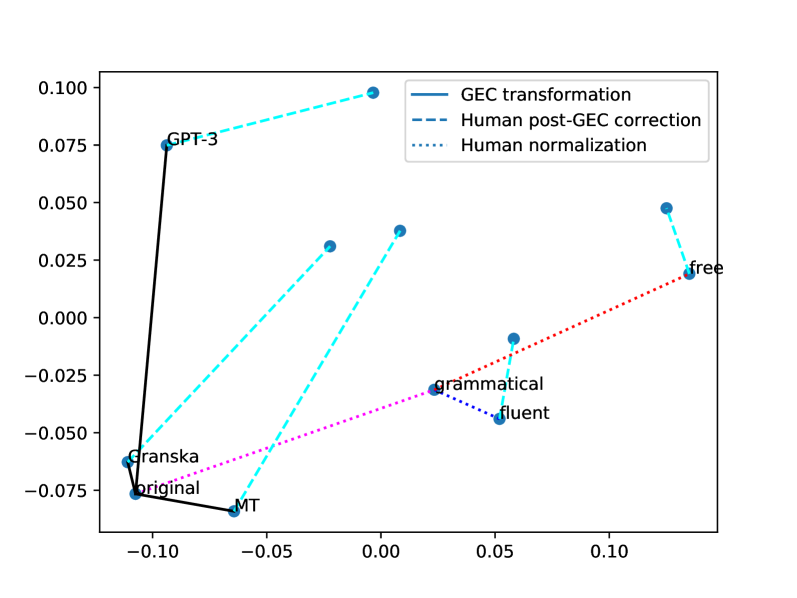
- Post-edit distance is quantified using normalized character-level Levenshtein distance between GEC outputs and human post-edits.
- The authors analyze discrepancies between automatic metrics and human judgments to reveal evaluation biases.
- A new dataset is created with human post-edits and assessments of grammaticality, fluency, and meaning preservation for each GEC output.
Experimental results
Research questions
- RQ1How do different automatic evaluation metrics (reference-based vs. reference-free) align with human judgments of grammaticality, fluency, and meaning preservation in GEC outputs?
- RQ2To what extent do reference-based metrics fail to differentiate high-performing GEC systems, especially at advanced proficiency levels?
- RQ3Can human post-editing reveal evaluation biases that automatic metrics overlook, particularly in LLM-based systems?
- RQ4How does the performance of GPT-3 in a few-shot setting compare to other GEC systems on Swedish, a low-resource language?
- RQ5What are the limitations of current evaluation methodologies when applied to state-of-the-art LLM-based GEC systems?
Key findings
- GPT-3 in a few-shot setting outperforms all prior GEC systems for Swedish, achieving human-like grammaticality and fluency despite Swedish comprising only 0.11% of its training data.
- Reference-free metrics such as Scribendi and SOME show high correlation with human judgments but can favor neural systems even over human corrections, indicating potential bias.
- Reference-based metrics like GLEU suffer from ceiling effects at high proficiency levels, failing to differentiate between systems like MT and GPT-3 despite clear differences in human evaluation.
- Human post-editing reveals that all GEC systems are clearly below human-level performance, with GPT-3 showing the smallest post-edit distance, indicating higher quality output.
- The study identifies that reference-based evaluations are biased toward conservative error correction and fail to capture semantic accuracy and fluency improvements.
- The authors demonstrate that human post-editing is a more reliable and informative evaluation method than automatic metrics, especially for high-performing LLM-based systems.
Read this paper
Open the full text in the Nubint reader and ask about any passage as you read.
Read this paper on NubintThis review was generated by AI from the original paper. Please check the paper before citing it.