
[Paper Review] Evaluation of the CaloINN generative network - Fast detector simulation
The paper benchmarks CaloINN (INN) and a VAE+INN approach for fast calorimeter shower simulations, evaluating performance across increasing phase-space dimensionality and reporting timing and quality metrics.
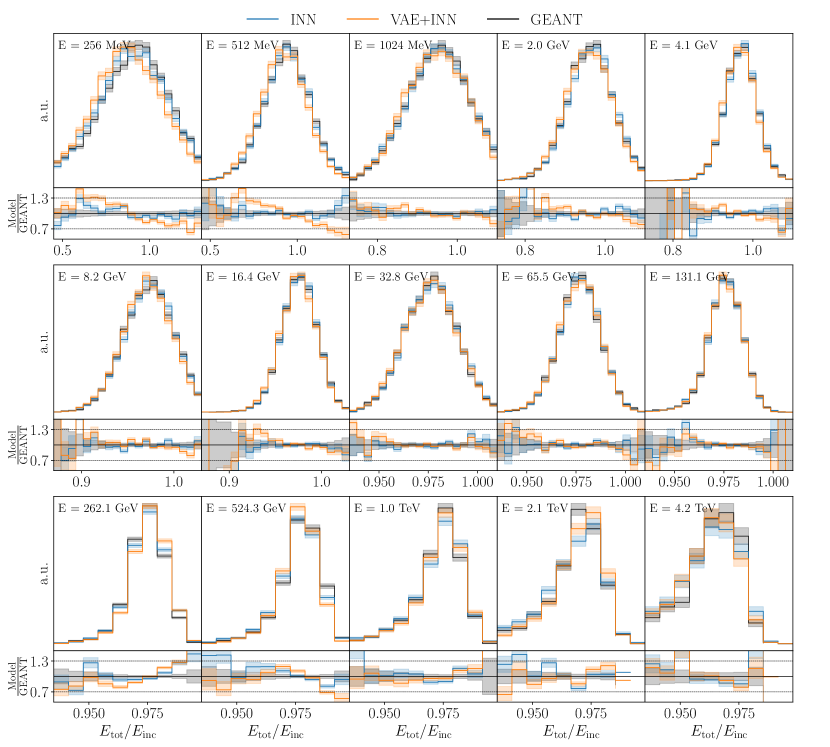
These are the sampled used in the paper "Normalizing Flows for High-Dimensional Detector Simulations" for the evaluation of the CaloINN and the CaloVAE+INN models. Each zip file contains the generated showers stored in the CaloChallenge format together with figures of high-level observables. We include the layer energy deposition, the center of energy, the width of the center of energy, the layer sparsity, the ratio E_tot/E_inc, and the full voxel energy distribution. For these features we provide: energy inclusive histograms for all the datasets; for dataset 1, three incident energies: 256 MeV, 8.192GeV, 262.144 GeV; for dataset 2 and 3, three incident energy windows, (1-10), (10-100), (100-1000) GeV; separation power between Geant4 and our samples calculatd from the histograms.
Motivation & Objective
- Assess how normalizing-flow-based surrogates (INN) perform for calorimeter shower generation in low- to high-dimensional phase spaces.
- Evaluate whether compressing showers with a VAE before INN improves scalability to dataset 3.
- Provide physics-aware evaluation metrics to diagnose where INN and VAE+INN succeed or fail.
- Benchmark generation speed against dataset dimensionality and hardware (GPU/CPU).
Proposed method
- Use two architectures: a standard INN with coupling layers and a VAE+INN pipeline where a VAE compresses showers before the INN maps to a Gaussian latent space.
- Train INN with a likelihood-based loss on Geant4-derived CaloChallenge datasets 1–3, conditioning on log-incident energy.
- Preprocess showers by normalizing to layer energy and appending energy-encoding variables per Eq. (4).
- For dataset 3, attach a VAE to reduce dimensionality and train INN on the VAE latent space, with a two-step training (VAE first, then INN).
- Evaluate using high-level physics features and a classifier-based likelihood-ratio metric to identify phase-space regions where the models under- or over-sample the data.
- Report generation timing on GPU/CPU across batch sizes and datasets.
Experimental results
Research questions
- RQ1How well do INN-based normalizing flows reproduce Geant4-calorimeter showers across increasing voxelization (368, 533, 6,480, 40,500 voxels)?
- RQ2Does a VAE+INN hybrid improve scalability to very high-dimensional calorimeter data compared to a plain INN?
- RQ3What are the main failure modes of INN and VAE+INN in reproducing shower features (shape, sparsity, energy deposition) across datasets?
- RQ4What are the relative generation speeds of INN and VAE+INN on CPU vs GPU for different batch sizes?
Key findings
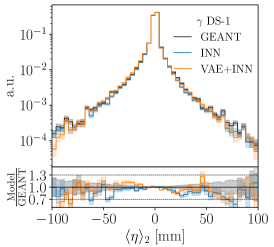
- For dataset 1 (photons and pions) the INN reproduces high-level features within about 10% for photons, with the VAE+INN showing no clear advantage.
- In dataset 1, the INN outperforms the VAE+INN for Gamma showers when evaluating a classifier-weight metric, with AUCs 0.601 (INN) vs 0.936 (VAE+INN).
- Dataset 2 (positrons, 6,480 voxels) shows degraded INN performance relative to dataset 1, with AUCs 0.703 (INN) vs 0.916 (VAE+INN); compression helps main features but harms low-energy depositions and sparsity.
- Dataset 3 (positrons, 40,500 voxels) cannot be effectively modeled by a plain INN; VAE+INN remains the viable option, but overall precision-density estimates may fail for this dimensionality.
- Timing results indicate SOTA sampling speeds for INN at small/batch sizes, while VAE+INN achieves millisecond-level generation times; GPU typically provides speedups over CPU.
- The study identifies distinct failure modes via classifier weights, notably under-sampling or over-sampling regions in phase space depending on network and dataset.
Read this paper
Open the full text in the Nubint reader and ask about any passage as you read.
Read this paper on NubintThis review was generated by AI from the original paper. Please check the paper before citing it.