
[Paper Review] Event generation with Sherpa 3
This paper presents SHERPA 3, a next-generation Monte Carlo event generator for high-energy collider physics, featuring advanced higher-order QCD and electroweak corrections, improved parton showers, enhanced hadronisation and colour reconnection models, and optimized event generation efficiency. The framework enables precision simulations of complex collider processes with full NLO accuracy, improved QED and electroweak effects, and supports high-performance computing and machine learning integration for phase-space sampling and unweighting.
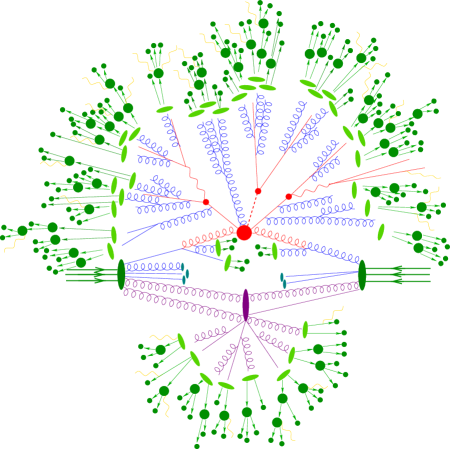
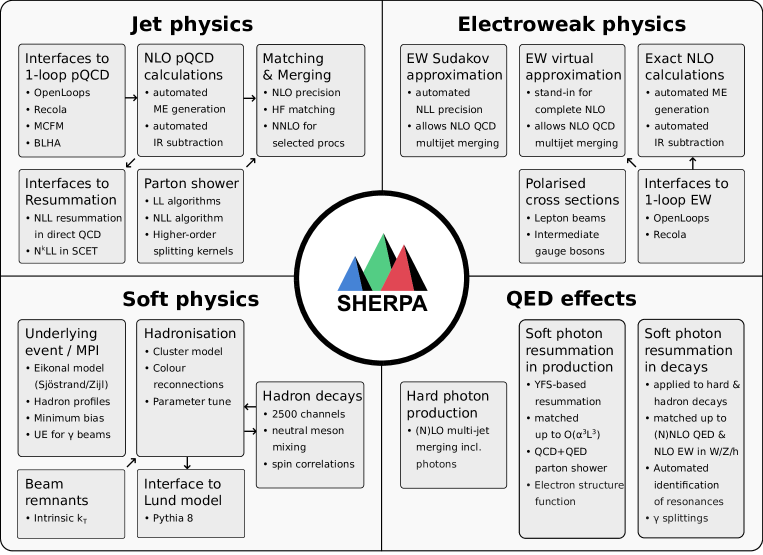
Sherpa is a general-purpose Monte Carlo event generator for the simulation of particle collisions in high-energy collider experiments. We summarise new developments, essential features, and ongoing improvements within the Sherpa 3 release series. Physics improvements include higher-order electroweak corrections, simulations of photoproduction and hard diffraction at NLO QCD, heavy-flavour matching in NLO multijet merging, spin-polarised cross section calculations, and a new model of colour reconnections. In addition, the modelling of hadronisation, the underlying event and QED effects in both production and decay has been improved, and the overall event generation efficiency has been enhanced.
Motivation & Objective
- To develop a next-generation Monte Carlo event generator capable of simulating high-energy collider processes with higher theoretical accuracy and improved physical modelling.
- To implement higher-order QCD and electroweak corrections, including NLO QCD for photoproduction and hard diffraction, and approximate electroweak corrections via Sudakov and virtual approximations.
- To enhance the simulation of non-perturbative effects such as hadronisation, beam remnant handling, and colour reconnections, improving agreement with experimental data.
- To optimize event generation efficiency through advanced phase-space sampling, unweighting, and integration with high-performance and heterogeneous computing architectures.
- To enable flexible, modular, and extensible simulation workflows via a configurable interface using YAML runcards and command-line parameters.
Proposed method
- SHERPA 3 employs a modular framework separating physics models from interfaces, allowing independent development and replacement of components like parton showers, hadronisation models, and matching schemes.
- It implements NLO QCD calculations for processes including photoproduction and hard diffraction using dedicated matching methods and dipole subtraction techniques.
- The generator uses the Catani–Seymour dipole shower at NLL accuracy and includes a new cluster-based hadronisation model with improved beam remnant and colour reconnection handling.
- Electroweak corrections are approximated via the EW Sudakov and virtual corrections, with soft-photon resummation applied to decays and e+e− processes.
- A new colour reconnection model is introduced, based on a colour-ordered parton list and momentum conservation, with adjustable parameters for intrinsic transverse momentum via a Gaussian-cut-off distribution.
- Event generation is configured via human-readable YAML runcards or command-line arguments, with automatic detection of unused settings and full configuration reporting.
Experimental results
Research questions
- RQ1How can a Monte Carlo event generator achieve higher-order QCD and electroweak accuracy while maintaining computational efficiency?
- RQ2What improvements are needed in beam remnant and colour reconnection models to better describe hadronisation and momentum conservation in hadron–hadron collisions?
- RQ3How can machine learning and high-performance computing be integrated into event generation to accelerate phase-space sampling and unweighting?
- RQ4What is the impact of NLO QCD corrections on photoproduction and hard diffraction processes in proton–proton collisions?
- RQ5How can modular design and user-configurable interfaces improve reproducibility and extensibility in event generator development?
Key findings
- SHERPA 3 achieves NLO QCD accuracy for photoproduction and hard diffraction processes, enabling precise simulations of diffractive and vector-boson-induced events.
- The inclusion of higher-order electroweak corrections via the EW Sudakov and virtual approximations improves the description of radiative corrections in high-multiplicity final states.
- A new cluster-based hadronisation model with refined beam remnant handling and colour reconnections leads to improved momentum conservation and better agreement with experimental data on jet and hadron distributions.
- The implementation of soft-photon resummation in decays and e+e− processes enhances the accuracy of QED radiation effects, particularly near resonances.
- Event generation efficiency is significantly improved through optimized phase-space sampling and unweighting, with support for on-the-fly uncertainty estimates and heterogeneous computing.
- The modular, user-configurable framework with YAML runcards and command-line interface ensures reproducibility, configurability, and traceability of simulation settings.
Read this paper
Open the full text in the Nubint reader and ask about any passage as you read.
Read this paper on NubintThis review was generated by AI from the original paper. Please check the paper before citing it.