
[Paper Review] Evolving Dark Energy or Supernovae Systematics?
This paper argues that the apparent evidence for evolving dark energy from the DESI 5-year supernova (DES5Y) sample is likely due to a systematic calibration offset of ~0.04 mag between low- and high-redshift supernovae, not true dark energy evolution. After correcting for this offset, the DES5Y data align with Planck's ΛCDM cosmology, eliminating the need for dynamical dark energy models.
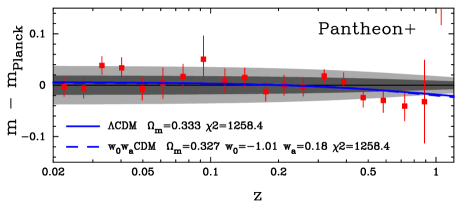
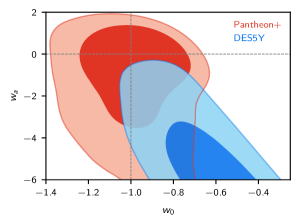
Recent results from the Dark Energy Spectroscopic Instrument (DESI) collaboration have been interpreted as evidence for evolving dark energy. However, this interpretation is strongly dependent on which Type Ia supernova (SN) sample is combined with DESI measurements of baryon acoustic oscillations (BAO) and observations of the cosmic microwave background (CMB) radiation. The strength of the evidence for evolving dark energy ranges from ~3.9 sigma for the Dark Energy 5 year (DES5Y) SN sample to ~2.5 sigma for the Pantheon+ sample. The cosmology inferred from Pantheon+ sample alone is consistent with the Planck LCDM model and shows no preference for evolving dark energy. In contrast, the the DES5Y SN sample favours evolving dark energy and is discrepant with the Planck LCDM model at about the 3 sigma level. Given these difference, it is important to question whether they are caused by systematics in the SN compilations. A comparison of SN common to both the DES5Y and Pantheon+ compilations shows evidence for an offset of ~0.04 mag. between low and high redshifts. Systematics of this order can bring the DES5Y sample into good agreement with the Planck LCDM cosmology and Pantheon+. I comment on a recent paper by the DES collaboration that rejects this possibility.
Motivation & Objective
- To investigate the origin of conflicting evidence for evolving dark energy between the DES5Y and Pantheon+ supernova samples.
- To assess whether the high significance (~3.9σ) for dynamical dark energy in the DES5Y sample is due to systematic errors rather than physical evolution.
- To test the consistency of the DES5Y supernova magnitude-redshift relation with the Planck ΛCDM cosmology after correcting for potential calibration offsets.
- To highlight the critical importance of cross-calibration between SN samples in cosmological parameter inference, especially at low redshift.
- To caution against interpreting high-significance tensions in dark energy parameters as evidence for new physics without rigorous systematics control.
Proposed method
- Cross-correlated the DES5Y and Pantheon+ supernova samples to identify discrepancies in magnitude-redshift relations.
- Quantified a systematic offset of ~0.04 mag between low- and high-redshift supernovae in the DES5Y sample relative to Pantheon+.
- Re-calibrated the DES5Y sample by applying a redshift-dependent magnitude correction to align it with the Pantheon+ data.
- Re-fitted cosmological parameters using the corrected DES5Y sample in combination with Planck CMB and DESI BAO data.
- Compared parameter constraints (w₀, wₐ) from the corrected DES5Y sample with those from Pantheon+ and the ΛCDM model.
- Used χ² statistics to evaluate the statistical preference for evolving dark energy before and after correction.
Experimental results
Research questions
- RQ1Is the high significance (~3.9σ) for evolving dark energy in the DES5Y supernova sample due to systematic errors or physical evolution?
- RQ2What is the magnitude offset between the DES5Y and Pantheon+ supernova samples at low and high redshifts?
- RQ3Does correcting for this offset eliminate the tension between DES5Y and the Planck ΛCDM cosmology?
- RQ4How do cosmological constraints from the corrected DES5Y sample compare to those from Pantheon+ and the standard ΛCDM model?
- RQ5To what extent are low-redshift supernova calibrations critical for detecting deviations in the dark energy equation of state?
Key findings
- A systematic magnitude offset of ~0.04 mag was identified between the DES5Y and Pantheon+ supernova samples, with DES5Y showing fainter magnitudes at high redshift.
- After correcting for this offset, the DES5Y sample's magnitude-redshift relation becomes consistent with the Planck ΛCDM cosmology.
- The corrected DES5Y sample shows no significant preference for evolving dark energy, with χ² reduction of only 3 when allowing w₀ and wₐ to vary.
- The parameter constraints from the corrected DES5Y sample now show strong overlap with both Pantheon+ and the ΛCDM expectation (w₀ = -1, wₐ = 0).
- The original high significance (~3.9σ) for evolving dark energy in DES5Y is therefore likely due to calibration systematics, not physical evolution.
- The cosmological parameters from the uncorrected DES5Y sample are in tension with other datasets, including BAO, further supporting the systematics explanation.
Read this paper
Open the full text in the Nubint reader and ask about any passage as you read.
Read this paper on NubintThis review was generated by AI from the original paper. Please check the paper before citing it.