
[Paper Review] Evolving from Single-modal to Multi-modal Facial Deepfake Detection: Progress and Challenges
This survey presents the first comprehensive review of facial deepfake detection, evolving from single-modal to multi-modal approaches, covering generative models (VAEs, GANs, diffusion models) and detection techniques across audio-visual and text-visual modalities. It introduces a unified taxonomy, highlights recent advances using transformers and vision-language models, and identifies key challenges in generalization, multi-modal alignment, real-time processing, and LLM integration, offering a roadmap for robust, future-proof detection systems.
As synthetic media, including video, audio, and text, become increasingly indistinguishable from real content, the risks of misinformation, identity fraud, and social manipulation escalate. This survey traces the evolution of deepfake detection from early single-modal methods to sophisticated multi-modal approaches that integrate audio-visual and text-visual cues. We present a structured taxonomy of detection techniques and analyze the transition from GAN-based to diffusion model-driven deepfakes, which introduce new challenges due to their heightened realism and robustness against detection. Unlike prior surveys that primarily focus on single-modal detection or earlier deepfake techniques, this work provides the most comprehensive study to date, encompassing the latest advancements in multi-modal deepfake detection, generalization challenges, proactive defense mechanisms, and emerging datasets specifically designed to support new interpretability and reasoning tasks. We further explore the role of Vision-Language Models (VLMs) and Multimodal Large Language Models (MLLMs) in strengthening detection robustness against increasingly sophisticated deepfake attacks. By systematically categorizing existing methods and identifying emerging research directions, this survey serves as a foundation for future advancements in combating AI-generated facial forgeries. A curated list of all related papers can be found at \href{https://github.com/qiqitao77/Comprehensive-Advances-in-Deepfake-Detection-Spanning-Diverse-Modalities}{https://github.com/qiqitao77/Awesome-Comprehensive-Deepfake-Detection}.
Motivation & Objective
- Address the growing societal threat posed by hyper-realistic face-centric deepfakes generated using advanced AI.
- Systematically categorize and compare single-modal and multi-modal deepfake detection techniques across evolving generative models.
- Identify critical gaps in generalization, robustness, and real-time performance of current detection methods.
- Explore the potential of large language models (LLMs) to enhance explainability and multi-modal consistency detection.
- Provide a comprehensive, up-to-date roadmap for future research in deepfake detection, focusing on practical and reliable deployment.
Proposed method
- Proposes a novel taxonomy of deepfake detection methods, classifying them by modality (video, audio, text), generative model (VAE, GAN, diffusion), and fusion strategy (early, late, early-fusion with attention).
- Reviews and categorizes detection techniques across three levels: input-level (data augmentation, preprocessing), feature-level (spatiotemporal, facial landmark, audio-visual alignment), and learning-level (transformers, vision-language models, self-supervised learning).
- Introduces a destruction-aware constraint in training to improve robustness against adversarial attacks and perturbations.
- Employs ensemble methods to combine diverse models, enhancing detection accuracy and resilience to adversarial examples.
- Evaluates multi-modal fusion strategies such as attention-based fusion and cross-modality attention to align and exploit correlations between video, audio, and text.
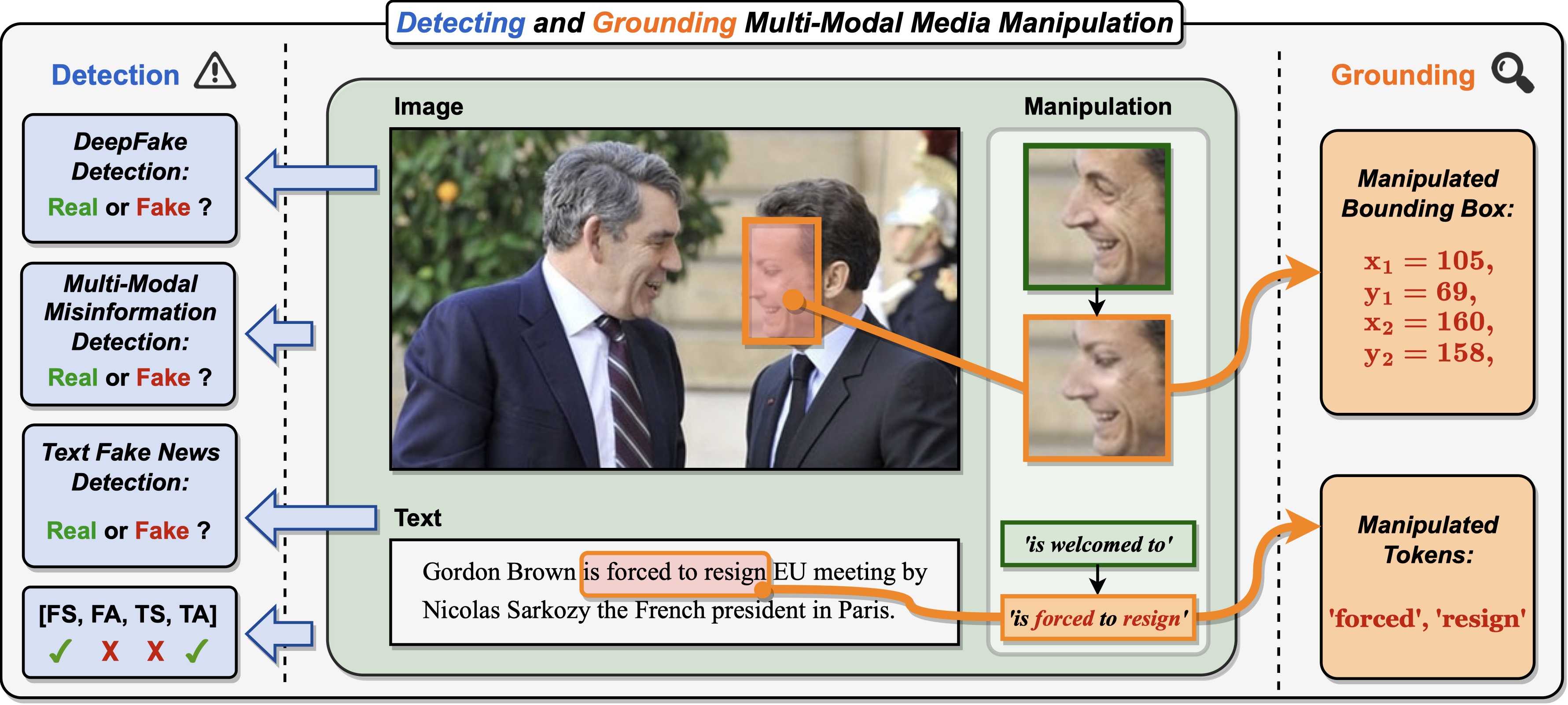
- Integrates large language models (LLMs) to analyze linguistic inconsistencies (e.g., lip-sync errors) and generate interpretable explanations for detection decisions.
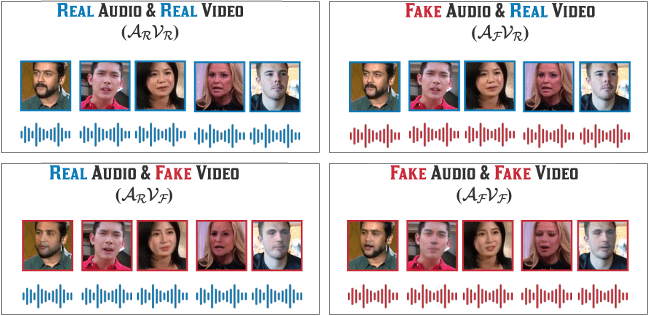
Experimental results
Research questions
- RQ1How have deepfake detection methods evolved from single-modal to multi-modal detection in response to increasingly realistic face-swapped and reenacted content?
- RQ2What are the key technical differences and performance trade-offs among detection models based on VAEs, GANs, and diffusion models?
- RQ3How can multi-modal fusion techniques effectively align and exploit correlations between video, audio, and text to improve detection accuracy?
- RQ4What are the primary challenges in achieving generalization and robustness of deepfake detectors across unseen datasets, manipulation types, and post-processing techniques?
- RQ5How can large language models (LLMs) be leveraged to improve explainability and detect subtle linguistic-visual inconsistencies in multi-modal deepfakes?
Key findings
- This survey is the first to comprehensively cover face-centric deepfake detection across single-modal and multi-modal settings, including emerging diffusion model-based generation.
- Multi-modal detection methods, especially those using attention-based fusion and cross-modal alignment, significantly outperform single-modal baselines in detecting complex audio-visual and text-visual deepfakes.
- Ensemble models and destruction-aware training improve robustness against adversarial attacks and distribution shifts, enhancing real-world deployability.
- Current detection models suffer from poor generalization across datasets and manipulation types, with performance dropping significantly under domain shift or post-processing.
- Large language models (LLMs) show strong potential in detecting linguistic-visual inconsistencies and generating interpretable explanations, improving trust and transparency in detection systems.
- Real-time deepfake detection remains a major challenge due to high computational cost of multi-modal processing, highlighting the need for efficient architectures and streaming inference.
Read this paper
Open the full text in the Nubint reader and ask about any passage as you read.
Read this paper on NubintThis review was generated by AI from the original paper. Please check the paper before citing it.