
[Paper Review] Exact solution of the Bose Hubbard model with unidirectional hopping
This paper presents the first exact solution of a non-Hermitian Bose-Hubbard model with unidirectional hopping, proving its integrability via the algebraic Bethe ansatz and deriving exact Bethe ansatz equations. The study reveals a superfluid-Mott insulator transition at integer filling and demonstrates that the non-Hermitian skin effect persists under interaction but is fully suppressed in the Mott insulator phase, establishing a new class of integrable non-Hermitian many-body systems without Hermitian counterparts.
A one-dimensional Bose Hubbard model with unidirectional hopping is shown to be exactly solvable. Applying the algebraic Bethe ansatz method, we prove the integrability of the model and derive the Bethe ansatz equations. The exact eigenvalue spectrum can be obtained by solving these equations. The distribution of Bethe roots reveals the presence of a superfluid-Mott insulator transition at the ground state, and the critical point is determined. By adjusting the boundary parameter, we demonstrate the existence of non-Hermitian skin effect even in the presence of interaction, but it is completely suppressed for the Mott insulator state in the thermodynamical limit. Our result represents a new class of exactly solvable non-Hermitian many-body systems, which have no Hermitian correspondence and can be used as a benchmark for various numerical techniques developed for non-Hermitian many-body systems.
Motivation & Objective
- To construct a new class of exactly solvable non-Hermitian many-body systems without Hermitian counterparts.
- To investigate the interplay between non-Hermiticity, many-body interactions, and quantum phase transitions.
- To provide an exact benchmark for numerical methods in non-Hermitian quantum many-body physics.
- To explore the persistence of the non-Hermitian skin effect in interacting systems and its suppression in the Mott insulator phase.
Proposed method
- Employing the algebraic Bethe ansatz method to solve the Hamiltonian with unidirectional hopping and repulsive on-site interaction.
- Deriving the Bethe ansatz equations from the Yang-Baxter equation, ensuring integrability of the model.
- Using the transfer matrix formalism with a non-traceless R-matrix and K-matrix to construct conserved quantities.
- Applying the coordinate Bethe ansatz to explicitly construct eigenstates and analyze wavefunction localization.
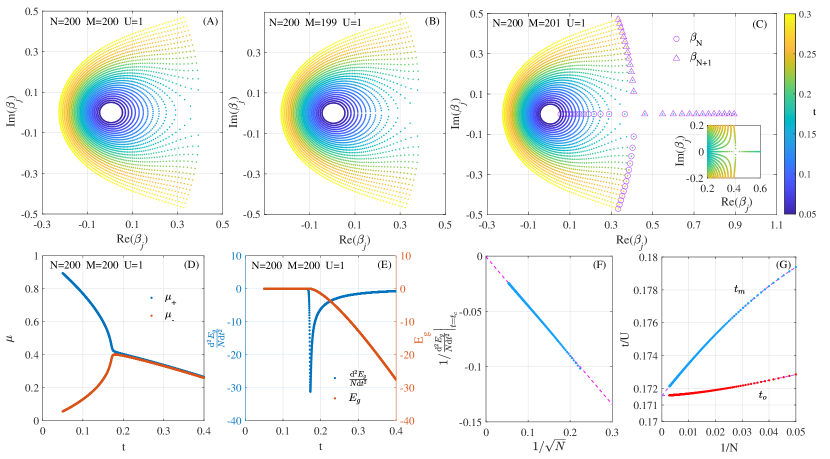
- Analyzing the distribution of Bethe roots to identify the superfluid-Mott insulator transition point.
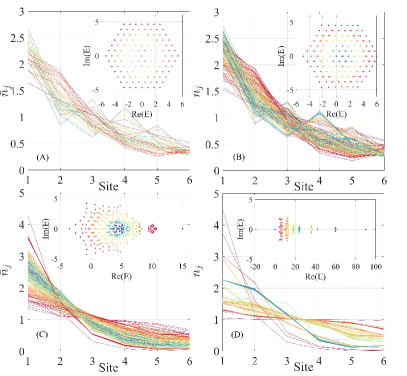
- Evaluating the particle number distribution to demonstrate the non-Hermitian skin effect and its suppression in the Mott phase.
Experimental results
Research questions
- RQ1Does a non-Hermitian Bose-Hubbard model with unidirectional hopping exhibit integrability and allow for an exact solution?
- RQ2What is the nature of the quantum phase transition between superfluid and Mott insulator phases in this non-Hermitian model?
- RQ3Can the non-Hermitian skin effect survive in the presence of strong on-site repulsive interactions?
- RQ4How does the boundary parameter ε influence the localization and spectrum of the system?
- RQ5Is the non-Hermitian skin effect suppressed in the Mott insulator phase, and if so, why?
Key findings
- The model is exactly solvable via the algebraic Bethe ansatz, with the full energy spectrum determined by solving the derived Bethe ansatz equations.
- The ground state energy is real, and a superfluid-Mott insulator transition is identified at integer filling by tuning the interaction-to-hopping ratio.
- The critical point of the transition is independent of the boundary parameter ε in the thermodynamic limit.
- The non-Hermitian skin effect persists in interacting states, with wavefunctions showing asymmetric localization proportional to the system size.
- The skin effect is completely suppressed in the Mott insulator phase, where the ground state exhibits uniform particle distribution.
- The system constitutes a new class of non-Hermitian many-body models without Hermitian counterparts, serving as an exact benchmark for numerical methods.
Read this paper
Open the full text in the Nubint reader and ask about any passage as you read.
Read this paper on NubintThis review was generated by AI from the original paper. Please check the paper before citing it.