
[Paper Review] ExaRanker: Explanation-Augmented Neural Ranker
ExaRanker proposes a neural ranker that improves retrieval performance by generating natural language explanations alongside relevance labels during fine-tuning, using LLMs like GPT-3.5 to synthesize explanations for training data. The model achieves performance on par with larger models fine-tuned on 3x more data, while incurring no inference cost and enabling on-demand explanation generation.
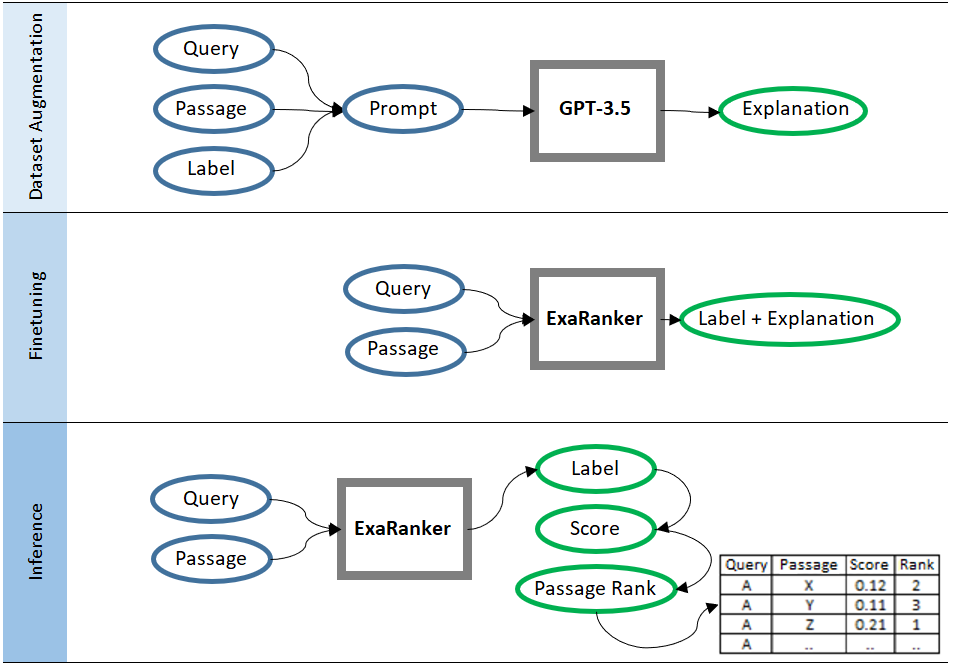
Recent work has shown that inducing a large language model (LLM) to generate explanations prior to outputting an answer is an effective strategy to improve performance on a wide range of reasoning tasks. In this work, we show that neural rankers also benefit from explanations. We use LLMs such as GPT-3.5 to augment retrieval datasets with explanations and train a sequence-to-sequence ranking model to output a relevance label and an explanation for a given query-document pair. Our model, dubbed ExaRanker, finetuned on a few thousand examples with synthetic explanations performs on par with models finetuned on 3x more examples without explanations. Furthermore, the ExaRanker model incurs no additional computational cost during ranking and allows explanations to be requested on demand.
Motivation & Objective
- To reduce the dependency on large-scale labeled training data in neural ranking by incorporating natural language explanations as additional supervision.
- To investigate whether generating explanations prior to relevance labels improves model performance in retrieval tasks.
- To enable low-resource retrieval settings by leveraging synthetic explanations from large language models like GPT-3.5.
- To maintain inference efficiency while adding explanation generation capability to ranking models.
- To explore the complementary role of explanation-augmented training with existing methods such as InPars and Promptagator.
Proposed method
- Fine-tune a sequence-to-sequence model to generate a relevance label (true/false) followed by a natural language explanation for query-document pairs.
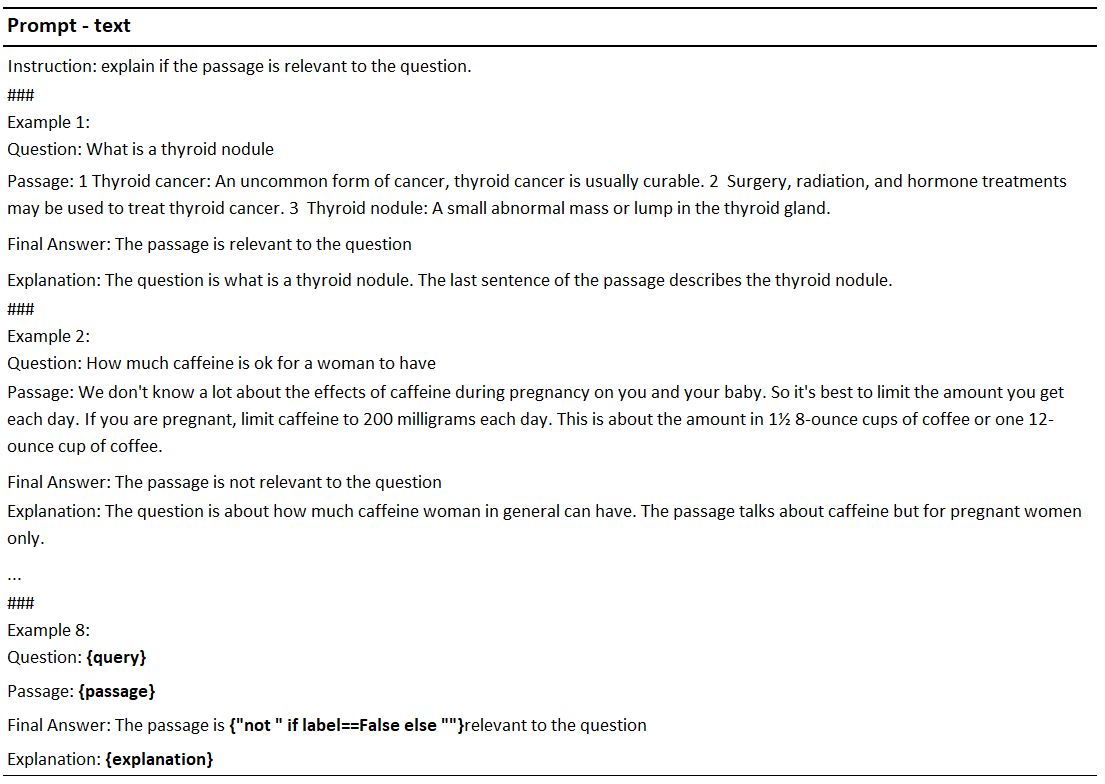
- Use GPT-3.5 with few-shot prompting to generate synthetic explanations for 30k query-passage pairs from the MS MARCO dataset.
- Structure the training data as: {label}. Explanation: {generated explanation} to guide the model to predict the label first.
- Apply greedy decoding with a 256-token limit to generate explanations during data augmentation.
- Use only the label token probability during inference, preserving computational efficiency.
- Conduct ablation studies comparing label-first vs. explanation-first generation order and evaluate on multiple BEIR benchmark datasets.
Experimental results
Research questions
- RQ1Does incorporating natural language explanations during fine-tuning improve neural ranking performance, especially in low-data regimes?
- RQ2Is the order of generation—label before explanation versus explanation before label—critical for model effectiveness?
- RQ3Can LLMs like GPT-3.5 effectively generate high-quality, task-relevant explanations for retrieval data at scale?
- RQ4Does explanation-augmented training remain beneficial when combined with large-scale pre-existing labeled data?
- RQ5Can the model generate explanations on demand without increasing inference cost?
Key findings
- ExaRanker fine-tuned on only 30k examples (15k positive, 15k negative) with synthetic explanations achieves nDCG@10 of 0.680, matching models fine-tuned on 3x more data without explanations.
- The model that generates the label before the explanation outperforms the reverse order by 9.6 nDCG@10 points, contrary to chain-of-thought reasoning patterns.
- When further fine-tuned on a large 400k positive pair dataset, the addition of explanations yields only a 0.2 nDCG@10 improvement, indicating diminishing returns with abundant data.
- The model incurs no additional computational cost during inference, as only the label token probability is used.
- The method enables on-demand explanation generation for relevance predictions without altering the ranking pipeline.
- The approach is complementary to existing methods like InPars and Promptagator, suggesting potential for integration in future work.
Read this paper
Open the full text in the Nubint reader and ask about any passage as you read.
Read this paper on NubintThis review was generated by AI from the original paper. Please check the paper before citing it.