
[Paper Review] Exceptional Bound States in the Continuum
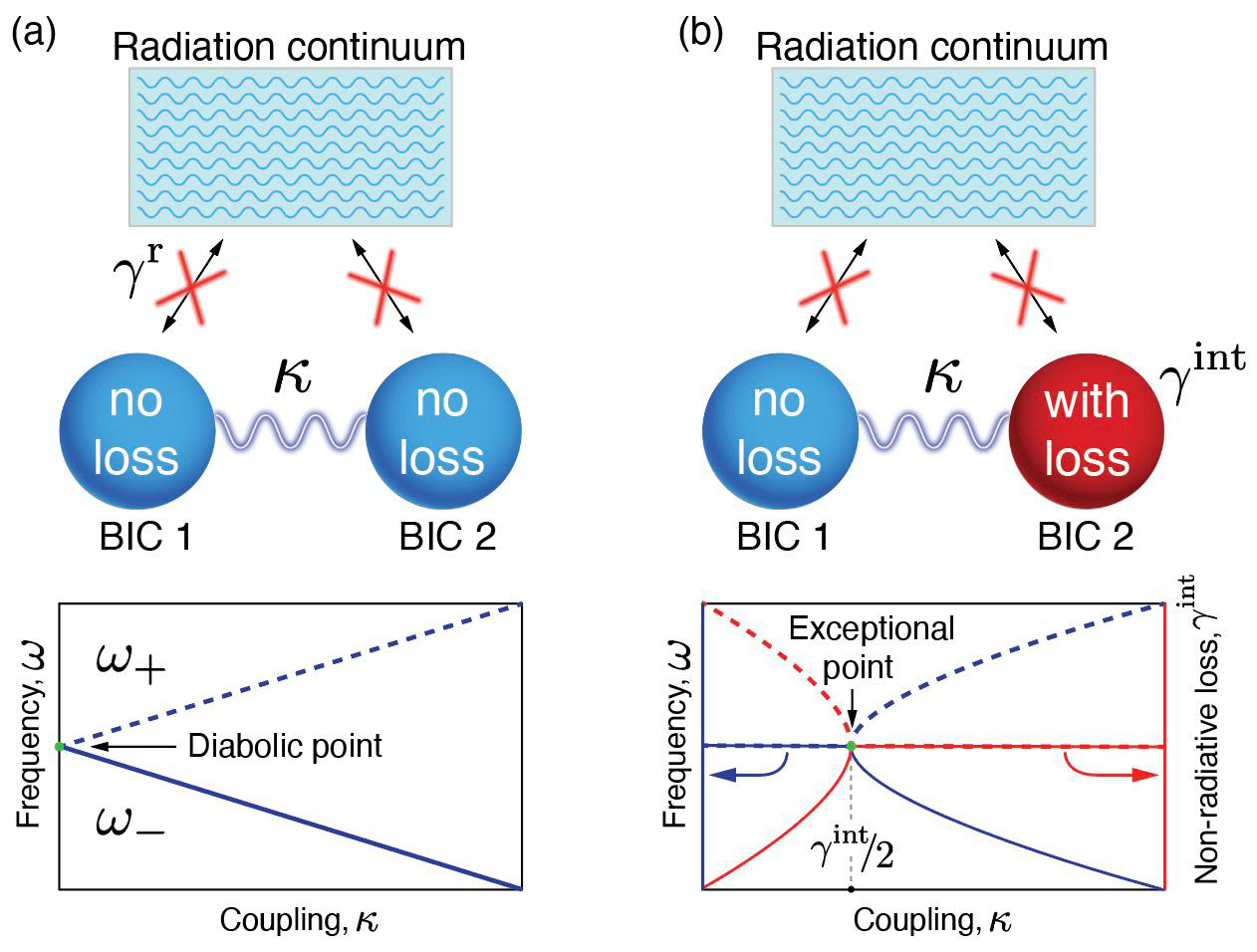
This paper proposes a new class of non-Hermitian singularities, Exceptional Bound States in the Continuum (EP-BICs), by coalescing multiple BICs into a single exceptional point of arbitrary order. The resulting states inherit the non-radiating behavior of BICs and the extreme sensitivity of EPs, with losses scaling as $p^{2/m}$ under symmetry-breaking perturbations, enabling enhanced sensing beyond conventional BICs.
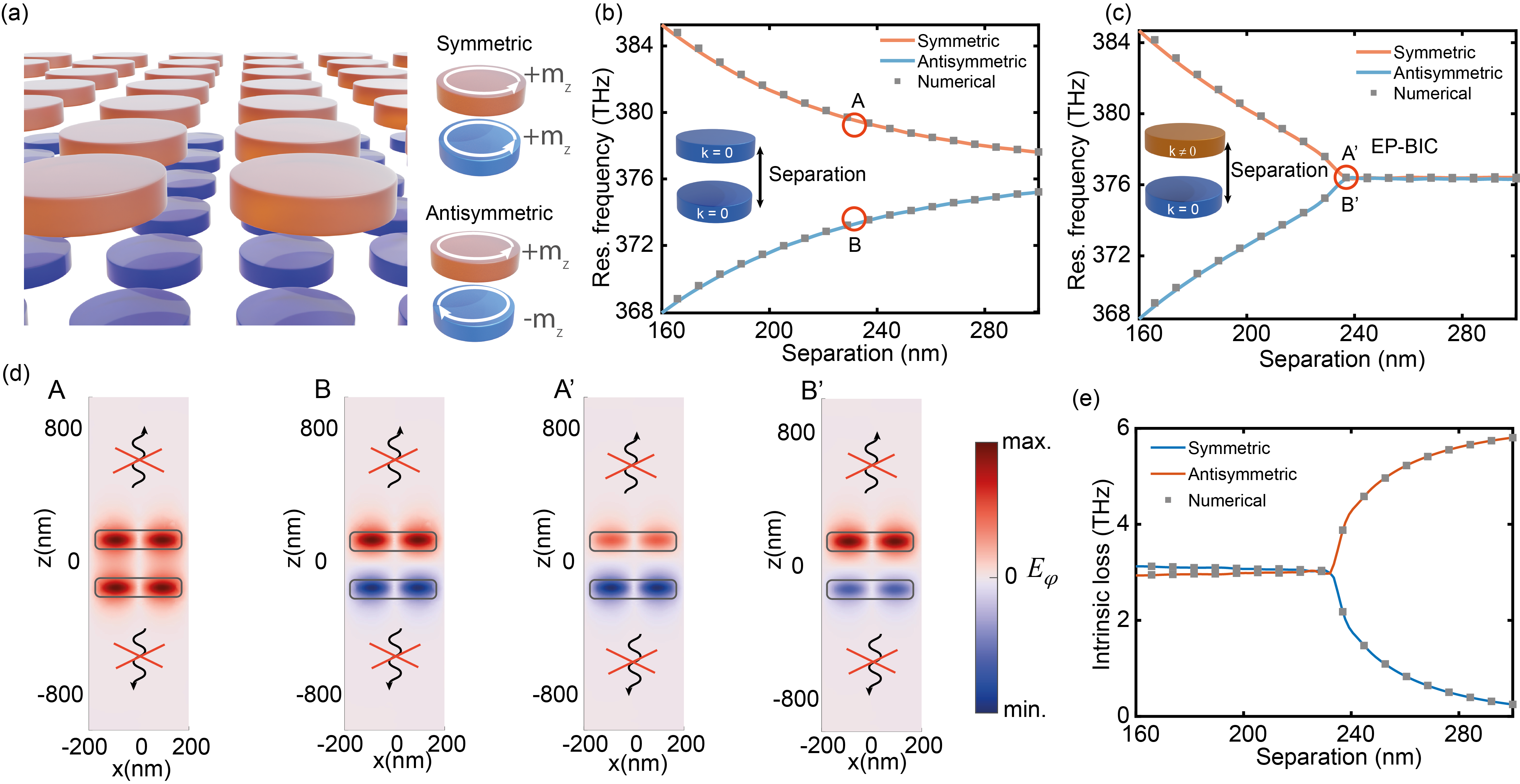
Bound states in the continuum (BICs) and exceptional points (EPs) are unique singularities of non-Hermitian systems. BICs demonstrate enhancement of the electromagnetic field at the nanoscale, while EPs exhibit high sensitivity to small perturbations. Here, we demonstrate that several BICs can be merged into one EP, forming an EP-BIC. The resulting state inherits properties from both BICs and EP, namely, it does not radiate and shows extremely high sensitivity to perturbations. We validate the developed theory with numerical simulations and demonstrate the formation of second and third-order EP-BICs in stacked dielectric metasurfaces. We also show that the losses of the resulting leaky resonances exhibit an anomalous behavior when the unit cell is broken, which differs from the asymptotics commonly attributed to BICs.
Motivation & Objective
- To explore the coalescence of multiple bound states in the continuum (BICs) into a single exceptional point (EP) of arbitrary order.
- To develop a theoretical framework for realizing higher-order EP-BICs in stacked dielectric metasurfaces.
- To demonstrate that EP-BICs retain infinite radiative Q-factors while exhibiting enhanced sensitivity to perturbations.
- To validate the theory through numerical simulations of bilayer and trilayer metasurfaces in the visible range.
- To establish a generalized loss scaling law for quasi-BICs emerging from EP-BICs of order $m$.
Proposed method
- Utilizes temporal coupled mode theory (TCMT) to model the dynamics of eigenmodes in open, non-Hermitian systems.
- Employs a tight-binding Hamiltonian model to describe coupled BICs in multilayer metasurfaces, with asymmetric intrinsic losses to enable EP-BIC formation.
- Applies a generalized Newton-Puisseux series expansion to derive the perturbation dependence of losses from EP-BICs of order $m$, yielding $\gamma_h \propto p^{2/m}$.
- Performs full-wave numerical simulations using finite-element methods to compute resonance frequencies, intrinsic losses ($\gamma^{\text{int}}$), and radiation losses ($\gamma^{\text{r}}$) in dielectric metasurfaces.
- Introduces a perturbation parameter $p$ (e.g., $\Delta r$) to break unit cell symmetry and analyze the resulting loss evolution.
- Validates the theoretical loss scaling by comparing simulated $\gamma_{\text{tot}}$ evolution with the derived $p^{2/m}$ asymptotics for second and third-order EP-BICs.
Experimental results
Research questions
- RQ1Can multiple BICs coalesce into a single exceptional point, forming a higher-order non-Hermitian singularity?
- RQ2What is the scaling behavior of losses in quasi-BICs emerging from an EP-BIC under small symmetry-breaking perturbations?
- RQ3How does the intrinsic loss distribution affect the formation of EP-BICs in multilayer metasurfaces?
- RQ4Can the formalism be generalized to realize EP-BICs of arbitrary order $m$?
- RQ5What are the implications of $p^{2/m}$ loss scaling for sensing applications compared to conventional BICs?
Key findings
- Second- and third-order EP-BICs are successfully realized in bilayer and trilayer dielectric metasurfaces with refractive index $n=4+ik$, demonstrating coalescence of multiple BICs into a single exceptional point.
- The resulting EP-BICs exhibit non-radiating behavior with infinite radiative Q-factor, while simultaneously showing enhanced sensitivity to perturbations.
- Losses in quasi-BICs emerging from an EP-BIC of order $m$ scale as $p^{2/m}$, with $m=3$ yielding $p^{2/3}$ dependence, significantly steeper than the quadratic $p^2$ scaling of conventional BICs.
- Numerical simulations confirm that only intrinsic losses ($\gamma^{\text{int}}$) contribute to the linear trend in loss evolution, while radiation losses ($\gamma^{\text{r}}$) grow quadratically and saturate quickly in symmetric modes.
- Field distributions show that increasing the perturbation $\Delta r$ localizes the symmetric mode on the bottom metasurface, reducing its intrinsic loss and weakening its $\Delta r$ dependence.
- The derived generalized loss scaling law $\gamma_h = \gamma_{\text{EP}} + \text{Im}\{\alpha \zeta^{h-1}\} c_0^{1/m} p^{2/m}$ accurately predicts the behavior of quasi-BICs from EP-BICs of any order $m$.
Read this paper
Open the full text in the Nubint reader and ask about any passage as you read.
Read this paper on NubintThis review was generated by AI from the original paper. Please check the paper before citing it.