
[Paper Review] Expanding Low-Density Latent Regions for Open-Set Object Detection
This paper proposes OpenDet, a novel open-set object detection framework that expands low-density regions in the latent space to improve unknown object identification. By combining instance-level contrastive learning and uncertainty-aware unknown probability estimation, OpenDet reduces Absolute Open-Set Errors by 25%-35% across six benchmarks without compromising close-set accuracy.
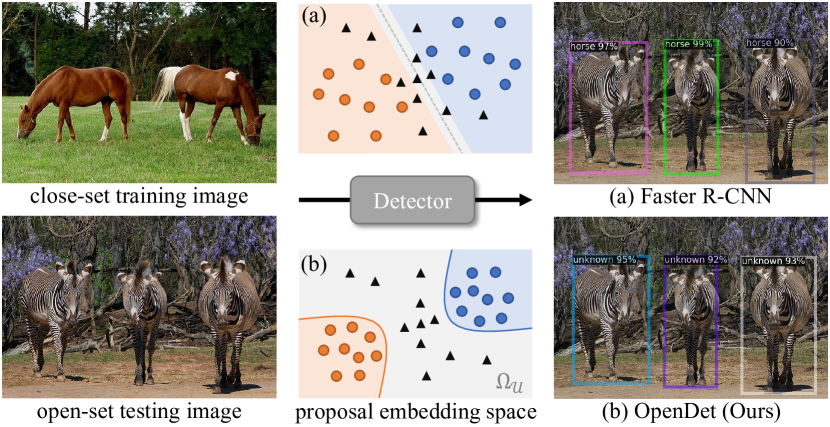
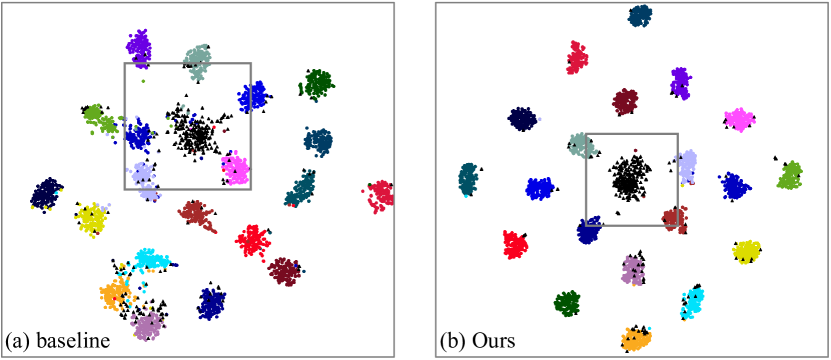
Modern object detectors have achieved impressive progress under the close-set setup. However, open-set object detection (OSOD) remains challenging since objects of unknown categories are often misclassified to existing known classes. In this work, we propose to identify unknown objects by separating high/low-density regions in the latent space, based on the consensus that unknown objects are usually distributed in low-density latent regions. As traditional threshold-based methods only maintain limited low-density regions, which cannot cover all unknown objects, we present a novel Open-set Detector (OpenDet) with expanded low-density regions. To this aim, we equip OpenDet with two learners, Contrastive Feature Learner (CFL) and Unknown Probability Learner (UPL). CFL performs instance-level contrastive learning to encourage compact features of known classes, leaving more low-density regions for unknown classes; UPL optimizes unknown probability based on the uncertainty of predictions, which further divides more low-density regions around the cluster of known classes. Thus, unknown objects in low-density regions can be easily identified with the learned unknown probability. Extensive experiments demonstrate that our method can significantly improve the OSOD performance, e.g., OpenDet reduces the Absolute Open-Set Errors by 25%-35% on six OSOD benchmarks. Code is available at: https://github.com/csuhan/opendet2.
Motivation & Objective
- Address the challenge of open-set object detection (OSOD), where unknown categories are misclassified as known classes under the close-set assumption.
- Overcome the limitation of traditional threshold-based methods that maintain only limited low-density regions, failing to cover all unknown objects.
- Develop a method that identifies unknown objects by expanding low-density regions in the latent space without requiring additional training data or complex post-processing.
- Maintain high close-set detection accuracy while significantly improving open-set generalization performance.
- Enable direct deployment of a detector trained on closed-set data to open-set environments with minimal modification.
Proposed method
- Introduce a two-learner framework: Contrastive Feature Learner (CFL) to enhance intra-class compactness and inter-class separation of known classes, thereby expanding the low-density latent space for unknowns.
- Use Unknown Probability Learner (UPL) to estimate instance-level uncertainty and assign unknown probabilities based on prediction confidence, enabling dynamic thresholding for unknown detection.
- Leverage instance-level contrastive learning to minimize feature variance within known classes, which naturally increases the volume of low-density regions for unknown objects.
- Optimize UPL to preserve close-set accuracy while learning a threshold-like unknown probability that partitions more of the latent space into low-density regions.
- During inference, classify an object as unknown if its unknown probability exceeds that of all known classes, enabling direct open-set detection.
- Train the model end-to-end using only closed-set annotations, avoiding the need for unknown class data or complex post-processing.
Experimental results
Research questions
- RQ1Can expanding low-density regions in the latent space improve the detection of unknown objects in open-set object detection?
- RQ2How can we effectively identify unknown objects without relying on additional unknown class annotations or complex post-processing?
- RQ3To what extent can instance-level contrastive learning and uncertainty-based probability estimation enhance the separation between known and unknown classes?
- RQ4Can the proposed method maintain high close-set detection accuracy while significantly improving open-set generalization?
- RQ5How does the performance of the proposed method compare to state-of-the-art baselines that require access to unknown class data or complex training procedures?
Key findings
- OpenDet reduces Absolute Open-Set Errors (AOSE) by 25%-35% across six open-set object detection benchmarks compared to prior methods.
- On the PASCAL VOC and COCO-based open-set settings, OpenDet achieves 14.95 WI and 11,286 AOSE with ResNet-50, outperforming FR-CNN (18.39 WI, 15,118 AOSE).
- With Swin-T backbone, OpenDet achieves 12.51 WI and 9,875 AOSE, showing consistent improvements over baseline detectors.
- OpenDet outperforms ORE and DS even without access to unknown class annotations, achieving 59.01 mAP K and 5,781 AOSE in open-world detection, comparable to Oracle.
- The ablation study confirms that both CFL and UPL contribute significantly to performance, with UPL enabling broader low-density region expansion.
- Qualitative results show OpenDet successfully detects unknown objects previously misclassified as known classes, with failure cases mainly in dense object scenes or background misclassification.
Read this paper
Open the full text in the Nubint reader and ask about any passage as you read.
Read this paper on NubintThis review was generated by AI from the original paper. Please check the paper before citing it.