
[Paper Review] Expectation-maximization for structure determination directly from cryo-EM micrographs
This paper proposes a stochastic approximate expectation-maximization (SAEM) algorithm that reconstructs 3D molecular structures directly from cryo-EM micrographs, bypassing the need for particle picking. By marginalizing over unknown particle locations and orientations, the method achieves high-resolution structure recovery even at low signal-to-noise ratios (SNR), successfully reconstructing a 31³-voxel BPTI mutant at SNR=0.75 and a smaller 11³-voxel volume at SNR=3.5 with high fidelity.
A single-particle cryo-electron microscopy (cryo-EM) measurement, called a micrograph, consists of multiple two-dimensional tomographic projections of a three-dimensional (3-D) molecular structure at unknown locations, taken under unknown viewing directions. All existing cryo-EM algorithmic pipelines first locate and extract the projection images, and then reconstruct the structure from the extracted images. However, if the molecular structure is small, the signal-to-noise ratio (SNR) of the data is very low, making it challenging to accurately detect projection images within the micrograph. Consequently, all standard techniques fail in low-SNR regimes. To recover molecular structures from measurements of low SNR, and in particular small molecular structures, we devise an approximate expectation-maximization algorithm to estimate the 3-D structure directly from the micrograph, bypassing the need to locate the projection images. We corroborate our computational scheme with numerical experiments and present successful structure recoveries from simulated noisy measurements.
Motivation & Objective
- To overcome the fundamental limitation of cryo-EM particle picking in low signal-to-noise ratio (SNR) regimes, especially for small molecular structures.
- To develop a consistent estimator for 3D structure determination by marginalizing over nuisance parameters (locations and orientations) instead of estimating them explicitly.
- To enable high-resolution 3D reconstruction directly from micrographs without prior particle extraction, particularly for molecules below 40 kDa.
- To validate the method on simulated micrographs with varying SNR and volume sizes, demonstrating robustness and resolution fidelity.
Proposed method
- The method employs a stochastic approximate expectation-maximization (SAEM) framework to iteratively estimate the 3D structure while integrating over unknown particle locations and orientations.
- It uses a likelihood model that accounts for the 2D projection of the 3D volume under unknown rotations and translations, formulated as a probabilistic model over micrograph patches.
- The E-step approximates the posterior distribution of pose parameters (rotation and shift) using Monte Carlo sampling over a finite set of rotation angles.
- The M-step updates the 3D structure estimate by maximizing the expected log-likelihood, using spherical harmonic coefficients up to a maximum degree ℓ_max.
- The algorithm is applied iteratively to refine the 3D volume estimate, with convergence monitored via the FSC curve.
- A particle-picking-like procedure is derived as a byproduct by computing the marginal likelihood over shifts, enabling location inference from the estimated structure.
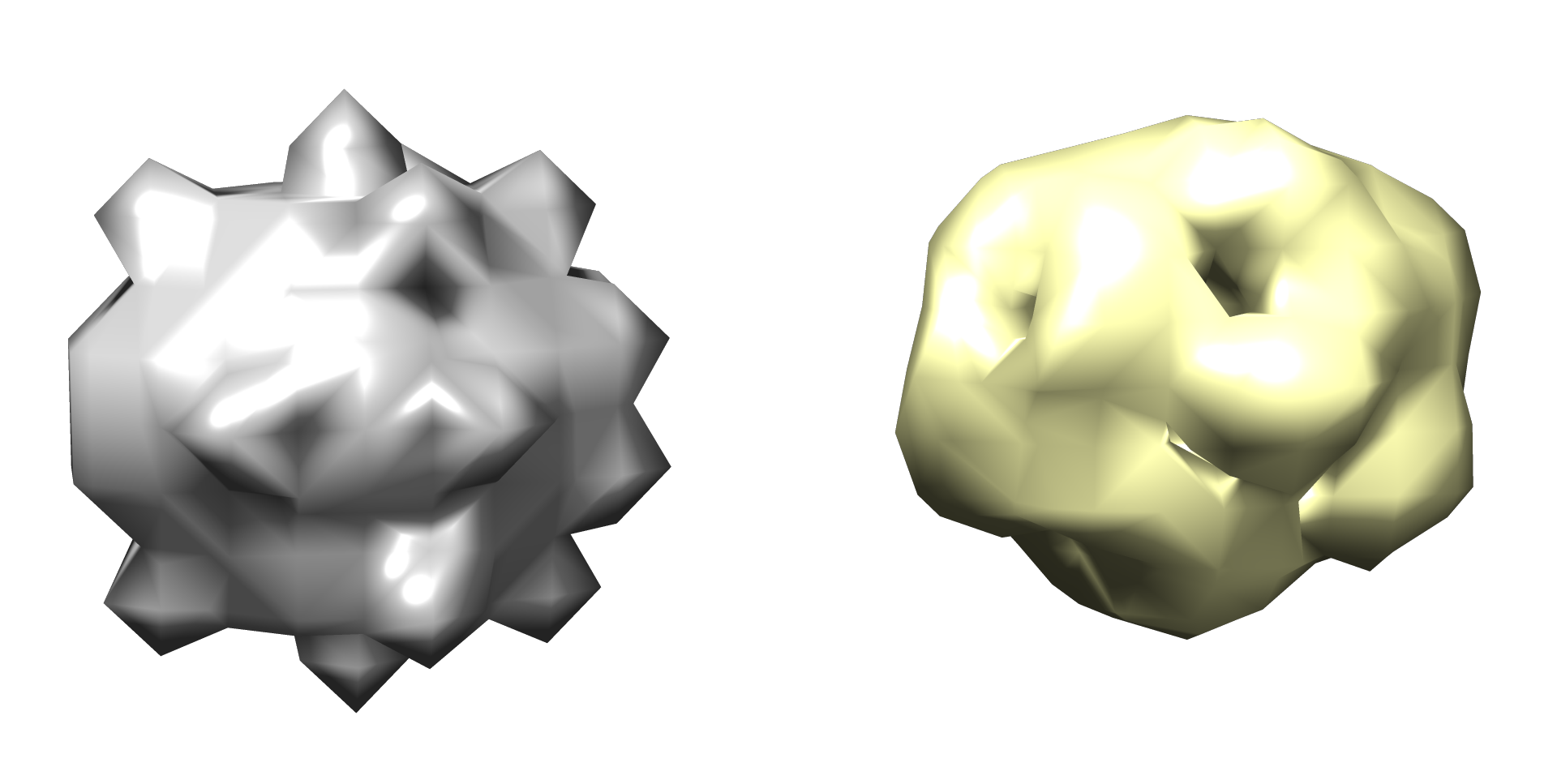
Experimental results
Research questions
- RQ1Can 3D cryo-EM structure determination be achieved directly from micrographs without particle picking, especially in low-SNR regimes?
- RQ2Is it possible to achieve consistent and high-resolution 3D reconstruction by marginalizing over unknown particle locations and orientations instead of estimating them?
- RQ3How does the performance of direct reconstruction compare to particle-picking-based pipelines when SNR is very low?
- RQ4To what extent can the proposed SAEM algorithm recover fine structural details (e.g., up to ℓ_max=10) from noisy micrographs?
- RQ5Can the method be used to infer particle locations indirectly via likelihood-based shift estimation, even if not intended as a primary particle picker?
Key findings
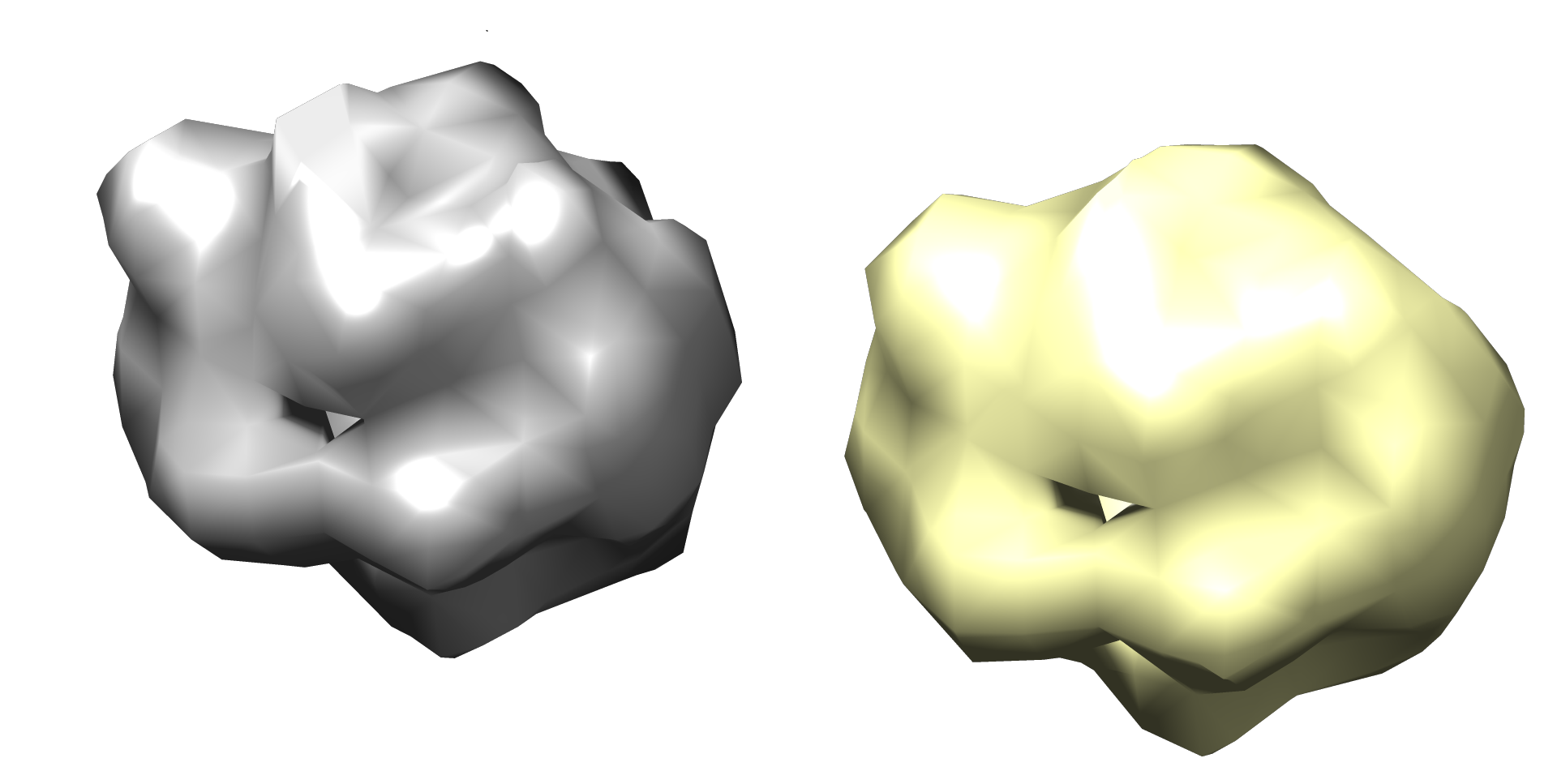
- The method successfully reconstructed a 31³-voxel BPTI mutant structure from a micrograph with SNR=0.75, achieving high-resolution fidelity despite the extremely low SNR.
- For a smaller 11³-voxel BPTI volume, the algorithm achieved accurate reconstruction at SNR=3.5, with visual and FSC-based validation showing strong agreement with the ground truth.
- The FSC curve for the 31³-voxel reconstruction reached a resolution of ℓ_max=10, indicating recovery of high-frequency structural details.
- The method outperformed prior autocorrelation-based approaches in resolution and noise robustness, recovering up to ℓ_max=10 compared to ℓ_max=2 in earlier work.
- The indirect particle-picking procedure based on likelihood maximization successfully identified true particle shifts when SNR was sufficiently high, demonstrating the method’s internal consistency.
- The algorithm demonstrated robustness across different volume sizes and SNR levels, confirming the feasibility of direct 3D reconstruction under challenging conditions.
Better researchstarts right now
From reading papers to final review, dramatically reduce your research time.
No credit card · Free plan available
This review was created by AI and reviewed by human editors.