
[Paper Review] Experimental method for perching flapping-wing aerial robots
This paper presents a controlled experimental method enabling autonomous perching of a 700 g flapping-wing ornithopter on a branch using a guided flight sequence involving a launcher, controlled flapping flight, real-time leg-based misalignment compensation, and bistable claws. The method achieves successful perching in 6 out of 9 trials with minimal impact forces and no damage, demonstrating a critical step toward outdoor, long-range flapping-wing robot missions.
In this work, we present an experimental setup and guide to enable the perching of large flapping-wing robots. The combination of forward flight, limited payload, and flight oscillations imposes challenging conditions for localized perching. The described method details the different operations that are concurrently performed within the 4 second perching flight. We validate this experiment with a 700 g ornithopter and demonstrate the first autonomous perching flight of a flapping-wing robot on a branch. This work paves the way towards the application of flapping-wing robots for long-range missions, bird observation, manipulation, and outdoor flight.
Motivation & Objective
- To develop a repeatable, controlled experimental setup for perching large flapping-wing robots under indoor, constrained conditions.
- To address the challenge of perching on branches due to forward flight requirements, limited payload, and vertical oscillations in large ornithopters.
- To enable autonomous perching through integrated control of flight dynamics, vision-based branch detection, and mechanical claw actuation.
- To validate the method with a 700 g ornithopter, demonstrating the first autonomous perching flight on a branch.
- To lay the groundwork for future outdoor, vision-based perching applications in bird observation, manipulation, and long-range missions.
Proposed method
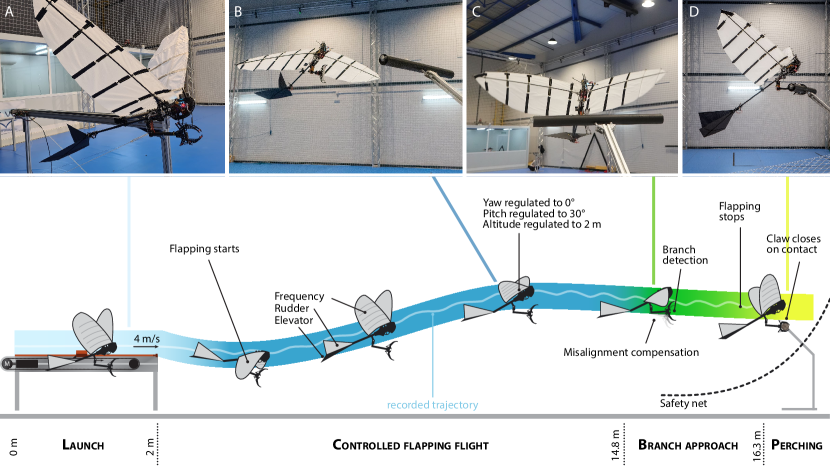
- A 2 m double-rail launcher accelerates the 700 g ornithopter to 4 m/s with consistent speed and direction, ensuring repeatable flight initiation.
- An onboard triple-loop PI controller maintains pitch at 30° and controls altitude via regulated flapping frequency, achieving stable flight at 2.5–3 m/s.
- A real-time optical detection system on the claw's leg enables 50 Hz feedback to a leg microcontroller, which adjusts the claw's angle to align with the branch during approach.
- At 150 cm from the branch, the system activates leg-based misalignment compensation to improve targeting accuracy despite flight position errors.
- At 20 cm from the branch, flapping is stopped and bistable claws—closing in 25 ms with 2 Nm torque—engage to secure the robot.
- Soft silicone pads and spikes on the claws provide sufficient friction to counteract center-of-mass offsets and prevent detachment.
Experimental results
Research questions
- RQ1How can a large flapping-wing robot achieve consistent, repeatable perching on a branch despite forward flight and vertical oscillations?
- RQ2What control and mechanical strategies are required to enable autonomous perching with minimal impact forces?
- RQ3How effective is real-time leg-based misalignment compensation in improving perching accuracy?
- RQ4Can a bistable claw system with sufficient torque and friction reliably secure a flapping-wing robot during perching?
- RQ5What is the performance and robustness of the full perching sequence in repeated trials under controlled conditions?
Key findings
- The experimental method enabled autonomous perching of a 700 g flapping-wing ornithopter on a 2 m-high branch in 6 out of 9 test flights.
- Flight trajectories reached the 2 m altitude target within 8–12 m of flight distance, with a maximum average vertical error of 16 cm.
- Lateral position errors rarely exceeded 60 cm, demonstrating sufficient flight control precision for perching.
- Impact forces were kept below 150 N due to low forward velocity (2.5–3 m/s) just before landing, minimizing damage risk.
- No damage occurred in any of the successful perching flights, and the second robot achieved perching without re-tuning, confirming system robustness.
- The bistable claw system closed in 25 ms with 2 Nm torque, and friction from silicone pads and spikes effectively compensated for center-of-mass offsets.
Read this paper
Open the full text in the Nubint reader and ask about any passage as you read.
Read this paper on NubintThis review was generated by AI from the original paper. Please check the paper before citing it.