
[Paper Review] Experimental Study: Enhancing Voice Spoofing Detection Models with wav2vec 2.0
This paper proposes enhancing voice spoofing detection by using a fine-tuned wav2vec 2.0 model as a feature extractor, selecting and fine-tuning specific Transformer layers from the pretrained model. The approach achieves state-of-the-art performance on the ASVspoof 2019 LA dataset, with a minimum t-DCF of 0.0032 and EER of 0.12% using XLS-R(1B) with RawNet2.
Conventional spoofing detection systems have heavily relied on the use of handcrafted features derived from speech data. However, a notable shift has recently emerged towards the direct utilization of raw speech waveforms, as demonstrated by methods like SincNet filters. This shift underscores the demand for more sophisticated audio sample features. Moreover, the success of deep learning models, particularly those utilizing large pretrained wav2vec 2.0 as a featurization front-end, highlights the importance of refined feature encoders. In response, this research assessed the representational capability of wav2vec 2.0 as an audio feature extractor, modifying the size of its pretrained Transformer layers through two key adjustments: (1) selecting a subset of layers starting from the leftmost one and (2) fine-tuning a portion of the selected layers from the rightmost one. We complemented this analysis with five spoofing detection back-end models, with a primary focus on AASIST, enabling us to pinpoint the optimal configuration for the selection and fine-tuning process. In contrast to conventional handcrafted features, our investigation identified several spoofing detection systems that achieve state-of-the-art performance in the ASVspoof 2019 LA dataset. This comprehensive exploration offers valuable insights into feature selection strategies, advancing the field of spoofing detection.
Motivation & Objective
- To improve voice spoofing detection by leveraging large pretrained wav2vec 2.0 models as deep audio feature extractors instead of handcrafted features.
- To address domain mismatch between general-purpose pretrained models and spoofing detection tasks through selective layer selection and fine-tuning.
- To identify optimal configurations of wav2vec 2.0—specifically, the number of selected and fine-tuned Transformer layers—for spoofing countermeasure systems.
- To evaluate the effectiveness of this approach across multiple back-end models, particularly AASIST and RawNet2, on the ASVspoof 2019 LA benchmark.
- To establish a new state-of-the-art performance baseline for spoofing detection using transfer learning with wav2vec 2.0.
Proposed method
- Utilizes pretrained wav2vec 2.0 models (XLS-R(1B), XLSR-53) as a front-end feature extractor for raw audio waveforms.
- Applies a two-stage strategy: first, selects a subset of leftmost Transformer layers from the full model; second, fine-tunes a portion of the rightmost layers in the selected subset.
- Introduces two key hyperparameters: #TTL (number of selected Transformer layers) and #FTL (number of fine-tuned layers), optimized via grid search.
- Employs five spoofing detection back-ends—LCNN, Non-OFD, RawNet2, RawGAT-ST, and AASIST—on top of the wav2vec 2.0 front-end for evaluation.
- Trains the back-end models end-to-end using the extracted features, with a focus on AASIST for detailed ablation and configuration analysis.
- Leverages transfer learning principles to adapt the general-purpose wav2vec 2.0 representations to the specific domain of spoofing detection.
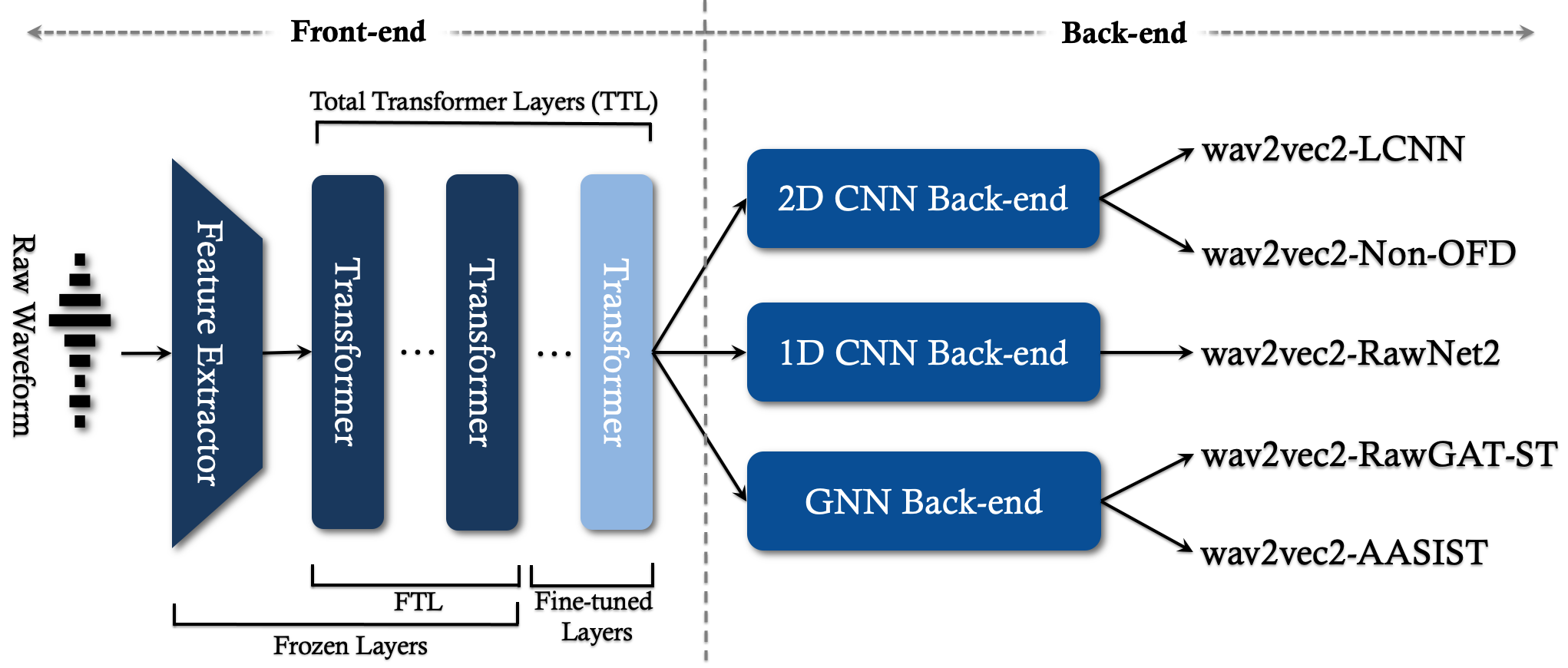
Experimental results
Research questions
- RQ1What is the optimal number of Transformer layers to extract from a pretrained wav2vec 2.0 model for voice spoofing detection?
- RQ2How does fine-tuning a subset of the selected layers improve domain adaptation and detection performance?
- RQ3Which combination of wav2vec 2.0 variant and back-end model achieves the best spoofing detection performance on the ASVspoof 2019 LA dataset?
- RQ4Can a carefully selected and fine-tuned wav2vec 2.0 front-end outperform traditional handcrafted features and existing state-of-the-art systems?
- RQ5What is the impact of model scale (e.g., XLS-R(1B) vs. XLSR-53) on spoofing detection performance when used with different back-end architectures?
Key findings
- The proposed method using XLS-R(1B) with RawNet2 as the back-end achieved a state-of-the-art minimum t-DCF of 0.0032 and EER of 0.12% on the ASVspoof 2019 LA dataset.
- Fine-tuning the rightmost layers of a selected subset of wav2vec 2.0’s Transformer layers significantly improved performance compared to using the frozen model.
- The optimal number of selected layers (#TTL) for spoofing detection on the ASVspoof 2019 LA dataset was found to be in the range {12, 15, 18}.
- The wav2vec 2.0 + AASIST system achieved an EER of 0.22% and t-DCF of 0.0063, demonstrating strong performance across multiple metrics.
- The XLS-R(1B) model outperformed smaller variants like XLSR-53 and BASE, highlighting the benefit of larger, more parameter-rich models when properly fine-tuned.
- The approach significantly outperformed prior state-of-the-art systems, including wav2vec 2.0 + VIB and wav2vec 2.0 + ASP, confirming the effectiveness of the proposed layer selection and fine-tuning strategy.
Read this paper
Open the full text in the Nubint reader and ask about any passage as you read.
Read this paper on NubintThis review was generated by AI from the original paper. Please check the paper before citing it.