
[Paper Review] Explainability for Large Language Models: A Survey
The paper surveys explainability techniques for Transformer-based LLMs, organizing methods by traditional fine-tuning and prompting paradigms, and discusses evaluation, debugging, and future challenges.
Large language models (LLMs) have demonstrated impressive capabilities in natural language processing. However, their internal mechanisms are still unclear and this lack of transparency poses unwanted risks for downstream applications. Therefore, understanding and explaining these models is crucial for elucidating their behaviors, limitations, and social impacts. In this paper, we introduce a taxonomy of explainability techniques and provide a structured overview of methods for explaining Transformer-based language models. We categorize techniques based on the training paradigms of LLMs: traditional fine-tuning-based paradigm and prompting-based paradigm. For each paradigm, we summarize the goals and dominant approaches for generating local explanations of individual predictions and global explanations of overall model knowledge. We also discuss metrics for evaluating generated explanations, and discuss how explanations can be leveraged to debug models and improve performance. Lastly, we examine key challenges and emerging opportunities for explanation techniques in the era of LLMs in comparison to conventional machine learning models.
Motivation & Objective
- Provide a taxonomy of explainability techniques for LLMs.
- Organize explanations by training paradigm (fine-tuning vs prompting).
- Summarize local and global explanation approaches for each paradigm.
- Discuss evaluation metrics for explanations and their use in debugging and improving models.
- Highlight challenges and future directions in LLM explainability.
Proposed method
- Proposes a taxonomy of explainability techniques for Transformer-based LLMs.
- Categorizes methods based on traditional fine-tuning vs prompting paradigms.
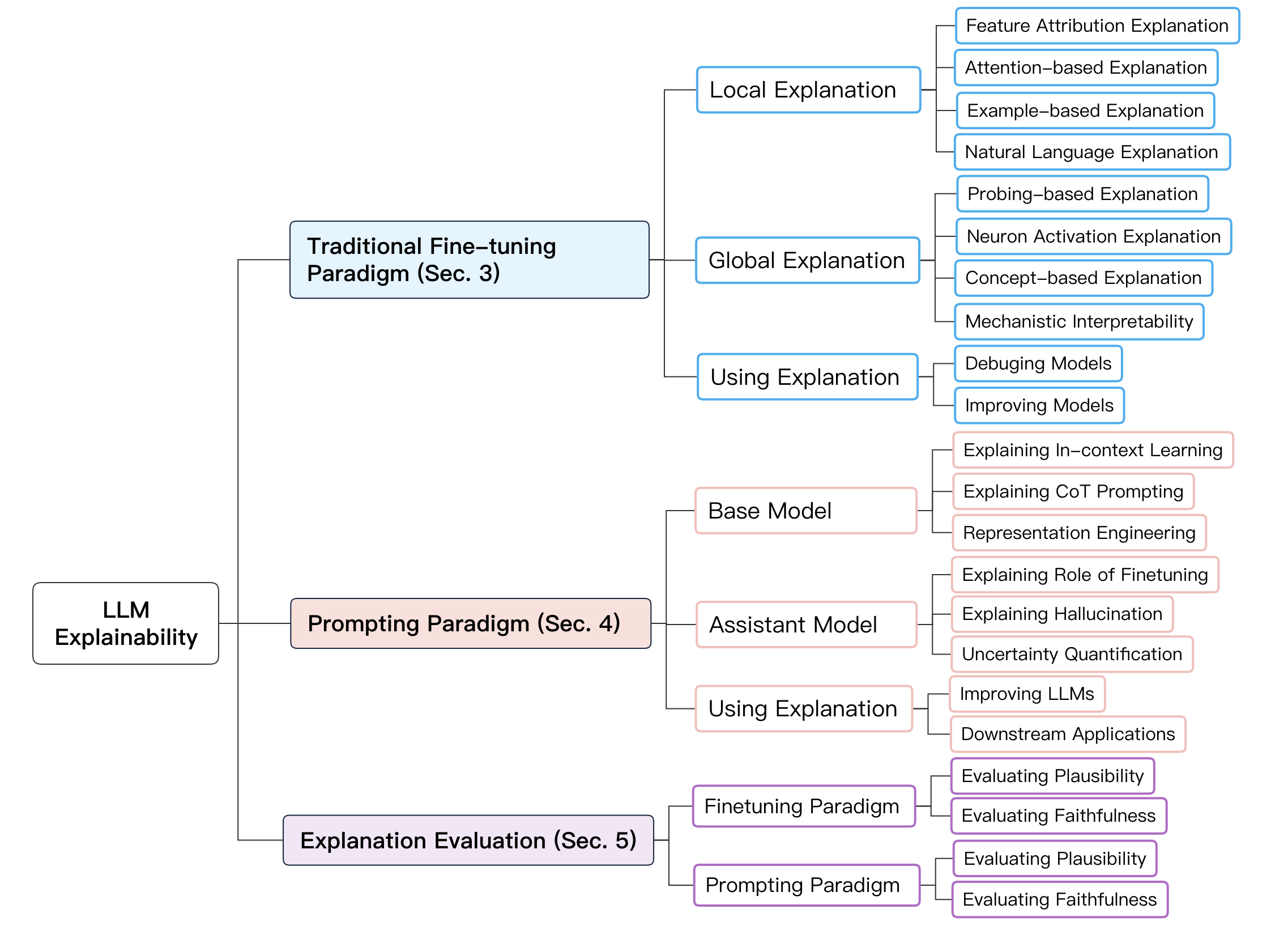
- Summarizes local explanations (feature attribution, attention, example-based, natural language) and global explanations (probing, neuron activation, concept-based) for each paradigm.
- Reviews evaluation metrics for explanations and their applicability.
- Discusses debugging, performance improvement, and future research directions in explainability.
Experimental results
Research questions
- RQ1How can we systematically categorize explainability techniques for LLMs?
- RQ2What local and global explanation methods exist for fine-tuned and prompting LLMs?
- RQ3What metrics evaluate the quality and usefulness of explanations?
- RQ4How can explanations be leveraged to debug models and improve performance?
- RQ5What are the key challenges and opportunities in LLM explainability compared to traditional DL models.
Key findings
- A taxonomy of LLM explainability techniques is provided, split into traditional fine-tuning and prompting paradigms.
- Within each paradigm, the paper surveys local explanations (feature attribution, attention-based, example-based, natural language) and global explanations (probing, neuron activation, concept-based).
- The survey discusses evaluation metrics for generated explanations and their applicability across paradigms.
- The work covers how explanations can be used to debug models and enhance performance.
- It also identifies challenges and emerging opportunities in LLM explainability vs. conventional DL models.

Read this paper
Open the full text in the Nubint reader and ask about any passage as you read.
Read this paper on NubintThis review was generated by AI from the original paper. Please check the paper before citing it.