
[Paper Review] Explainable Data-driven Modeling of Adsorption Energy in Heterogeneous Catalysis
The paper combines shallow ML models with post-hoc SHAP analysis and Symbolic Regression to explain adsorption energy predictions for adsorbate–catalyst systems using OC20 data, highlighting adsorbate properties as primary drivers and deriving interpretable relationships.
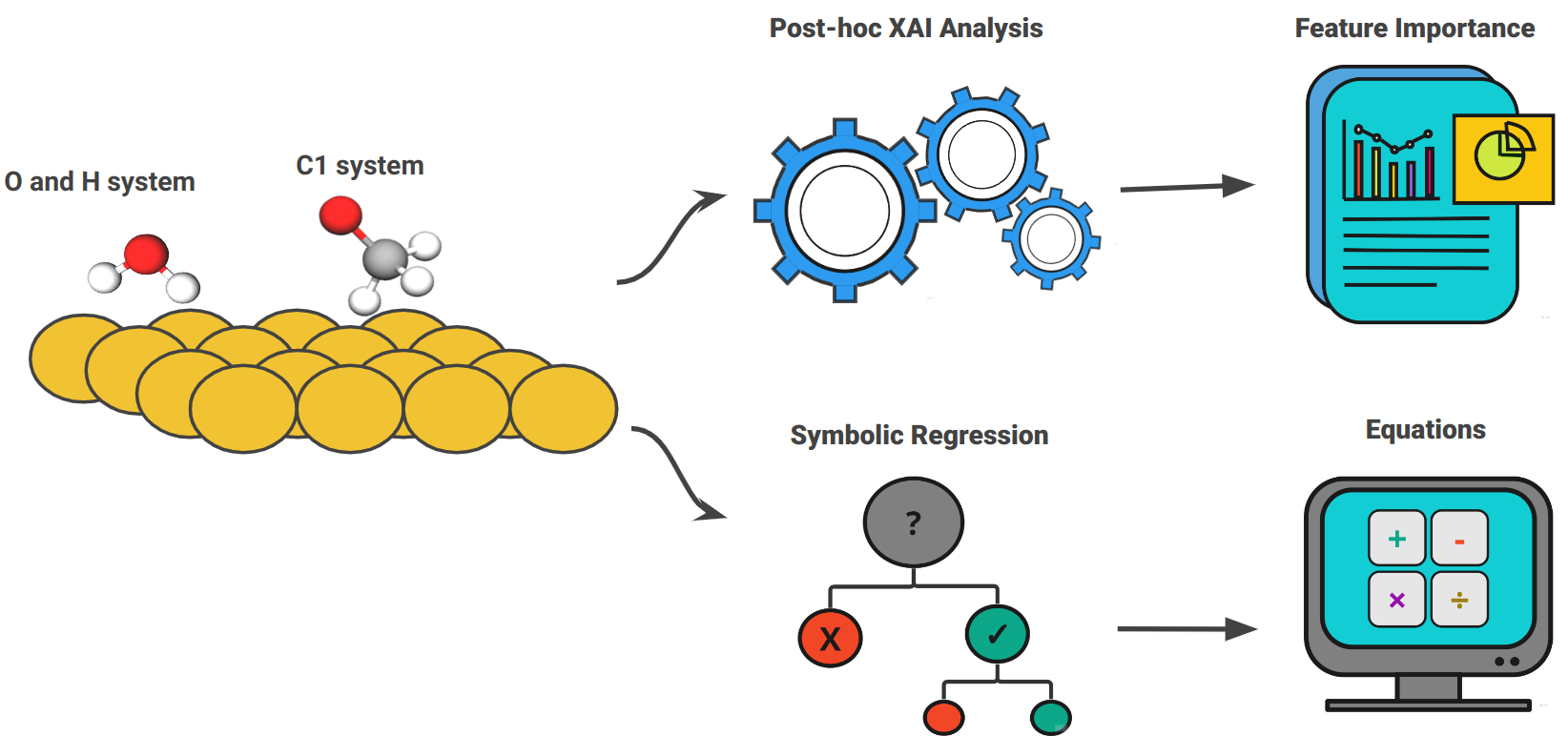
The increasing popularity of machine learning (ML) in catalysis has spurred interest in leveraging these techniques to enhance catalyst design. Our study aims to bridge the gap between physics-based studies and data-driven methodologies by integrating ML techniques with eXplainable AI (XAI). Specifically, we employ two XAI techniques: Post-hoc XAI analysis and Symbolic Regression. These techniques help us unravel the correlation between adsorption energy and the properties of the adsorbate-catalyst system. Leveraging a large dataset such as the Open Catalyst Dataset (OC20), we employ a combination of shallow ML techniques and XAI methodologies. Our investigation involves utilizing multiple shallow machine learning techniques to predict adsorption energy, followed by post-hoc analysis for feature importance, inter-feature correlations, and the influence of various feature values on the prediction of adsorption energy. The post-hoc analysis reveals that adsorbate properties exert a greater influence than catalyst properties in our dataset. The top five features based on higher Shapley values are adsorbate electronegativity, the number of adsorbate atoms, catalyst electronegativity, effective coordination number, and the sum of atomic numbers of the adsorbate molecule. There is a positive correlation between catalyst and adsorbate electronegativity with the prediction of adsorption energy. Additionally, symbolic regression yields results consistent with SHAP analysis. It deduces a mathematical relationship indicating that the square of the catalyst electronegativity is directly proportional to the adsorption energy. These consistent correlations resemble those derived from physics-based equations in previous research. Our work establishes a robust framework that integrates ML techniques with XAI, leveraging large datasets like OC20 to enhance catalyst design through model explainability.
Motivation & Objective
- Bridge the gap between data-driven ML and physics-based understanding in adsorption energy modeling.
- Identify which adsorbate and catalyst features most influence adsorption energy.
- Provide interpretable explanations of ML predictions via SHAP analysis and symbolic regression.
- Demonstrate consistency between post-hoc explanations and symbolic regression results.
- Leverage OC20 to inform catalyst design through explainable models.
Proposed method
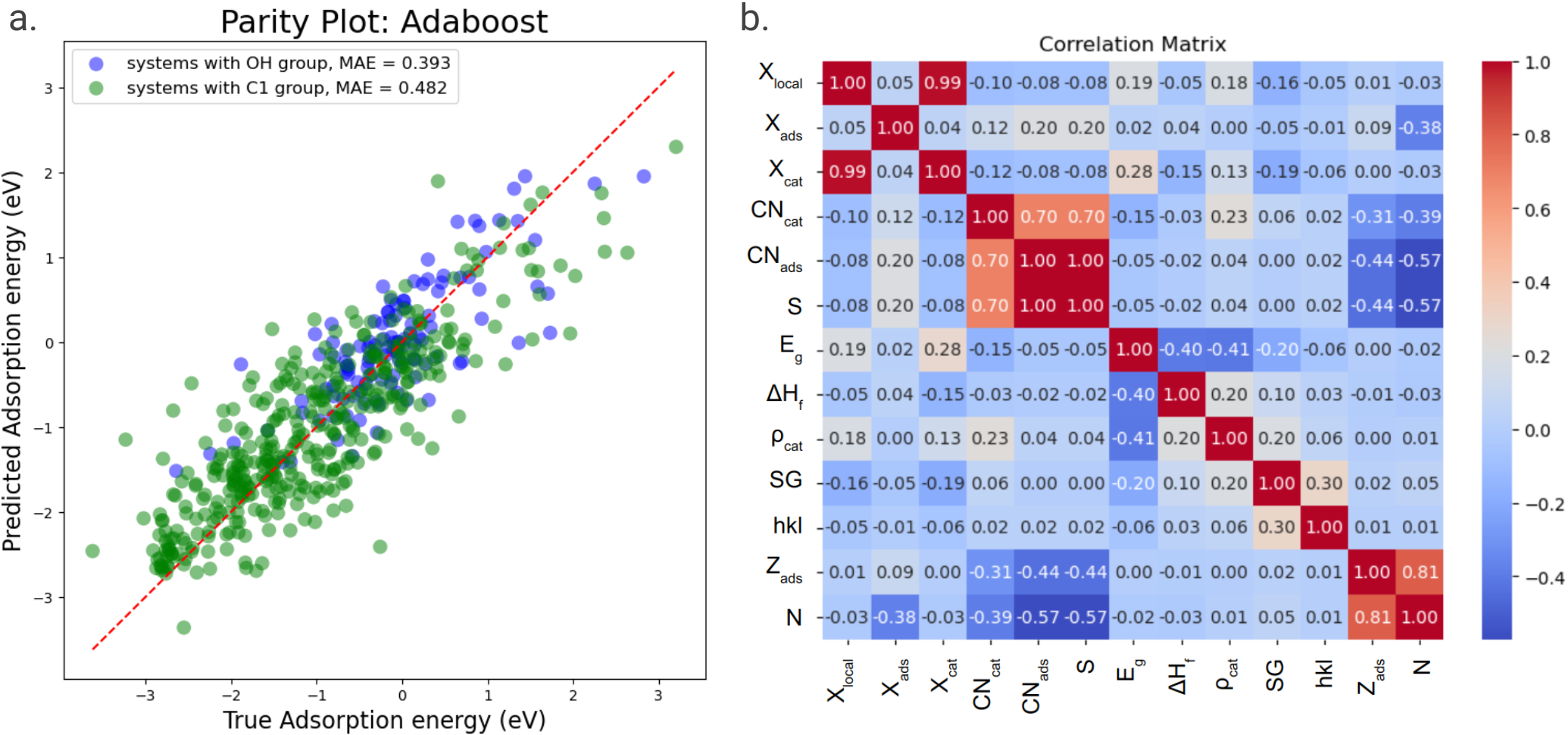
- Train shallow ML models (Adaboost, XGBoost, SVR, KRR, LASSO) on OC20-derived features to predict adsorption energy.
- Apply SHAP post-hoc analysis to determine feature importance and inter-feature correlations.
- Perform symbolic regression using PySR to derive interpretable equations relating inputs to adsorption energy.
- Compare SHAP-derived insights with symbolic regression equations to validate physical plausibility.
- Use a subset (2886 systems) for post-hoc analysis and a hydrogen-adsorbate subset (994 systems) for symbolic regression.
Experimental results
Research questions
- RQ1What feature(s) most strongly influence adsorption energy predictions in the OC20-based dataset?
- RQ2DoSHAP-derived explanations align with physically motivated relationships identified by symbolic regression?
- RQ3Can a simple mathematical expression capture the dependence of adsorption energy on catalyst and adsorbate features?
- RQ4How do adsorbate features compare to catalyst features in driving adsorption energy predictions?
Key findings
- Top five features by SHAP importance: adsorbate electronegativity, number of adsorbate atoms, catalyst electronegativity, effective coordination number, and sum of adsorbate atomic numbers.
- Adsorbate properties exert greater influence on adsorption energy than catalyst properties.
- Positive correlation observed between catalyst electronegativity and adsorption energy in this dataset.
- Symbolic regression yields relationships consistent with SHAP results, notably ΔE_ads ∝ X_cat^2 in several equations.
- PySR-derived MAEs are generally lower than the Trasatti reference equation, indicating reliable, simpler expressions.
- Electronegativity of the catalyst bulk can proxy surface electronegativity for adsorption studies.
Read this paper
Open the full text in the Nubint reader and ask about any passage as you read.
Read this paper on NubintThis review was generated by AI from the original paper. Please check the paper before citing it.